• Contact
  • My Account
  • Log In
  • 0Shopping Cart
thoughtLEADERS, LLC: Leadership Training for the Real World
  • About
  • Services
  • eLearning
  • Team
  • Blog
  • Clients
  • Books
  • Contact
  • Menu Menu

3 Counterintuitive Tips For More Effective Brainstorming

May 3, 2021/0 Comments/in Books, Communications, Guest Blogger, Leadership, Strategy /by Trevor Jones

group meeting whiteboard

Avoid these three behaviors to improve your next brainstorming session.

Today’s post is by Samuel Sanders, author of Your Next Big Idea (CLICK HERE to get your copy).

We’ve all heard of brainstorming, but what exactly is it? In a business sense, brainstorming is the process of coming up with creative ideas and solutions to problems using rapid freethinking. Brainstorming is critical in problem solving, creativity, ideation, and innovation. While in business, many imagine brainstorming as a group activity; it can be done alone or in a group. There are many tips and tricks that can help you have more effective brainstorms. However, there are three unique counterintuitive tips that many ignore. Following these tips can take your brainstorms to the next level.

The first tip is, “During a brainstorm, do not use cell phones, computers, or tablets.”

This is a tough ask for everyone. We take our laptops and phones with us almost everywhere we go. Many of us are addicted to our devices. You may even be wondering, what if I come up with an idea but need to look something up? Don’t. Write down everything that you want to find out more information on in a list during the brainstorm. Then after, look it up. Staring at a device or looking something up will distract your train of thought. It is better to minimize the distractions and get out all of your ideas before bringing devices into the process.

The second tip is, “Always add to ideas, don’t edit or compare ideas.”

Often when we hear a new idea, our first thought is to analyze whether the idea would work. In brainstorming, that is counterproductive. The goal of brainstorming is to get as many possible ideas out there, not edit and start checking the viability of ideas. When someone pitches an idea, it is not our job to rate, evaluate or edit that idea during a brainstorming session. Additionally, it is essential not to compare two ideas to each other. Remember, brainstorming is for getting ideas out there, not trying and figuring out what idea is best. You can feel free to add to ideas, though! Here is an example of the difference between adding and editing: if someone pitches an idea for a new sneaker, you may think, “Wow, that sneaker would go well with these laces.” That is not editing but instead adding more valuable information to the brainstorm. If you instead said, “Well, this sneaker won’t work with this feature.” That is editing. It is important that you or your team clearly understand the difference as editing will hurt a brainstorm’s effectiveness while adding can help grow ideas.

The third tip is, “Don’t have a rigorous schedule.”

In American culture, this one comes as kind of a shock. Typically meetings are set for a distinct amount of time, whether on the hour or half-hour, lasting an exact amount of minutes. A rigorous agenda or schedule can hinder people’s ability to think creatively. Say you need to brainstorm three topics, and you have one hour. Naturally, you’d think it would make sense to brainstorm each subject for 20 minutes. But to be the most productive, you should brainstorm each topic for as long as it is comfortable. It may take 35 minutes for the first topic, 15 minutes for the second, and 10 minutes for the third. If you run out of time, it is important to schedule another meeting or extend the current session to continue. Often ideas can start flowing near the end of a time limit, and putting a time restriction can add unnecessary pressure. During a brainstorm, you want to make sure your team comes up with as many ideas as possible. That way, when you go to evaluate the results, you have as much information as possible.

Today, brainstorming can feel like a lost practice. We are so busy getting work done that it does not seem fruitful or financially profitable to direct employees to brainstorm. However, the best ideas come from the workers in the trenches. Giving employees time to think over their experiences and ideas for innovation in a brainstorm may lead to high-quality cost cutting or profitability-growing results.

your next big idea bookSamuel Sanders is an award-winning entrepreneur who has seen innovation, creativity, problem-solving, and ideation in action at many different levels: a Fortune 500 company, an Inc. 5000 fastest-growing company, as well as incubators. He also co-founded the company Wundershirt, which at its peak, sold athletic training clothing to Olympic athletes preparing for the 2016 Olympics. Currently, he runs Heard, LLC, a software application that helps governments and large companies get targeted and reviewed feedback from their citizens/employees to improve decision making. His award-winning and highly-praised new book, Your Next Big Idea, is available for pre-order at www.yournextbigideabook.com and Amazon. Connect with Sam Sanders at www.samueltsanders.com.

Did you enjoy this post? If so, I highly encourage you to take about 30 seconds to become a regular subscriber to this blog. It’s free, fun, practical, and only a few emails a week (I promise!). SIGN UP HERE to get the thoughtLEADERS blog conveniently delivered right to your inbox! 

https://i0.wp.com/www.thoughtleadersllc.com/wp-content/uploads/2021/04/20210427-Group-Meeting-Whiteboard.jpg?fit=1920%2C1440&ssl=1 1440 1920 Trevor Jones https://www.thoughtleadersllc.com/wp-content/uploads/2022/04/logo.png Trevor Jones2021-05-03 08:00:282021-05-09 09:22:513 Counterintuitive Tips For More Effective Brainstorming

Learn to Build Goals from the Bottom Up

April 28, 2021/0 Comments/in Business Toolkit, Leadership, Sales, Strategy /by Trevor Jones

bottom of mountain

Learning how to build goals from the bottom up connects individuals to the broader mission.

In addition to building your goals from the top-down, a useful exercise is to build goals from the bottom-up. It helps get team buy-in and it can identify new opportunities for upside. For bottom-up goals, start with what the team thinks they can commit to. What they can deliver. Ask them what they can stretch to. Then work from those individual drivers, those individual goals, up to the bigger metrics that matter for the organization.

If you have an organization that’s trying to drive sales and you have a team full of sales reps, you may look at the individual bottom-up goals of number of calls that they’re going to make in an hour. Those then roll up to the number of calls that they’re able to connect on in an hour, which rolls up to a broader goal of the number of pitches that they’re making to customers, and a goal above that of how many pitches are being accepted by the customer. That can tie to a bigger goal of the number of contracts sent and pricing being achieved, a bigger goal of number of contracts being closed, and ultimately, end up in the big organizational goal of how much revenue is being generated.

Working from the bottom-up ties the individual to the broader mission. In terms of identifying new opportunities, I found this out firsthand. I had a team where I went to all my team members and I asked them for their profit goal for the year. One team came back to me with five times what I would have expected. I would have given them a goal of say, $5 million. And they came back and said, we’re going to get you 25. I was shocked and I asked them, where did you get this? They showed me they had found a huge new opportunity I wasn’t aware of. When I went to commit to my boss, I only committed 3x of that 5x they had found. I learned on the back end they had sandbagged me, and the number was 10x what I would have asked for them in the first place. They left upside for themselves and had hedged their goal to me. They were excited to exceed that hedge but they made sure they didn’t over promise to the organization.

Building from the bottom-up in that situation was great because it brought forth a new opportunity and we were able to roll it into the broader organizational goal. When you go through your goal setting exercise, go to your team and work from the bottom-up, from those low level metrics that tie to the higher level organizational goals. Look for buy-in from your team in terms of the goals that they’re going to set, and try and identify new opportunities for upside. That bottom-up goal setting process is going to give you tighter goals that are more closely tied to the broader organizational ones and hopefully help you find new opportunities to pursue.


Want to learn more about setting goals? How about taking an entire course on it? Go directly to the course and start learning how to set better goals. The entire course is available at LinkedIn Learning. Enjoy!

Did you enjoy this post? If so, I highly encourage you to take about 30 seconds to become a regular subscriber to this blog. It’s free, fun, practical, and only a few emails a week (I promise!). SIGN UP HERE to get the thoughtLEADERS blog conveniently delivered right to your inbox!

https://i0.wp.com/www.thoughtleadersllc.com/wp-content/uploads/2021/04/20210428-Bottom-of-Mountain.jpg?fit=1920%2C1280&ssl=1 1280 1920 Trevor Jones https://www.thoughtleadersllc.com/wp-content/uploads/2022/04/logo.png Trevor Jones2021-04-28 06:30:482021-04-28 00:43:50Learn to Build Goals from the Bottom Up

Mentorship: My Secret Weapon for Overcoming Obstacles & Becoming a Strong Leader

April 26, 2021/0 Comments/in Books, Career, Entrepreneur, Guest Blogger, Leadership, Strategy /by Trevor Jones


two men working on laptop

Finding a mentor who has experience in your field can be a transformative step in your career.

Today’s post is by Harma Hartouni, author of Getting Back Up: A Story of Resilience, Self-Acceptance and Success (CLICK HERE to get your copy).

I was born in the U.S. but raised in Iran from the time I was an infant. As a gay man in an extremely homophobic country like Iran, there was no way for me to thrive while being honest about who I was. When I was 18 years old, a horrific car accident broke both of my legs and left me unable to walk for a year as I recovered. Afterward, I packed up everything and moved to the U.S., determined to create a better life and find success as my authentic self. As a Middle Eastern man who didn’t speak English, I was certainly at a disadvantage when I came to this country. But I found success through diligence, investment in myself, and a strong belief in the value of mentorship. Read more

https://i0.wp.com/www.thoughtleadersllc.com/wp-content/uploads/2021/04/Two-men-working-on-laptop.jpg?fit=1920%2C1262&ssl=1 1262 1920 Trevor Jones https://www.thoughtleadersllc.com/wp-content/uploads/2022/04/logo.png Trevor Jones2021-04-26 08:00:162021-04-26 01:37:08Mentorship: My Secret Weapon for Overcoming Obstacles & Becoming a Strong Leader

Learn to Build Goals from the Top Down

April 21, 2021/0 Comments/in Business Toolkit, Leadership, Strategy /by Trevor Jones


top of mountain

Learning how to build goals from the top down ensures that everyone’s work is headed in the same direction.

Goals shouldn’t just tie from your strategy down to the individual goals. When you add your goals up, they also need to align from corporate goals down to the individual. Ensure everyone’s work is headed in the same direction and people know how they fit in—how their work contributes to the broader goals we’re trying to achieve. The way you do this is you work from the vision down to subcomponents, then down to subcomponents below that, all the way down to individual goals. Goals should cascade from the highest levels down. And when you add them all up, hopefully, it’s more than you’re trying to get to at the top level. Why? Well, you want to make sure that you hit that goal. By over-allocating that goal across the organization, you’re going to increase the chances that you hit the big goal.

I worked for an operating division at one point, and we had a goal of $200 million of revenue. There were five regions in the organization. Each region was given a goal of $42 million. Now, that’s $210 million. Within those regions, each branch was given a goal. And when you totaled up all the branches, it came to $215 million worth of goals. We then looked at the individual sales reps, and every sales rep was given a goal. When we totaled up all the sales rep goals, it was $220 million. Adding up those individual goals exceeded the division goal by 10%, by $20 million. The reason we did this was to ensure that we hit that top level, $200 million goal.

Over the course of the year, obviously, some sales reps exceeded their goals, some met their goals, and some fell short. Working from the top-down ensured the primary goal was focused on. Everyone was focused on driving sales. And by over-allocating that goal from top down to individual helped us achieve that goal. Now, when you do this, if you’re going to go with an over-allocating approach to setting these goals from the big goal down to individuals, be careful about over-planning that hand because you may make it such that that goal is not achievable.

One time I’ve seen this dynamic is when I was in the Army and we had to be at formation at a certain time. Our company commander would say, “I want everybody at formation at 6:00 a.m.” The lieutenants would then go to the organization and say, “I want everybody at formation at 5:30 a.m.” The platoon sergeants then went to the teams and said, “I want everybody in formation at 5:00 a.m.” The squad leaders then said, “I want everybody in formation at 4:30 a.m.” The next thing you know, you’ve got this Corp private standing out there in a parking lot at 4:00 a.m., waiting for a formation that happens two hours from now. Bad things can happen when you over-allocate a goal down to the individual level.

So balance it out. Look at the high-level goal, break it down into subcomponents, and look at the individual goals that are going to add up to that broader goal. Make sure the goals you set at the individual level are still achievable and they’re directly tied to the broader goal you’re trying to achieve. By doing so, people know how they contribute, how they fit in, and you’re going to make sure that you hit those top-level goals if everybody hits their individual goals.


Want to learn more about setting goals? How about taking an entire course on it? Go directly to the course and start learning how to set better goals. The entire course is available at LinkedIn Learning. Enjoy!

Did you enjoy this post? If so, I highly encourage you to take about 30 seconds to become a regular subscriber to this blog. It’s free, fun, practical, and only a few emails a week (I promise!). SIGN UP HERE to get the thoughtLEADERS blog conveniently delivered right to your inbox!

https://i0.wp.com/www.thoughtleadersllc.com/wp-content/uploads/2021/04/20210421-Top-of-Mountain.jpg?fit=1280%2C853&ssl=1 853 1280 Trevor Jones https://www.thoughtleadersllc.com/wp-content/uploads/2022/04/logo.png Trevor Jones2021-04-21 06:30:212021-04-21 00:14:31Learn to Build Goals from the Top Down

What Makes a Presentation Unsuccessful?

March 31, 2021/0 Comments/in Business Toolkit, Communications, Innovation, Leadership, Strategy /by Mike Figliuolo

presentation

Do you struggle to get your ideas approved? Follow the structured thought process to create better presentations.

When you have a recommendation you’re trying to get approved within your organization, there are going to be a lot of stakeholders you have to get your idea in front of. You’ll have to put it in front of your manager, maybe their boss, a director, and some vice presidents. Some of your ideas may even go all the way up to the C-suite. There’s something I like to call Figliuolo’s Law, which states:

“An individual’s annual compensation is inversely proportional to the number of slides they can look at before they have a stroke.”

I’ve worked with a CEO who said, “If it has a staple, I won’t read it.” I worked closely with another CEO and we went in to present. The other team went to present first. He picked up their presentation, he felt it for heft, and it was about 25 pages long. He threw it across the room and said, Read more

https://i0.wp.com/www.thoughtleadersllc.com/wp-content/uploads/2021/03/20210331-Presentation.jpg?fit=1920%2C1280&ssl=1 1280 1920 Mike Figliuolo https://www.thoughtleadersllc.com/wp-content/uploads/2022/04/logo.png Mike Figliuolo2021-03-31 06:30:522021-03-31 04:27:47What Makes a Presentation Unsuccessful?

How to Prioritize Your Team’s Work and Improve Focus

March 24, 2021/0 Comments/in Business Toolkit, Innovation, Leadership, Project Management, Strategy /by Mike Figliuolo


meeting sticky notes

It’s easy for your team to get sidetracked if your strategy has a lot of moving parts. Learn how to prioritize your most meaningful work.

A consistent and regularly-scheduled prioritization process helps eliminate distractions and focus your efforts on the most meaningful projects. Some processes are formal while others are simply frequent conversations about priorities. Choose a process that’s appropriate for the size of your organization.

I’ve worked for two very different organizations. One was large and one was a small business unit. In the large one we had a very formal prioritization process. All departments were involved, and you had to have a very rigorous business case to get your idea on the list. In the small business unit it was an informal process. We achieved prioritization by allocating budget to different budget owners.

We then gave them discretion to choose their own priorities. In the large organization it was very rigorous, but sometimes we lacked agility. It kept us focused, but at the cost of innovating every once in a while. In the small organization it enabled a lot of distractions to happen. People pursued some pet projects. Pet projects and distractions should not be worked on if they haven’t been prioritized. They had a huge impact.

In the small business unit I was in we got a lot of small things done, but a lot of times they were disjointed, they lacked impact, and some of them weren’t even on strategy. Build a prioritization process that is appropriate for the size and complexity of your organization, and make sure that process is in charge of allocating resources accordingly.

Embedding prioritization

Prioritization processes work great for larger projects that require resource allocation. They don’t necessarily change behaviors related to more day-to-day activities. Embedding a prioritization mindset in your team will help everyone focus on the most meaningful work. When you talk about projects, refer back to the prioritization criteria so people know how you make decisions and that you expect them to do the same.

I had a great boss at one point who would meet with me every week to ask me what I was working on. If he saw I was working on something that was off-strategy, he’d ask for justification. He’d say, “Mike, how does this tie to the strategy?” He forced me to think through how the work I was doing tied to the overall strategy. If the work didn’t, he asked what I thought we should do about the project. Usually, I decided to kill it. I then modeled that behavior for my team. Prioritization became a way of life for us.

Ask people on your team what they’re working on. Have them explain how that work ties to the overall strategy. Ask them to make choices based on the strategy versus just telling them, “No, stop that project.” When they come up with the rationale on their own, they’re much more likely to stop doing non-strategic work and focus on the things that matter the most.

Stopping off-track work

When you come across work that isn’t high priority or is a distraction, it’s important to stop it quickly. Before stopping that work though, understand why people are working on it and why they thought it should be a focus. There may be a good reason they’re pursuing that project. It could be related to safety, regulations, or company policy. If there’s not a strong reason for the work and it’s clear that it’s a distraction, stop it immediately. Explain your rationale and refocus efforts on high-priority items that require additional resources.

I worked with one CEO who was very excited about making an acquisition. He had a lot of activity going on. He had people looking at the market and evaluating the target company. He was spinning up a lot of work. We went through a strategic planning session, and he realized this work was off strategy. It was a distraction. He immediately stopped all work on it. That sent a strong message to the organization that it’s okay to stop work in progress once you realize it’s off strategy.

When you stop off-track work, be sure to replace it with something more meaningful. You don’t want that individual feeling discouraged or unimportant because you stopped their project. Let them know, “Hey it’s about the project, it’s not about you. And by the way, now that you’re free, I want you to go work on this really high-priority strategic project.” Stopping off-track work is a key to achieving focus for your organization.


Want to learn more about strategic focus? How about taking an entire course on it? Go directly to the course and start learning how to improve your strategic focus. The entire course is available at LinkedIn Learning. Enjoy!

Did you enjoy this post? If so, I highly encourage you to take about 30 seconds to become a regular subscriber to this blog. It’s free, fun, practical, and only a few emails a week (I promise!). SIGN UP HERE to get the thoughtLEADERS blog conveniently delivered right to your inbox!

https://i0.wp.com/www.thoughtleadersllc.com/wp-content/uploads/2021/03/20210324-Meeting-Sticky-Notes.jpg?fit=1920%2C1280&ssl=1 1280 1920 Mike Figliuolo https://www.thoughtleadersllc.com/wp-content/uploads/2022/04/logo.png Mike Figliuolo2021-03-24 06:30:552021-03-24 01:01:14How to Prioritize Your Team’s Work and Improve Focus

How to Link Your Goals to Your Strategy

March 17, 2021/0 Comments/in Business Toolkit, Innovation, Leadership, Strategy /by Mike Figliuolo

chain links

Make sure your team has a clear understanding of how their goals relate to your organization’s broader vision and mission.

For a goal to be relevant, it has to tie to the broader purpose and goals of the entire organization. Your strategy is going to help drive that. The strategy consists of a desired future state and definition of how you’re going to get there. You should break that strategy down into smaller, interim goals on that path. Every goal that gets set in the organization should be linked to that broader element of your strategy.

How to Tie Your Goals to the Broader Mission

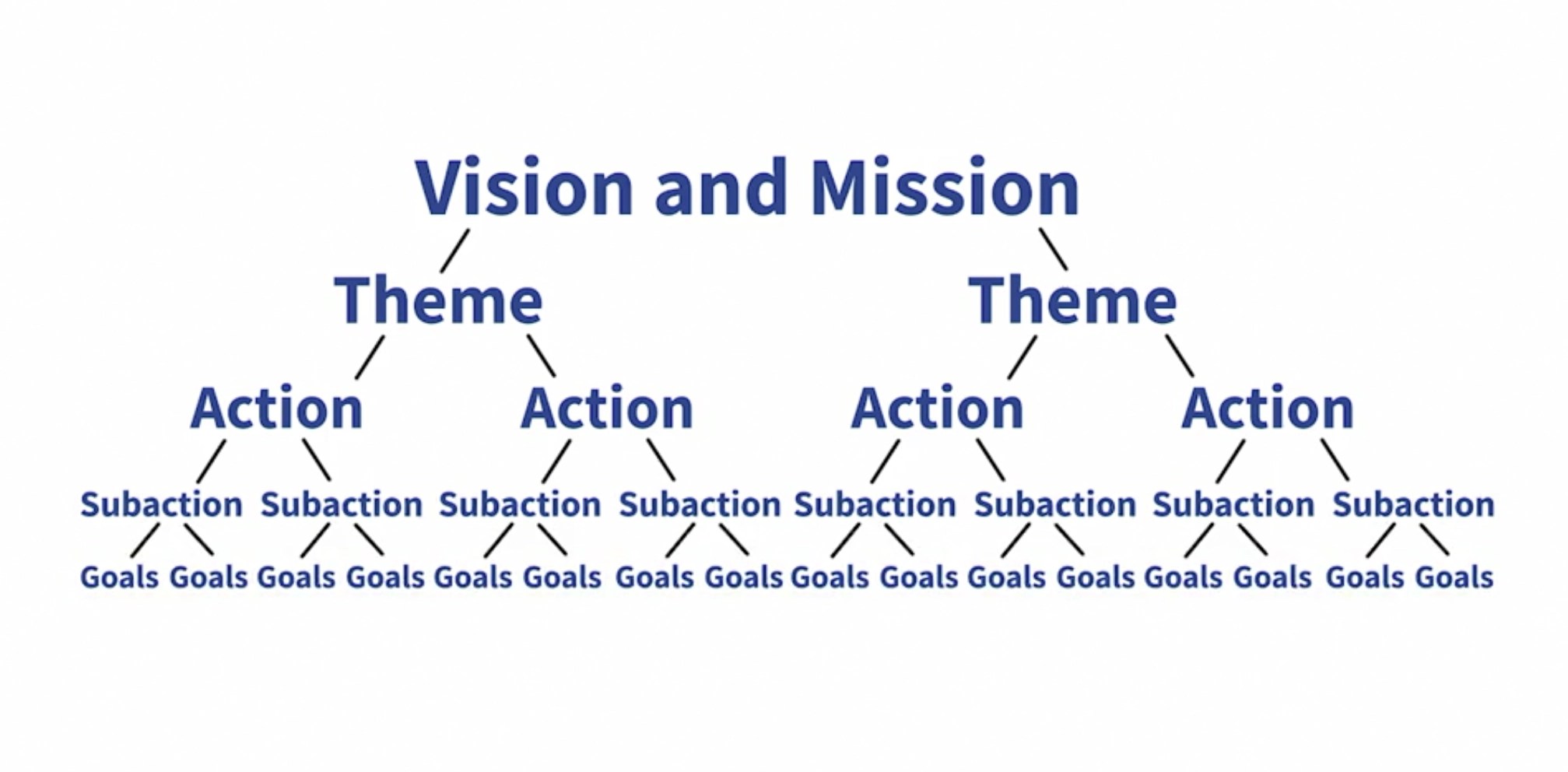
How do you do that? Take a look at your vision and your mission. Look at where you’re going as an organization. Break that down into major themes over the course of the strategic planning period. For each theme, break that down into actions you’ll have to take to achieve that theme. For each action, break that down into sub-actions until you can set an individual goal for each of those actions.goals and strategy

Case Study: Lawn and Garden Company

I worked for a lawn and garden company at one point and I was in the strategic planning group. We said we’re no longer going to just be a lawn and garden company. We’re going to move into outdoor living. It was a much broader expansion strategy.

For each part of the organization, we set goals that were tied to that outdoor living strategy. Our consumer package goods business had goals for new product line expansion and getting into new categories. Our services business had goals for offering new services. Even in the strategy group, we had goals for achieving that outdoor living strategy.

We had goals for how many acquisitions we would do and what categories we were going to enter. For each acquisition, we had goals related to targets we were going to make offers to. We had a time for when we were going to make the offer. We had deadlines for making a deal. We had deadlines and goals around integration, execution of the plan, and expansion of those businesses once they were acquired.

Every single one of those goals tied to a broader strategic theme, and those themes tied to the broader strategy of getting into outdoor living. We all knew how we were contributing to the broader strategy. Therefore, our goals made sense and they were meaningful and relevant to the mission of the organization.

When you set your goals, make sure that you can go from strategy to themes to actions to goals, and then explain to the members of your team how those goals roll up to the broader strategy. It will give their work meaning and help them understand how they fit in.

Want to learn more about goal setting? How about taking an entire course on it? Check out the video below to learn more about the course and get started. Or you can go directly to the course and start learning how to set better goals. The entire course is available at LinkedIn Learning. Enjoy!

Link goals to strategy from Setting Team and Employee Goals Using SMART Methodology by Mike Figliuolo

Did you enjoy this post? If so, I highly encourage you to take about 30 seconds to become a regular subscriber to this blog. It’s free, fun, practical, and only a few emails a week (I promise!). SIGN UP HERE to get the thoughtLEADERS blog conveniently delivered right to your inbox!

https://i0.wp.com/www.thoughtleadersllc.com/wp-content/uploads/2021/03/20210316-Chain-Links.jpg?fit=1920%2C1285&ssl=1 1285 1920 Mike Figliuolo https://www.thoughtleadersllc.com/wp-content/uploads/2022/04/logo.png Mike Figliuolo2021-03-17 06:30:042021-03-16 20:40:59How to Link Your Goals to Your Strategy

The 7 Aspects of High-Performing Teams

March 10, 2021/0 Comments/in Business Toolkit, Innovation, Leadership, Strategy /by Mike Figliuolo

team with laptops

Assembling a high-performing team involves more than just finding great talent. Follow this 7-step formula to develop the team of your dreams.

As a leader, one of your most critical responsibilities is to turn your team into what can be considered a high-performing team. And to do that, there are seven elements that you need to bring together to turn your team from one that just exists to one that’s considered high-performing:

Read more

https://i0.wp.com/www.thoughtleadersllc.com/wp-content/uploads/2021/03/20210310-Team-with-Laptops.jpg?fit=1920%2C1260&ssl=1 1260 1920 Mike Figliuolo https://www.thoughtleadersllc.com/wp-content/uploads/2022/04/logo.png Mike Figliuolo2021-03-10 06:30:332021-03-10 02:35:24The 7 Aspects of High-Performing Teams

Entrepreneurs: The Best Firefighter and Chief Arsonist

March 8, 2021/0 Comments/in Books, Business Toolkit, Entrepreneur, Guest Blogger, Leadership, Strategy /by Mike Figliuolo

firefighters

Solving day-to-day business problems can sap your time and energy. Learn how to be more efficient by identifying the roots of your problems.

Today’s post is by Todd Palmer, CEO of Diversified Industrial Staffing and author of From Suck to Success: A Guide to Extraordinary Entrepreneurship (CLICK HERE to get your copy).

One common struggle entrepreneurs face is that they spend too much of their day putting out fires. That leaves them less time to do the most important work in their business. It also stretches them thin from a personal perspective, so they end up overworked, stressed out, and unfulfilled.

Are you spending all day putting out fires?

Do you struggle to get ahead with your workload because there’s so much on your to-do list?

Have you spent years telling yourself that you need to better train team members but haven’t had a break long enough to do so because you are putting out so many fires?

If you answer yes to any of these questions, congratulations. You’re your company’s best firefighter. This role is important because it can keep a company going for a long time. Fires come up in every business. These businesses need firefighters on the inside to prevent those fires from spreading.

So many business owners I coach complain to me that they spend all their days “putting out fires.” I get it. That’s how I felt for my entire first decade at Diversified Industrial Staffing, too. I spent every day putting out fire after fire, keeping the business open for nearly a decade before the flames got too big for me to control any longer. Every day, it was fire after fire. I’d swoop in and save the day and then move onto the next fire. That was my Groundhog Day. I’d head to the office, put out fires all day, and head home. The next day, I’d head to the office, put out more fires, and head home. I’d do that day after day until everything collapsed.

The first step to getting out of that stressful routine is to shift your mindset. Sure, you will likely remain your company’s best firefighter. That’s not an issue. Fires will pop up in entrepreneurship. But if you’re going to be your company’s best firefighter, you can’t just put out fires and then move on. Firefighters do much more than that. You need to complete the work of a firefighter.

Firefighters don’t just put out the flames of a burning structure and then head back to the station. They also take time to research the cause of the fire and, if there are signs of arson, work with law enforcement to prosecute the arsonists.

If we know we are our companies’ best firefighters, we must shift our mindset and complete the work to identify the cause of the fire. When Greg worked with me to continue the job at Diversified Industrial Staffing, I learned that my fires were all caused by arson. We had someone inside the company who kept starting fires. Thus, the solution was to either get rid of the arsonist or prevent them from being able to start fires in the future.

Unfortunately, I learned that the arsonist at Diversified Industrial Staffing was me. If not for me, I wouldn’t have had so many fires to put out. When I realized that, everything changed. Instead of seeing myself as the hero who swept in and put out fires to keep the company going, I visualized myself starting a bunch of fires and then running around putting them out until the fires grew too big for me to handle. I loved the jolt of adrenaline solving the problems. I felt like I had accomplished something that day. It was a fool’s dream.

It’s not just me, either. When I work with leaders who are overwhelmed by putting out fires all day, I ask them to shift their mindset from putting out fires to completing the job. Virtually every time, my clients realize they were their company’s chief arsonists too. Some of them identified other arsonists as well, but every single one of them realized they could quickly improve their company if they just stopped starting fires themselves.

You don’t have to find yourself crumpled on the pavement (or worse) to recognize that something has to change in your business, either. Sure, a setback could be as large as bankruptcy, or it could be as small as a mishandled meeting. What they have in common is a gut-wrenching, hair-raising feeling of regret, fear, and self-doubt that stops us in our tracks and stunts our growth. But many times, we feel overwhelmed by putting out fires all day because we don’t do the work it takes to prevent fires in the first place.

As leaders, we can be the best firefighters—while also being the chief arsonists. Think about it: the scary but joyous feeling we, as entrepreneurs, get from putting out a fire can be very visceral, like a spike of dopamine. Often, we lack self-awareness around the “rush” it gives us. So we will be subversive and act as an arsonist, which is self-sabotaging long term, in exchange for the rush of putting out the fire and being seen as the savior, the only one who can put out the fire. But we can make the complex simple by merely doing something different.

As straightforward as it might sound to identify the source of fires before moving on, you won’t be able to do it if you don’t shift your mindset. It takes awareness, discipline, and continuous practice to do so. Otherwise, the stress and relief of fighting and extinguishing fires will send us right back into our own versions of Groundhog Day.  

from suck to successTodd Palmer is a highly sought-after speaker, executive coach, and longtime CEO of Diversified Industrial Staffing. With the mindset shifts and business techniques shared in his new book From Suck to Success: A Guide to Extraordinary Entrepreneurship, he transformed his company into one of the fastest growing companies in America, landing it onto the INC 5000 list an impressive six times.

Did you enjoy this post? If so, I highly encourage you to take about 30 seconds to become a regular subscriber to this blog. It’s free, fun, practical, and only a few emails a week (I promise!). SIGN UP HERE to get the thoughtLEADERS blog conveniently delivered right to your inbox!

https://i0.wp.com/www.thoughtleadersllc.com/wp-content/uploads/2021/02/20210206-Firefighters.jpg?fit=1920%2C1280&ssl=1 1280 1920 Mike Figliuolo https://www.thoughtleadersllc.com/wp-content/uploads/2022/04/logo.png Mike Figliuolo2021-03-08 08:00:012021-02-06 18:36:50Entrepreneurs: The Best Firefighter and Chief Arsonist

Challenge How Your Business Operates

March 3, 2021/0 Comments/in Business Toolkit, Entrepreneur, Innovation, Leadership, Strategy /by Mike Figliuolo

whiteboard sticky notes

Transform your business by completely rethinking how it works. Analyzing your business model, revenue, and costs can lead you to innovative solutions.

When you go to generate new ideas to run things better, you need to think critically about the way your business runs. I like to look at three things: a business model blowup, a revenue blowup, and a cost blowup.

On the business model blowup, fundamentally rethink how you go to market. And rethink what your market actually is. You’re going to challenge the entire business model for the way you deliver products and services. On the revenue blowup side, how do you dramatically expand the products, your pricing, the geography, and the reach of your business? And on the cost blowup, how do you fundamentally eliminate drag from the business to become more efficient?

Business Model Blowup: Skybus Airlines

Read more

https://i0.wp.com/www.thoughtleadersllc.com/wp-content/uploads/2021/03/20210303-Whiteboard-Sticky-Notes.jpg?fit=1920%2C1304&ssl=1 1304 1920 Mike Figliuolo https://www.thoughtleadersllc.com/wp-content/uploads/2022/04/logo.png Mike Figliuolo2021-03-03 06:30:292021-03-03 01:08:52Challenge How Your Business Operates

How to Ask Good Discovery Questions While Maintaining Your Authenticity

March 1, 2021/0 Comments/in Business Toolkit, Communications, Guest Blogger, Sales, Strategy /by Mike Figliuolo


meeting hands gesturing

Preserving authenticity is fundamental for generating a sale. Ask these simple discovery questions in your next client meeting. 

Today’s post is by Jeff Kirchick, Vice President of Enterprise Sales at Next Caller, and author of Authentic Selling: How to Use the Principles of Sales in Everyday Life (CLICK HERE to get your copy).

In traditional sales programs, you are typically taught to ask certain questions. The problem with being taught to ask certain questions is that you are fundamentally changing your behavior when you ask them. Generally speaking, you are probably changing your behavior out of self-interest – to generate a sale – rather than asking in the interest of the customer. And the thing about sales is that you should always be focusing on the needs of the customer. Why? Because sales is not about you. Sales is about them. So what questions would you normally ask someone when you are trying to figure out what is best for them?

In my new book, Authentic Selling: How to Use the Principles of Sales in Everyday Life, I discuss the importance of authenticity relative to the usual tips and tricks you might learn in a formal sales training program. The rationale for this is two-fold: first, people just register authenticity easily. and authenticity is the key to building trust, which is fundamental for generating any sale; second – and perhaps more importantly – Read more

https://i0.wp.com/www.thoughtleadersllc.com/wp-content/uploads/2021/02/20210203-Meeting-Hands-Gesturing-scaled.jpg?fit=2560%2C1707&ssl=1 1707 2560 Mike Figliuolo https://www.thoughtleadersllc.com/wp-content/uploads/2022/04/logo.png Mike Figliuolo2021-03-01 08:00:072021-02-03 21:16:17How to Ask Good Discovery Questions While Maintaining Your Authenticity

SMART Goals: How to Make Your Goals Achievable, Relevant, and Time-Bound

February 24, 2021/0 Comments/in Business Toolkit, Entrepreneur, Leadership, Strategy /by Mike Figliuolo

hourglass

Part 2 of 2: Use the SMART acronym to set better goals. Learn how to make your future goals achievable, relevant, and time-bound.

When you go to set goals, I suggest you try to set smart goals. Smart is an acronym. It stands for specific, measurable, achievable, relevant, and time-bound. These are the key characteristics of a good goal. Now there are multiple versions of smart out there, but they all get to the same thing: creating clear and actionable goals that matter.

This week, we’re talking about the last three SMART characteristics: achievable, relevant, and time-bound. If you missed the first two characteristics—specific and measurable—check out last week’s post here.

Achievable

Another characteristic of a good goal is that the goal is achievable. If a goal is too extreme, people won’t even try. You may have heard of the term “big, hairy, audacious goals.” That sounds great—let’s set a huge goal for the team and they’ll try really hard to achieve it. The thing is, those types of goals can be very demotivating. The team looks at it and they say, “We don’t even have a chance. We’re guaranteed to fail. So you know what, forget it. I’m not even going to try.”

And if a goal is too easy, people won’t care about it or see it as meaningful. “Oh, 1% improvement? No problem, I can do that in my sleep.” And then what happens? Read more

https://i0.wp.com/www.thoughtleadersllc.com/wp-content/uploads/2021/02/20210221-Hourglass.jpg?fit=1920%2C1280&ssl=1 1280 1920 Mike Figliuolo https://www.thoughtleadersllc.com/wp-content/uploads/2022/04/logo.png Mike Figliuolo2021-02-24 06:30:432021-02-24 19:42:41SMART Goals: How to Make Your Goals Achievable, Relevant, and Time-Bound
Page 28 of 46«‹2627282930›»

Get free blog posts by email NOW!

It’s the best 5 minutes a week you can spend on your development.

Subscribe HERE!

Get new posts FREE via RSS!
Follow thoughtLEADERS on LinkedInFollow thoughtLEADERS on twitter
This site contains affiliate links to products. We may receive a commission for purchases made through these links.
 

Check Out Our Courses

Our courses teach immediately applicable skills that have real impact on your business. From leadership to strategy and negotiation to conflict resolution, we have a broad set of course offerings that will drive immediate performance improvements.
OUR COURSES

Our Courses

Group of Business People Meeting
Puzzle Pieces
Glasses Looking Over Cityscape
Doors on a Wall
Cog Wheels
Man Reading Book
Fishing hook in the sea
Microphone in Lecture Hall
Charts on Blue Background
Wristwatch
Exploding Light Bulb
Man on Summit of Mountain
Lightning Bolts
Man Painting the Word Change on a Wall
Construction Cranes
Plant Growing in a Hand
High Performance Gears
Men Shaking Hands Closeup
Influence Definition
Sailboat at Sunset
Hanging light bulbs with glowing one isolated on dark blue background
Wagon Wheel
Risk
Strategic Client Engagement
Strategic Business Planning
Advanced Meeting Leadership
Building a Growth Mindset
Executive Communications
Structured Problem Solving
Creating Leadership Maxims
Leading inside the Box
Deliberate Decision Making
Simple Strategic Planning
Storytelling for Leaders
Storytelling for Sales
Executive Presence
Principles of Chart Design
Time Management Mastery
Breakthrough Innovation
Leadership Resilience
Conflict Resolution
Leading through Change
Project Management Reality
Coaching for Impact
High Performing Teams
Everything is Negotiable
Leading with Influence
Building Personal Resilience
thoughtLEADERSHIP
Engagement Management
Risk Management
Client Engagement
Strategic Business Planning
Advanced Meeting Leadership
Building a Growth Mindset
previous arrow
next arrow
 

eLearning Courses on TITAN

Structured Thought: Problem Solving
Puzzle Pieces
Structured Thought: Problem Solving

Clearly define a problem, scope all issues related to the problem, generate potential solutions, then analyze and select the best solution by using time-tested critical thinking methods and tools.

VIEW COURSE
Structured Thought and Communication
Group of Business People Meeting
Structured Thought and Communication

Craft clear and compelling recommendations that resonate with stakeholders. Get your ideas approved by using a proven method for delivering executive-level communications.

VIEW COURSE
Principles of Chart Design
Different Types of Line and Bar Charts
Principles of Chart Design

Create well-designed presentation charts that get your message across quickly and clearly to drive your audience to action. From data charts to concept charts, these methods help make your point.

VIEW COURSE
Engagement Management
Wagon Wheel
Engagement Management

Whether you’re an internal or external consultant or a project leader, learn proven methods, techniques, and processes to effectively lead consulting engagements that drive your client’s success.

VIEW COURSE
Strategic Business Planning
Cog Wheels
Strategic Business Planning

Use a straightforward and effective strategic planning process that shows how to craft a clear, compelling plan for your organization - not just one time, but on an ongoing basis year after year.

VIEW COURSE
Deliberate Decision Making

Make better, faster, and more effective decisions. Apply simple yet powerful decision making tools to define decision authority, manage risk, increase accountability, and drive execution.

VIEW COURSE
Everything is Negotiable
Men Shaking Hands
Everything is Negotiable

Become a better negotiator in all situations – from day to day interactions to hammering out large deals. Build the skills required to get what you want and strengthen relationships while you do.

VIEW COURSE
Breakthrough Innovation
Exploding Lightbulb
Breakthrough Innovation

Generate and select unique strategies that separate you from the competition. Construct bold and disruptive solutions then build and execute a plan for taking those strategies to market.

VIEW COURSE
Storytelling for Leaders
Man reading stories from a book
Storytelling for Leaders

Create business stories that inspire people, build connections with your audience, and ultimately advance your organization's goals by using a repeatable, straightforward method.

VIEW COURSE
Storytelling for Salespeople

Create and deliver stories that will take your sales efforts to the next level. Connect with and convince buyers in all situations using memorable stories. These stronger relationships drive more sales.

VIEW COURSE
Leading through Change

Lead your organization through the most challenging times using a proven change management process. Get people through the change and back to driving performance quickly and effectively.

VIEW COURSE
Building Leadership Resilience
Mountain Climbing Expedition
Building Leadership Resilience

Prepare your body and brain to be ready for and recover from your biggest challenges. Build approaches for overcoming stress, managing reactions to difficult events, and leading more effectively.

VIEW COURSE
Compelling Executive Presence

Build your ability to connect with your audience and convey your ideas in a clear and resonant way. Create meaningful connections between you and your audience to build buy-in.

VIEW COURSE
Coaching for Impact
Plant Growing in a Hand
Coaching for Impact: Foundation Course

Coach employees for performance and development more effectively by helping them identify and pursue their own solutions. Create the right environment and conditions to help them grow.

VIEW COURSE
Building Personal Resilience
Boat at Sunset
Building Personal Resilience

Build the habits and learn the behaviors required to manage stress, deal with adversity, and maintain your physical and mental wellbeing. Personal resilience is a key to your ongoing success.

VIEW COURSE
Time Management Mastery
Watches
Time Management Mastery

Learn techniques to manage your time, delegate, say “no,” and be more efficient. Balance your limited supply of time with the overwhelming demands that are placed on you every day.

VIEW COURSE
previous arrow
next arrow

Books You MUST Read

The Elegant Pitch
One Piece of Paper by Mike Figliuolo
Lead Inside the Box
10 Stories Great Leaders Tell
Getting Ahead
Sell with a Story
Lead with a Story
Mastering Communication at Work
The Hook
Innovative Leadership Fieldbook
Innovative Leaders Guide to Transforming Organizations
The Three Commitments of Leadership
The Littlest Green Beret
Storytelling in the Land of Oz
The Camino Way
Hiring Veterans
Disability is Human book
Race to Innovation
The Emergent Leader
Business is Simple
Business is Simple
The Elegant Pitch
One Piece of Paper by Mike Figliuolo
Lead Inside the Box
10 Stories Great Leaders Tell
Getting Ahead
Sell with a Story - Border
Lead with a Story
Leading from Your Best Self
Mastering Communication at Work
The Hook
Innovative Leadership Fieldbook
Innovative Leaders Guide to Transforming Organizations
20120318 Three Commitments
Leadership Vertigo
The Littlest Green Beret
Storytelling in the Land of Oz
The Camino Way
Hijacked by Your Brain
Outthink the Competition
Driving Innovation from Within
Hiring Veterans
Disability is Human
Race to Innovation
The Emergent Leader
Business is Simple
Global Mindset
previous arrow
next arrow
  • The Elegant Pitch
  • Disability is Human
  • Hiring Veterans
  • Race to Innovation
  • The Emergent Leader
  • Business is Simple
  • Global Mindset

Categories

This site contains affiliate links to products. We may receive a commission for purchases made through these links.

Our Course Offerings

Leadership Skills

Creating Your Leadership Maxims
Leading Inside the Box
Leading With Influence
Leading Through Change
Structured Problem Solving
Deliberate Decision Making
High Performing Teams
Simplified Strategic Planning
Strategic Business Planning
Coaching for Impact: Foundations
Coaching for Impact: Applications
Building Leadership Resilience
Engagement Management
Project Management Reality
Risk Management

Communication Skills

Communications: Foundations
Communications: Applications
Principles of Chart Design
Strategic Client Engagement
Storytelling for Leaders
Storytelling for Salespeople
Compelling Executive Presence
Advanced Meeting Leadership

Individual Skills

Conflict Resolution
Everything is Negotiable
Building a Growth Mindset
thoughtLEADERSHIP: Innovation
Building Personal Resilience
Time Management Mastery

Coaching & Consulting

©2026 thoughtLEADERS, LLC: Leadership Training for the Real World. thoughtLEADERS, LLC is a registered trademark of thoughtLEADERS, LLC.
  • Privacy Policy
  • Terms of Use
  • Cookie Policy
Scroll to top