• Contact
  • My Account
  • Log In
  • 0Shopping Cart
thoughtLEADERS, LLC: Leadership Training for the Real World
  • About
  • Services
  • eLearning
  • Team
  • Blog
  • Clients
  • Books
  • Contact
  • Menu Menu

Collaboration Is Difficult. This Unconventional Approach Makes It Easier

November 1, 2021/0 Comments/in Books, Career, Guest Blogger, Leadership, Strategy, Training /by Trevor Jones


hands in

Collaboration is difficult, especially when the people involved have different interests, perspectives, and positions. A method called transformative facilitation can make it easier. 

Today’s guest post is by Adam Kahane, author of Facilitating Breakthrough: How to Remove Obstacles, Bridge Differences, and Move Forward Together (CLICK HERE to get your copy).

The most straightforward way to get something done is just to do it, or to get other people to do it in the way you think it should be done. You can do this by forcing people gently or harshly, making use of your authority, brilliance, money, or other inducements. This way of getting things done often works, and in many contexts, it’s the default.

In many other situations, however, using force doesn’t and cannot work because getting something done requires other people to come along, and they aren’t willing to. So, an alternative approach is collaborating: a group of people getting things done by working together, with every person freely contributing what they think should be done.

The problem? Collaboration isn’t straightforward. It’s usually difficult—especially when the people involved have different interests, perspectives, and positions.

I’ve spent the past 30 years facilitating collaboration among diverse groups of people within and across organizations, including among people who don’t agree with or like or trust one another, but who nevertheless are trying to get things done by acting together because they can’t do so by acting separately.

What I’ve learned from this experience is that such collaboration is possible and can be highly creative and productive, but it requires an unconventional approach.

Start by finding a facilitator

A facilitator is someone who helps a group work together to effect change. This role can be played by a leader, executive, manager, consultant, coach, organizer, mediator, stakeholder, or friend; you can play this role, or someone else or several people can.

The word group is both a singular and plural noun, and a facilitator’s task is to help both the singular group as a whole and the plural members of the group. This is the core tension underlying all facilitation.

Some facilitators deal with this tension by focusing primarily on the first part of this task: helping the group as a whole address the problematic situation that has motivated their collaboration, often using an authoritative, top-down, “vertical” approach.

Other facilitators focus primarily on the second part: helping the individual members of the group address the diverse aspects of the situation that they find problematic. Top-down, vertical messaging gives way to openly shared ideas and opinions, a more “horizontal” approach.

These two approaches, the vertical and the horizontal, are the most common and conventional approaches to facilitation. Both have their proponents and methodologies. The upsides of vertical facilitation are coordination and cohesion, but the downsides are rigidity and domination. The upsides of horizontal facilitation are autonomy and variety, yet the downsides are fragmentation and gridlock. Both approaches can help a group collaborate to create change, but both also have limits and risks.

The solution? Choose both

The approach to facilitation that I’ve found to be most effective doesn’t choose between the vertical or the horizontal; it chooses both. This method, called transformative facilitation, produces progress by employing the vertical and the horizontal alternatively, the same way breathing doesn’t choose between inhaling and exhaling but doing both in succession.

More specifically, the facilitator explains, guides, and models five pairs of alternating moves:

  1. Advocating and inquiring. Often, both the participants and the facilitator start off a collaboration with the confident vertical perspective: “We have the right answer. Let’s get everyone in line.” Each person thinks, “If only the others would agree with me, then the group would be able to move forward together quickly and easily.”

But when the group takes this position too far or for too long and starts to get stuck in rigid certainty, the facilitator needs to help participants move toward horizontal plurality. When participants are pounding the table, certain that they have the right answer, the facilitator can encourage them to add “In my opinion” to the beginning of each sentence, and if that’s insufficient, to try “In my humble opinion.”

These playful modifications open the door to inquiry and discussion. Then, when the participants take this horizontal “We each have our own answer” too far and for too long and start to get stuck in cacophony and indecision, the facilitator helps them move toward the clarity and decisiveness of vertical unity.

  1. Concluding and advancing. Typically, both participants and the facilitator start with the vertical belief, “We need to agree.” Yet when a group gets stuck in this demand for a conclusion, the facilitator needs to help them keep moving. One of my most important learnings as a facilitator has been that, to move forward together, agreement isn’t required as often or on as many matters as most people think.

Then, when participants start to get stuck in the unfocused horizontal “We each just need to keep moving,” the facilitator needs to help people pause to work out what they can agree to focus on.

  1. Mapping and discovering. Many participants and facilitators start off a collaboration with an assured vertical perspective: “We know the way.” But when they start to get stubbornly stuck, the facilitator needs to help participants experiment, test their understandings, and discover new options.

Later, when the participants start to get stuck in the horizontal “We’ll each just find our way as we go,” the facilitator can help them map out a common way forward.

  1. Directing and accompanying. When participants and the facilitator start a collaboration thinking, “Our leaders will decide,” they may get stuck in ineffective, vertical bossiness. When this happens, the facilitator needs to help all participants take responsibility for their own actions.

Then, when the participants start to get stuck in the misaligned, horizontal “We each need to decide for ourselves,” the facilitator should help them align their actions.

  1. Standing outside a problematic situation and standing inside it. In most cases, participants and the facilitator start a collaboration chanting the vertical mantra, “We must fix this.” But when they take this position too far or for too long and get stuck in cold remoteness, the facilitator needs to help participants consider how they are part of the problem and therefore have the leverage to be part of the solution.

Later, when the participants start to get stuck in the self-centered and myopic horizontal “We must each put our own house in order,” the facilitator can help them stand outside the situation to get a clear, nonpartisan, and neutral perspective on what’s happening.

Through this process of alternating between the plural and singular, a group can make progress. They can collaborate to get things done in spite of—and also because of—their diversity and differences. This approach isn’t straightforward, but it works.
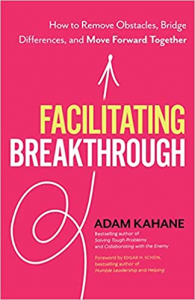
facilitating breakthroughADAM KAHANE is director of Reos Partners, an organization that helps people move forward together on their most important and intractable issues. He has worked in more than 50 countries with teams of leaders from business, government, and civil society, and his methods have been praised by Nobel Peace Prize–winners Nelson Mandela and Juan Manuel Santos. He is the author of five books, including his newest release, Facilitating Breakthrough: How to Remove Obstacles, Bridge Differences, and Move Forward Together. Learn more at adamkahane.com.

Did you enjoy this post? If so, I highly encourage you to take about 30 seconds to become a regular subscriber to this blog. It’s free, fun, practical, and only a few emails a week (I promise!). SIGN UP HERE to get the thoughtLEADERS blog conveniently delivered right to your inbox!

https://i0.wp.com/www.thoughtleadersllc.com/wp-content/uploads/2021/10/20211031-Hands-In.jpg?fit=1920%2C1280&ssl=1 1280 1920 Trevor Jones https://www.thoughtleadersllc.com/wp-content/uploads/2022/04/logo.png Trevor Jones2021-11-01 08:00:132021-10-31 21:51:14Collaboration Is Difficult. This Unconventional Approach Makes It Easier

Don’t Fake It to Make It: Authenticity is the Real Key to Success

October 12, 2021/0 Comments/in Books, Career, Guest Blogger, Leadership, Strategy /by Trevor Jones

From navigating new methods of closing deals, to landing get that next promotion, to understanding new norms of leadership, authenticity is the key to success.

Today’s guest post is by Dr. Sharon Lamm-Hartman, author of The Authenticity Code: The Art and Science of Success and Why You Can’t Fake It to Make It (CLICK HERE to get your copy).

I was once approached by an executive assistant by the name of Viola (real name withheld for anonymity) who was in attendance at one of our 5-day Authenticity Code™ programs. She confided in me, and with tears in her eyes, that she didn’t know why she was not being promoted. She stated that she had watched many peers get jobs that she would have loved to get, but she never got selected when she did land an interview. When I heard about her struggle, my heart sank. Viola was a black woman in her thirties, and she felt stuck at her current level. I asked her what her dream job would be, and she passionately said that she wanted to be a VP of this Fortune 50 company, which at the time, only had 300 VP’s out of about 160,000 employees.

Viola started on the path to finding her authentic self, which can be done by cracking open the Authenticity Code – which is your presence + your audience + your presentation = your success. Viola defined her authentic brand statement, looked at what authentic presence qualities she needed to grow in – including confidence. She got at the core of what was blocking her which was she didn’t believe in herself. In the program, she put together an exceptional presentation that she used to influence critical senior leaders in the company. Her idea ended up saving the company millions of dollars. And I am ecstatic to say that today just seven years after she took our program, Viola has mastered the art and science of success because she achieved her authentic brand and is a VP in that same Fortune 50 company. She was promoted up five levels, from executive assistant to VP in seven years which is faster than anyone else I know in that company.

Authenticity is the key to getting your dream job, closing a big sale, feeling more fulfilled, and getting to yes in any presentation or communication. Authenticity is your most powerful way of adding value by expressing your unique gifts and talents to your chosen audience. Think about it- do you buy from or want to work with someone who is inauthentic and has no leadership presence?

According to the Center for Talent Innovation, leadership presence counts for at least 26% of whether you get selected for a job or promotion. This is also true for whether you make a big sale or another positive business impact. That percentage can be substantial in terms of professional and personal growth, something I have seen firsthand.

COVID-19 has had an immeasurable impact on the business world. Company hiring practices have changed, as have workplace culture and leadership norms. Companies face hiring shortages. With companies forced to reevaluate how they approach their day-to-day business, individuals have also been forced to adapt. From navigating new methods of closing deals to determining how to get that next promotion to understanding new methods of leadership, many have found the need to acclimate to the changing world. This has been called the Great Reassessment.

The question is, how do individuals and businesses make a change once they have reassessed? What is the secret to realizing your true potential and achieving your goals in the post-pandemic world? From my experience, authenticity is the key to professional and personal success. So how does one become more authentic, and what is necessary to improve those skills?

There are three key elements on which to focus. First, your presence, such as warmth, sincerity, confidence, integrity, trustworthiness, and even your body language will help you better communicate your message. Connecting with your own authentic brand statement is critical in improving your authentic presence. This is a statement that expresses what you want out of your career and what is your greatest professional/leadership gift to give no matter what job you hold.

Second, understanding your audience and tailoring your message to that audience will greatly improve your presentation skills. Before you go into a big meeting or start writing a big presentation, ask yourself 4 simple questions: 1) What is most important to my audience? 2) What details do they need? 3) What hooks them to listen? and 4) What are they willing to compromise (e.g., cost, schedule, quality). It is an authentic choice to be in front of an audience, so you want to do everything you can to help give your audience what they need.

Third, is your presentation itself. There is a simple formula for presentation success: 1) Attention Getting Opening, 2) Executive Summary, 3) Agenda with Clear Body Message, and 4) Finish Strong.

Over my more than two-decade-long career, I have seen thousands of clients like Viola who work on their authentic presence and presentation skills, get promoted, land their dream job, and feel considerably more fulfilled. Crack the authenticity code by developing ‘Your Presence + Your Audience + Your Presentation = Your Success’. Focusing on these factors is the secret to improving your professional and leadership development.

the authenticity codeDr. Sharon Lamm-Hartman is the Founder and CEO of Inside Out Learning, Inc. (IOL), an award‐winning global leadership, team and organization development consulting business. In addition to running IOL, with a doctorate in Leadership Development from Columbia University, and a Masters from Cornell University, Dr. Sharon is a global executive and presentation skills coach, leadership and organization development consultant, speaker, writer, educator, wife and mom. Dr. Sharon has worked with tens of thousands of CEOs, executives, educators, professionals, and entrepreneurs worldwide. She has been an Adjunct Faculty Member at Columbia University and the Center for Creative Leadership. Her new book, The Authenticity Code™: The Art and Science of Success and Why You Can’t Fake It to Make It is available for preorder at Amazon and Barnes & Noble and was named a top business book to read this fall by Texas CEO Magazine. 

Did you enjoy this post? If so, I highly encourage you to take about 30 seconds to become a regular subscriber to this blog. It’s free, fun, practical, and only a few emails a week (I promise!). SIGN UP HERE to get the thoughtLEADERS blog conveniently delivered right to your inbox!

https://i0.wp.com/www.thoughtleadersllc.com/wp-content/uploads/2021/10/Reflection-Mirror.jpg?fit=1920%2C1283&ssl=1 1283 1920 Trevor Jones https://www.thoughtleadersllc.com/wp-content/uploads/2022/04/logo.png Trevor Jones2021-10-12 21:30:562021-10-12 21:27:49Don’t Fake It to Make It: Authenticity is the Real Key to Success

Is Trauma Slowly Destroying Your Company? Look for These Signs

October 4, 2021/1 Comment/in Books, Career, Guest Blogger, Leadership, Strategy /by Trevor Jones


cracked floor

Organizational trauma comes in many forms but impacts organizations in predictable, destructive ways. Here’s how to tell if trauma is harming your workplace.

Today’s guest post is by Dr. Diana Hendel, author of Trauma to Triumph: A Roadmap for Leading Through Disruption and Thriving on the Other Side (CLICK HERE to get your copy).

My understanding of organizational trauma was born of firsthand experience. In 2009, a horrific workplace shooting occurred at the hospital where I served as CEO. Three people died at the hands of a disgruntled employee. Even after the initial terror wore off, repercussions from the event sowed long-lasting uncertainty, fear, distrust, and division throughout the organization. From feelings of shame to diagnoses of PTSD to employee departures, the collective damage went deep.

Why am I telling you this? Because there’s a good chance that, at some point, your organization may experience trauma. It’s true that (thankfully) most won’t experience this type of extremely violent “shock and awe” crisis. But there are many types of disruptive events and systemic issues that can sow distrust, erode morale, and severely impact an organization’s ability to function.

I’m not talking about routine workplace stress which, even when intense, is temporary and manageable. Trauma is different. It takes away our feeling of control, warps our worldview, leaves us feeling helpless and vulnerable, and sends us tumbling into survival mode. Obviously, trauma leaves its mark on individuals. But it’s also deeply destructive to organizations.

Mass layoffs, sexual harassment, natural disasters, the death of a coworker, workplace accidents, a leader’s embezzlement, racism, and discrimination are all examples of organizational trauma I’ve encountered. And, of course, there’s the collective trauma we’ve all experienced over the past year and half, brought on by the COVID-19 pandemic.

Whatever the source of the trauma, it’s all destructive. And if unaddressed, it will cause your organization’s structures, systems, values, and people to suffer. That’s why it’s vital to know what causes trauma and recognize how it manifests. Let’s take a closer look at what you can expect to see if your organization is traumatized.

First, people create their own narratives. Humans naturally want to make sense of upsetting and unexpected events, and I’ve found that there can be nearly as many points of view, personal experiences, and relationship dynamics as there are employees.

As all of these narratives are shared, rumor and speculation can cause secondary blame to spread. People want to know why the traumatic event happened. Could it have been foreseen or prevented? Why weren’t leaders prepared? You may find that victims are blamed, or that leaders are vilified for not preventing “witch hunts.” Strong and sometimes conflicting opinions abound.

Employees who are closer to a traumatic event than others (perhaps they witnessed it or worked closely with the perpetrator) are especially likely to struggle with feelings of guilt. They may blame themselves for not recognizing warning signs or feel that they should have prevented the event from occurring. Some might feel guilty that they survived or remained employed, while others did not.

It’s no surprise that in such an emotionally charged and uncertain environment, communication can be haphazard and inadequate. Traumatized leaders might struggle to be transparent while maintaining confidentiality, which chips away at equally traumatized employees’ trust and confidence. And until a “new normal” is established, it may not even be clear who is making decisions or how they will be reached.

Before long, polarization occurs. You may quickly see people dividing into two or more opposing groups. We’ve all seen what happens in well-publicized sexual harassment cases: one faction might support the victim while another might believe that the alleged perpetrator was falsely accused. The same thing can happen inside a traumatized organization.

As time passes, people begin to worry that they or their organization will be defined by the event, scandal, or circumstance that caused the trauma. This is especially true when there’s media coverage or widespread knowledge of the incident. Rising feelings of shame that “such a thing could happen here” can eclipse former pride in working for the organization and shake employees’ confidence that the organization is trustworthy.

I’ve found that when trauma isn’t addressed, it eventually becomes almost taboo. It can feel painful and even unsafe to speak frankly about what happened. But just because people aren’t talking about trauma doesn’t mean they aren’t still struggling. The shame, blame, division, guilt, and misunderstandings I’ve already mentioned are often festering just beneath the surface, where they silently corrode trust, morale, culture, and more.

Without intervention, trauma can cripple or even destroy a company. But organizational trauma doesn’t have to be a death sentence for your business. Over and over, I’ve seen how transformative it can be to seek help. (And the sooner leaders take action to break the chain of repercussions set in motion by trauma, the better.)

Here’s the good news: While the field of organizational trauma is fairly new, it’s becoming more widely understood every day. And resources—including Trauma to Triumph, a book I coauthored with Mark Goulston, MD—are increasingly easier to access.

You can establish processes to help both individuals and the organization as a whole successfully weather trauma. Even better, you can get prepared before a traumatic event strikes. When leaders learn how to destigmatize trauma, communicate effectively, and make decisions thoughtfully, it’s possible to successfully reunify and recover. In fact, a stronger culture, greater transparency, higher performance, and the ability to more effectively handle future disruption are often achieved on the other side of organizational trauma.

trauma to triumphAbout the Author: Diana Hendel, PharmD

Dr. Diana Hendel is the coauthor along with Mark Goulston, MD, FAPA of Trauma to Triumph: A Roadmap for Leading Through Disruption and Thriving on the Other Side (HarperCollins Leadership, March 2021) and Why Cope When You Can Heal?: How Healthcare Heroes of COVID-19 Can Recover from PTSD (Harper Horizon, December 2020). She is an executive coach and leadership consultant, former hospital CEO, and the author of Responsible: A Memoir, a riveting and deeply personal account of leading during and through the aftermath of a deadly workplace trauma.  

About the Book:

Trauma to Triumph: A Roadmap for Leading Through Disruption and Thriving on the Other Side (HarperCollins Leadership, March 2021, ISBN: 978-1-4002-2837-9, $17.99) is available from major online booksellers.

Did you enjoy this post? If so, I highly encourage you to take about 30 seconds to become a regular subscriber to this blog. It’s free, fun, practical, and only a few emails a week (I promise!). SIGN UP HERE to get the thoughtLEADERS blog conveniently delivered right to your inbox!

https://i0.wp.com/www.thoughtleadersllc.com/wp-content/uploads/2021/10/20211004-Cracked-Floor.jpg?fit=1920%2C1275&ssl=1 1275 1920 Trevor Jones https://www.thoughtleadersllc.com/wp-content/uploads/2022/04/logo.png Trevor Jones2021-10-04 08:00:112021-10-04 03:16:53Is Trauma Slowly Destroying Your Company? Look for These Signs

How to Become an A+ Manager Today

September 27, 2021/0 Comments/in Books, Career, Communications, Leadership, Project Management, Strategy /by Trevor Jones

Learn how to improve your managerial skills by studying the eight attributes of the employee-centric manager.

Today’s guest post is by Dr. Jack Wiley, author of The Employee-Centric Manager (CLICK HERE to get your copy).

Over the past two decades, the practice of gathering employee feedback on the performance of their managers has grown. And why not? Subordinates have the most knowledge about their manager’s performance, and they are the ones most affected by their behavior. Leading organizational scientists argue that the ratings of managers provided by employees are the most valid. Indeed, research shows that subordinate ratings of a manager’s performance correlate with ratings provided by the manager’s own boss.

So, as a manager, what does it take to achieve great performance reviews from your employees? I asked a representative and systematically selected sample of 10,000 workers in the United States to rate the overall performance of their manager. I also asked these employees to rate their managers on the eight attributes of the employee-centric manager (or ECM), which are: (1) show support and understanding; (2) provide recognition; (3) treat employees with dignity and respect; (4) communicate clear performance expectations; (5) reward performance contributions with fair compensation and development opportunities; (6) demonstrate skill in decision-making and problem-solving; (7) be fair and just; and (8) be honest and trustworthy.

I learned that 67% of a manager’s overall performance rating is explained by their ratings on the attributes that define the employee-centric manager. This means that how employees rate their manager on these eight attributes determines two-thirds of their overall effectiveness rating. There is still another 33% of a manager’s rating that is accounted for by other factors, but the implication is clear: if you rate highly on the ECM attributes, you will also rate highly on overall performance. The reverse is also true – if you rate poorly on the ECM attributes, you will also rate poorly on overall performance.

Let’s dig a little deeper. Which of the eight attributes are most impactful? Statistical regression analysis reveals that these three attributes most influence employees’ views of their manager’s overall performance:

LISTEN: As in, “My manager is an effective listener.”

MAKE GOOD DECISIONS: As in, “My manager displays competence in making day-to-day work decisions.”

RECOGNIZE: As in, “My manager provides me with praise or recognition for doing good work.”

So, what do employees really want when it comes to listening (a subset of the support and understanding attribute)? They want their manager to be available and accessible. They want them to listen to their concerns with the energy and attention needed to genuinely identify with where they are coming from. They want their manager to follow through on concerns brought to their attention and seek employee input on important decisions affecting their work or how to solve a work-related problem. And they want their manager to get to know them – sufficiently well so that they understand their current capabilities, training and development needs, and goals, including their career goals.

This example of effective listening comes from an employee in the healthcare industry.

“I brought a problem to my manager’s attention, and she let me explain what I think would work best moving forward. She understood that I was the one out there doing the job, and I would have the best understanding of the situation. She got back to me quickly and trusted me to make the decision.”

When it comes to making good decisions, what do employees really want? They want their manager to make decisions in a timely way and not drag their feet. They want their manager to make decisions based on a rational, data-based approach. They want their manager to involve them in decision-making and problem-solving. They also want their manager to think through the implications of their decisions so that the team doesn’t end up dealing with blow-back. And finally, they want their manager to be flexible and learn from experience.

Here is an example of a manager being skilled in problem-solving and decision-making from the experience of a financial services employee.

“My manager had to clean up a project that a former employee had messed up before leaving the company, and it was very stressful; she needed our help. She was very helpful in trying to get us all to understand what the project was and what it needed to look like in the end. She didn’t rush or get us overwhelmed. This made me see she is a great leader and that I can count on her to help me remain calm in stressful situations.”

Finally, when it comes to recognition, what do employees really want from their manager? They want an honest and sincere “thank you” for working hard, staying late, busting through obstacles, or going the extra mile to get the job done. They want real-time recognition when their performance is worthy of praise – employees want to receive it in the here-and-now. They also want recognition that fits them, their style, and their personality. And they want recognition that is specific to the behavior or performance under consideration; this helps employees understand how the boss defines good performance.

An employee in the retail sales industry provides this example of a boss effective at providing recognition.

“My manager hired me at the seasonal time, and not everyone hired then gets to stay on and become a regular employee. But she watched me, gave me pointers, and did my reviews. She’s so great and has helped me in all kinds of situations; she saw the determination in me to strive to just keep going. She nominated me as employee of the month in front of everyone.”

Becoming an A+ Manager is relatively straightforward: think seriously about how you like to be treated by your manager and consistently do the same toward your employees. Be especially good at listening, making good decisions, and recognizing worthy performance.

the employee centric managerDR. JACK WILEY has more than 30 years of experience studying what employees most want and what organizational design factors best promote employee engagement, performance confidence and business success. He is the president & CEO of Jack Wiley Consulting, LLC, and Employee Centricity LLC. In addition to his business ventures, he’s the chief scientific officer at Engage2Excel. He is the author of The Employee Centric Manager and RESPECT: Delivering Results by Giving Employees What They Really Want. In 2014, Dr. Wiley was awarded the prestigious Professional Practice award by the Society of Industrial-Organizational Psychology, a lifetime achievement award for outstanding contributions to the practice of industrial-organizational psychology. In addition to being elected to Fellow status in SIOP, he is also a Fellow of the American Psychological Association and the Association for Psychological Science.

Did you enjoy this post? If so, I highly encourage you to take about 30 seconds to become a regular subscriber to this blog. It’s free, fun, practical, and only a few emails a week (I promise!). SIGN UP HERE to get the thoughtLEADERS blog conveniently delivered right to your inbox!

https://i0.wp.com/www.thoughtleadersllc.com/wp-content/uploads/2021/09/20210927-Letter-A.jpg?fit=1920%2C1275&ssl=1 1275 1920 Trevor Jones https://www.thoughtleadersllc.com/wp-content/uploads/2022/04/logo.png Trevor Jones2021-09-27 08:00:472021-09-27 04:35:07How to Become an A+ Manager Today

Building High Performing Teams: Giving Authority and Responsibility

August 18, 2021/0 Comments/in Business Toolkit, Career, Leadership, Strategy /by Trevor Jones

handing over keys

Giving your team the authority to make important decisions improves trust, satisfaction, and accountability.

Members of high performing teams are going to be the most satisfied when they feel like they can have an impact on the outcome of their work. And to get to that point you need to understand the difference between accountability and responsibility and then how authority interplays with both of them. Read more

https://i0.wp.com/www.thoughtleadersllc.com/wp-content/uploads/2021/08/20210817-Handing-Over-Keys.jpg?fit=1920%2C1280&ssl=1 1280 1920 Trevor Jones https://www.thoughtleadersllc.com/wp-content/uploads/2022/04/logo.png Trevor Jones2021-08-18 06:30:362021-08-17 21:33:00Building High Performing Teams: Giving Authority and Responsibility

Building High Performing Teams: Empower Your People

August 11, 2021/0 Comments/in Business Toolkit, Leadership, Project Management, Strategy, Training /by Trevor Jones

delegate

To build and foster a high performing team, sometimes you have to step back and let your people do their thing. 

For you to get the most out of the members of your high performing team, you need to empower them. Remember, on a high performing team, those team members are typically very self-motivated, and they like being self-directed. You need to understand how letting go of your agenda, creating space for them to flourish, and then accepting that there are different ways of doing things is going to bring out the best in your people. Read more

https://i0.wp.com/www.thoughtleadersllc.com/wp-content/uploads/2021/08/20210811-Delegate.jpg?fit=1920%2C1277&ssl=1 1277 1920 Trevor Jones https://www.thoughtleadersllc.com/wp-content/uploads/2022/04/logo.png Trevor Jones2021-08-11 06:30:042021-08-11 05:21:13Building High Performing Teams: Empower Your People

Why You Shouldn’t Rush Into a Business Partnership – 5 Factors to Consider

August 9, 2021/0 Comments/in Books, Business Toolkit, Career, Entrepreneur, Guest Blogger, Strategy /by Trevor Jones

handshake

Too often, entrepreneurs seek business partners for the wrong reasons, from skills to capital. Whether leading a startup or growing organization, here’s how to avoid making a bad decision.

Today’s post is by Patrick Burke, author of The 10 Biggest Business Mistakes And How To Avoid Them (CLICK HERE to get your copy). 

“Do I need a business partner?” I’ve been a business adviser for more than 40 years and this is one of the most common questions entrepreneurs ask, whether they are starting their first business or expanding an existing one.

Holding onto as much of your company’s ownership as possible and sharing it only when absolutely necessary is simple logic. But entrepreneurs often succumb to the emotional need to partner. Though by nature an independent and confident group, they start tossing ownership around with little or no regard for its current or eventual value.

So whenever I’m asked that question, I remind them that there’s no Rorschach test for what a successful business partnership looks like. Too often, you may think the inkblot looks like an opportunity, while your partner sees only obstacles. It’s an extremely tough chasm to bridge. But if you’re seriously considering a partnership, ask yourself these five questions as your guide: Read more

https://i0.wp.com/www.thoughtleadersllc.com/wp-content/uploads/2021/08/20210809-Handshake.jpg?fit=1920%2C1328&ssl=1 1328 1920 Trevor Jones https://www.thoughtleadersllc.com/wp-content/uploads/2022/04/logo.png Trevor Jones2021-08-09 08:00:512021-08-09 01:00:56Why You Shouldn’t Rush Into a Business Partnership – 5 Factors to Consider

How to Create a Stretch Goal

August 4, 2021/0 Comments/in Business Toolkit, Leadership, Strategy, Training /by Trevor Jones

dog jumping for frisbee

Once you’ve established your commit goals, you should also set stretch goals. Learn how to use the one-third, two-third method to set a stretch goal. 

In addition to setting a commit goal, you should also set a stretch. A stretch goal is what’s going to push people to achieve more. It still needs to be achievable when you go back and look at SMART goals, but it won’t have a guarantee of success. More often than not, you’ll fall short of your hitting your stretch goal. If you’re always hitting your stretch, you’re not stretching far enough.

So why should you set stretch goals? Well, if you only set a commit goal, the team might coast once you reach it. They’re going to say, “Well, we hit our goal. We don’t have to push ourselves so hard. Let’s just relax and get to the end of the year.”

A stretch goal gets them to continue performing. Once they hit the commit, there’s still something more that they can go out and achieve. A stretch goal can motivate and excite people. When they hit it, it creates a sense of shared achievement that’s going to build morale and team identity. Stretch goals force people to think differently.

Many times, a commit goal is based upon what people know they can do. They don’t challenge constraints or look for new ways of doing things. A commit goal is about getting things done and doing it the way we’ve always done it. A stretch goal gets them to challenge assumptions. They’ll look at the business differently. They’re going to be willing to make large changes and they’re going to take risks to achieve that stretch. A stretch goal helps them build new skills from trying new things.

So by combining a commit goal that they can achieve and they can deliver to the organization, and a stretch goal that pushes them to improve their performance, you’re getting the best of both worlds.

The one-third, two-third method for stretch goals

I often get asked, “How can I set a good stretch goal?” I like to tell people to use the 1/3, 2/3 rule. For the gap between your commit and your stretch, your team should have a good sense for how they might close 2/3 of that gap, and no idea for where the other 1/3 will come from.

Why 1/3, 2/3? Well, if it’s more than 1/3 that they don’t know where it’s going to come from, they’re going to give up and just say, “This is too hard. I don’t have any ideas.” If it’s less than 1/3, it may be too easy and they might coast. To create this list and understand what this 1/3, 2/3 is, gather a list from your team for ideas beyond the commit and add them up.

Let’s walk through an example. Let’s say we set a commit goal of X, and now we’re trying to figure out what the stretch is. I tell the team, “I need all your best ideas for how we’re going to drive revenue beyond that commit event.” The team goes off, they come back with their ideas, and they come up with $2 million worth of ideas. Now these will be hard, but they have a reasonable idea of how they can capture $2 million. That two million is my 2/3. What I need to do next is add another third beyond that. When you look at the math, you just divide that two million in half and add it. So I would add another $1 million, and then I’d have a total stretch goal of three million. Now let’s look at that 1/3, 2/3. 2/3 of that $2 million, they have ideas. 1/3 of it, $1 million, they don’t know where it’s going to come from. They’re going to have to innovate to find that incremental $1 million.

When you set your stretch goals, following this 1/3, 2/3 rule will help you identify ideas and make that stretch feel like it’s something they can get, but it will still push them beyond the ideas they’ve already got, and hopefully drive incremental innovation.

Want to learn more about setting team and employee goals? How about taking an entire course on it? Go directly to the course and start learning how to create a culture of strategy execution. The entire course is available at LinkedIn Learning. Enjoy!

Did you enjoy this post? If so, I highly encourage you to take about 30 seconds to become a regular subscriber to this blog. It’s free, fun, practical, and only a few emails a week (I promise!). SIGN UP HERE to get the thoughtLEADERS blog conveniently delivered right to your inbox!

https://i0.wp.com/www.thoughtleadersllc.com/wp-content/uploads/2021/08/20210803-Dog-Jumping-for-Frisbee.jpg?fit=1920%2C1280&ssl=1 1280 1920 Trevor Jones https://www.thoughtleadersllc.com/wp-content/uploads/2022/04/logo.png Trevor Jones2021-08-04 06:30:212021-08-04 00:00:25How to Create a Stretch Goal

How to Create a Commit Goal

July 28, 2021/0 Comments/in Business Toolkit, Leadership, Strategy, Training /by Trevor Jones

goals

Learn what a commit goal is and what you should consider when creating one.

When you set goals, I encourage you to set two kinds of goals. The first is a commit goal and the second is a stretch goal.

A commit goal is something you’re committing to do for the organization. If you miss it, you can get fired. There should be extreme consequences for missing a commit goal. To build your commit goal, work from the bottom up. Work directly with your team and have them make commitments to you as far as what they’re going to deliver for their goals. You’ll then need to reconcile the team’s commits and make sure they all add up to your commit to your organization. 

At one point I had three different teams and we were tasked with a major cost reduction project. My boss came to me and asked me how much cost reduction would I commit to removing from the system. I went to my teams and I asked them how much cost they could take out, and I asked them for their goals. They gave me commit goals of one and a half million, two million, and three million dollars, for a total of six point five million dollars that they would commit to.

When I went to my boss, I hedged on that number a little bit and I told him I could commit to six million dollars. Now, he knew better and he knew I was hedging a little and he pushed me on it. He eventually got me to a point where we negotiated and I committed to six point two five million. Over the plan period, we exceeded that goal and we hit seven million dollars of cost reduction. Obviously there were no negative consequences for the team, but the result of having that commit was the entire team was focused on delivering six point two five. We tracked it over the course of the year. It was something that was at the top of our priority list because we knew we had to deliver it to the organization. Our commit was fed into the budgeting process at the beginning of the year and by doing so we ended up with a very accurate budget that people could plan for.

When you’re creating your commit goal, sit down with the team and make sure they understand what they’re committing to is going to have implications. The organization will plan based on that number and if they miss that number, there will be consequences for them and for you. Having that clear commit will drive the focus you need in terms of achieving a goal and making sure that the rest of the organization can plan for what you’re going to deliver.

Want to learn more about setting team and employee goals? How about taking an entire course on it? Go directly to the course and start learning how to create a culture of strategy execution. The entire course is available at LinkedIn Learning. Enjoy!

Did you enjoy this post? If so, I highly encourage you to take about 30 seconds to become a regular subscriber to this blog. It’s free, fun, practical, and only a few emails a week (I promise!). SIGN UP HERE to get the thoughtLEADERS blog conveniently delivered right to your inbox!

https://i0.wp.com/www.thoughtleadersllc.com/wp-content/uploads/2021/07/20210728-Goals.jpg?fit=1920%2C1280&ssl=1 1280 1920 Trevor Jones https://www.thoughtleadersllc.com/wp-content/uploads/2022/04/logo.png Trevor Jones2021-07-28 06:30:432021-07-28 01:03:05How to Create a Commit Goal

Employees Experience Distractions Every 31 Minutes: What Leaders Can Consider Before Making Decisions on Returning To the Workplace

July 26, 2021/1 Comment/in Balanced Lifestyle, Guest Blogger, Leadership, Strategy /by Trevor Jones

cell phone

A recent survey conducted by Mopria Alliance shows employees experience 77 distractions per week. Phil shares how employees are affected by work environments.

Today’s post is by Phil Mazzilli, Marketing Working Group Chair for Mopria Alliance.

After COVID-19 pushed employees out of their offices and into their homes, we’ve gained a new wealth of knowledge on the benefits and pitfalls of working from home versus in an office. As a leader in the printing industry, the pandemic got me thinking about how this new work-from-home environment was affecting how employees interact with their workspaces. What equipment would companies need to supply their employees with? Would we see any shifts in employee behavior? And perhaps most importantly, how would a work-from-home model affect productivity? Read more

https://i0.wp.com/www.thoughtleadersllc.com/wp-content/uploads/2021/07/20210726-Cell-Phone.jpg?fit=1920%2C1280&ssl=1 1280 1920 Trevor Jones https://www.thoughtleadersllc.com/wp-content/uploads/2022/04/logo.png Trevor Jones2021-07-26 08:00:012021-07-26 01:40:33Employees Experience Distractions Every 31 Minutes: What Leaders Can Consider Before Making Decisions on Returning To the Workplace

How to Set Zero-Based Goals

July 21, 2021/0 Comments/in Business Toolkit, Leadership, Strategy, Training /by Trevor Jones


zero

Use this common budgeting technique to set goals that are more relevant and actionable.

When you’re setting goals, you can borrow a technique from a common budgeting process called zero-based budgeting. What you do is look at last year, forget about it, and then look at where you are today and what you can achieve going forward. Every dollar you’re going to spend in the budget is justified. And every number you’re going to deliver is based on your current reality. Read more

https://i0.wp.com/www.thoughtleadersllc.com/wp-content/uploads/2021/07/20210721-Zero-2.jpg?fit=1920%2C1280&ssl=1 1280 1920 Trevor Jones https://www.thoughtleadersllc.com/wp-content/uploads/2022/04/logo.png Trevor Jones2021-07-21 06:30:082021-07-21 01:06:16How to Set Zero-Based Goals

Which Comes First: The Entrepreneur or the Company’s Brand?

July 19, 2021/0 Comments/in Books, Business Toolkit, Career, Entrepreneur, Guest Blogger, Leadership, Strategy /by Trevor Jones


chicken or the egg

Learn how your personal brand and your company brand can influence each other. 

Today’s post is by Lida Citroën, author of Control the Narrative (CLICK HERE to get your copy).

Where do personal and company brands intersect? Should an entrepreneur seek to establish their own name first, or focus on the company brand to launch? Unlike the chicken/egg predicament, when the entrepreneur builds their personal brand first, establishing their presence and representing their vision, passion, talents and mission, the company brand becomes proof of that vision and an element of fulfilling their mission. Read more

https://i0.wp.com/www.thoughtleadersllc.com/wp-content/uploads/2021/07/20210718-Chicken-or-the-Egg.jpg?fit=1920%2C1280&ssl=1 1280 1920 Trevor Jones https://www.thoughtleadersllc.com/wp-content/uploads/2022/04/logo.png Trevor Jones2021-07-19 08:00:452021-07-18 22:49:48Which Comes First: The Entrepreneur or the Company’s Brand?
Page 26 of 46«‹2425262728›»

Get free blog posts by email NOW!

It’s the best 5 minutes a week you can spend on your development.

Subscribe HERE!

Get new posts FREE via RSS!
Follow thoughtLEADERS on LinkedInFollow thoughtLEADERS on twitter
This site contains affiliate links to products. We may receive a commission for purchases made through these links.
 

Check Out Our Courses

Our courses teach immediately applicable skills that have real impact on your business. From leadership to strategy and negotiation to conflict resolution, we have a broad set of course offerings that will drive immediate performance improvements.
OUR COURSES

Our Courses

Group of Business People Meeting
Puzzle Pieces
Glasses Looking Over Cityscape
Doors on a Wall
Cog Wheels
Man Reading Book
Fishing hook in the sea
Microphone in Lecture Hall
Charts on Blue Background
Wristwatch
Exploding Light Bulb
Man on Summit of Mountain
Lightning Bolts
Man Painting the Word Change on a Wall
Construction Cranes
Plant Growing in a Hand
High Performance Gears
Men Shaking Hands Closeup
Influence Definition
Sailboat at Sunset
Hanging light bulbs with glowing one isolated on dark blue background
Wagon Wheel
Risk
Strategic Client Engagement
Strategic Business Planning
Advanced Meeting Leadership
Building a Growth Mindset
Executive Communications
Structured Problem Solving
Creating Leadership Maxims
Leading inside the Box
Deliberate Decision Making
Simple Strategic Planning
Storytelling for Leaders
Storytelling for Sales
Executive Presence
Principles of Chart Design
Time Management Mastery
Breakthrough Innovation
Leadership Resilience
Conflict Resolution
Leading through Change
Project Management Reality
Coaching for Impact
High Performing Teams
Everything is Negotiable
Leading with Influence
Building Personal Resilience
thoughtLEADERSHIP
Engagement Management
Risk Management
Client Engagement
Strategic Business Planning
Advanced Meeting Leadership
Building a Growth Mindset
previous arrow
next arrow
 

eLearning Courses on TITAN

Structured Thought: Problem Solving
Puzzle Pieces
Structured Thought: Problem Solving

Clearly define a problem, scope all issues related to the problem, generate potential solutions, then analyze and select the best solution by using time-tested critical thinking methods and tools.

VIEW COURSE
Structured Thought and Communication
Group of Business People Meeting
Structured Thought and Communication

Craft clear and compelling recommendations that resonate with stakeholders. Get your ideas approved by using a proven method for delivering executive-level communications.

VIEW COURSE
Principles of Chart Design
Different Types of Line and Bar Charts
Principles of Chart Design

Create well-designed presentation charts that get your message across quickly and clearly to drive your audience to action. From data charts to concept charts, these methods help make your point.

VIEW COURSE
Engagement Management
Wagon Wheel
Engagement Management

Whether you’re an internal or external consultant or a project leader, learn proven methods, techniques, and processes to effectively lead consulting engagements that drive your client’s success.

VIEW COURSE
Strategic Business Planning
Cog Wheels
Strategic Business Planning

Use a straightforward and effective strategic planning process that shows how to craft a clear, compelling plan for your organization - not just one time, but on an ongoing basis year after year.

VIEW COURSE
Deliberate Decision Making

Make better, faster, and more effective decisions. Apply simple yet powerful decision making tools to define decision authority, manage risk, increase accountability, and drive execution.

VIEW COURSE
Everything is Negotiable
Men Shaking Hands
Everything is Negotiable

Become a better negotiator in all situations – from day to day interactions to hammering out large deals. Build the skills required to get what you want and strengthen relationships while you do.

VIEW COURSE
Breakthrough Innovation
Exploding Lightbulb
Breakthrough Innovation

Generate and select unique strategies that separate you from the competition. Construct bold and disruptive solutions then build and execute a plan for taking those strategies to market.

VIEW COURSE
Storytelling for Leaders
Man reading stories from a book
Storytelling for Leaders

Create business stories that inspire people, build connections with your audience, and ultimately advance your organization's goals by using a repeatable, straightforward method.

VIEW COURSE
Storytelling for Salespeople

Create and deliver stories that will take your sales efforts to the next level. Connect with and convince buyers in all situations using memorable stories. These stronger relationships drive more sales.

VIEW COURSE
Leading through Change

Lead your organization through the most challenging times using a proven change management process. Get people through the change and back to driving performance quickly and effectively.

VIEW COURSE
Building Leadership Resilience
Mountain Climbing Expedition
Building Leadership Resilience

Prepare your body and brain to be ready for and recover from your biggest challenges. Build approaches for overcoming stress, managing reactions to difficult events, and leading more effectively.

VIEW COURSE
Compelling Executive Presence

Build your ability to connect with your audience and convey your ideas in a clear and resonant way. Create meaningful connections between you and your audience to build buy-in.

VIEW COURSE
Coaching for Impact
Plant Growing in a Hand
Coaching for Impact: Foundation Course

Coach employees for performance and development more effectively by helping them identify and pursue their own solutions. Create the right environment and conditions to help them grow.

VIEW COURSE
Building Personal Resilience
Boat at Sunset
Building Personal Resilience

Build the habits and learn the behaviors required to manage stress, deal with adversity, and maintain your physical and mental wellbeing. Personal resilience is a key to your ongoing success.

VIEW COURSE
Time Management Mastery
Watches
Time Management Mastery

Learn techniques to manage your time, delegate, say “no,” and be more efficient. Balance your limited supply of time with the overwhelming demands that are placed on you every day.

VIEW COURSE
previous arrow
next arrow

Books You MUST Read

The Elegant Pitch
One Piece of Paper by Mike Figliuolo
Lead Inside the Box
10 Stories Great Leaders Tell
Getting Ahead
Sell with a Story
Lead with a Story
Mastering Communication at Work
The Hook
Innovative Leadership Fieldbook
Innovative Leaders Guide to Transforming Organizations
The Three Commitments of Leadership
The Littlest Green Beret
Storytelling in the Land of Oz
The Camino Way
Hiring Veterans
Disability is Human book
Race to Innovation
The Emergent Leader
Business is Simple
Business is Simple
The Elegant Pitch
One Piece of Paper by Mike Figliuolo
Lead Inside the Box
10 Stories Great Leaders Tell
Getting Ahead
Sell with a Story - Border
Lead with a Story
Leading from Your Best Self
Mastering Communication at Work
The Hook
Innovative Leadership Fieldbook
Innovative Leaders Guide to Transforming Organizations
20120318 Three Commitments
Leadership Vertigo
The Littlest Green Beret
Storytelling in the Land of Oz
The Camino Way
Hijacked by Your Brain
Outthink the Competition
Driving Innovation from Within
Hiring Veterans
Disability is Human
Race to Innovation
The Emergent Leader
Business is Simple
Global Mindset
previous arrow
next arrow
  • The Elegant Pitch
  • Disability is Human
  • Hiring Veterans
  • Race to Innovation
  • The Emergent Leader
  • Business is Simple
  • Global Mindset

Categories

This site contains affiliate links to products. We may receive a commission for purchases made through these links.

Our Course Offerings

Leadership Skills

Creating Your Leadership Maxims
Leading Inside the Box
Leading With Influence
Leading Through Change
Structured Problem Solving
Deliberate Decision Making
High Performing Teams
Simplified Strategic Planning
Strategic Business Planning
Coaching for Impact: Foundations
Coaching for Impact: Applications
Building Leadership Resilience
Engagement Management
Project Management Reality
Risk Management

Communication Skills

Communications: Foundations
Communications: Applications
Principles of Chart Design
Strategic Client Engagement
Storytelling for Leaders
Storytelling for Salespeople
Compelling Executive Presence
Advanced Meeting Leadership

Individual Skills

Conflict Resolution
Everything is Negotiable
Building a Growth Mindset
thoughtLEADERSHIP: Innovation
Building Personal Resilience
Time Management Mastery

Coaching & Consulting

©2026 thoughtLEADERS, LLC: Leadership Training for the Real World. thoughtLEADERS, LLC is a registered trademark of thoughtLEADERS, LLC.
  • Privacy Policy
  • Terms of Use
  • Cookie Policy
Scroll to top