• Contact
  • My Account
  • Log In
  • 0Shopping Cart
thoughtLEADERS, LLC: Leadership Training for the Real World
  • About
  • Services
  • eLearning
  • Team
  • Blog
  • Clients
  • Books
  • Contact
  • Menu Menu

Navigating Imposter Syndrome: Meditations for Young Chief Executives

November 20, 2023/0 Comments/in Business Toolkit, Career, Entrepreneur, Guest Blogger, Leadership, Strategy /by Trevor Jones

woman in suit thinking

Here are 5 top tips to conquer imposter syndrome and lead with confidence as a young entrepreneur.

Today’s guest post is by Sofie Roux, Founder — BloomBox Design Labs

When I started college at a school I had dreamed of attending since I was six, I was awestruck. This feeling was rapidly followed by the thought, “How will I ever measure up to this amazing place?”

I threw myself into my classes and work and clubs, but I often wondered if I was doing anything right. I soon learned that almost every college student experiences some form of imposter syndrome, “the persistent inability to believe that one’s success is deserved.” I want to tell you what I learned about imposter syndrome this year — and especially how it can deeply affect young leaders.

After an amazing freshman year, I decided not to return for the fall quarter, but instead to focus my energy on leading my newly formed public benefit company to bring solar-powered, off-grid science, technology, and design labs to schools around the world, to help close disparities in access to high-quality education. This was extremely daunting, but the decision to go was largely guided by the values of fearless innovation and the pursuit of truth and beauty I had observed at college.

Now, I work full-time on my startup, BloomBox Design Labs. Being a young female founder can come with next-level imposter syndrome. Though I am far from an expert, and I can’t comment on running a big company, here’s what I’ve learned in the very early stages of my enterprise.

In moments of doubt, I have found inspiration from innovators that I admire, and from my current favorite dog-eared book, “Meditations” by the stoic Marcus Aurelius. Before I dispense this bit of advice, I’ll just say, if you have imposter syndrome right now, good! It means you are ambitious, sensitive, and ready to grow — a powerful combination for any young CEO.

1. Start with why: “To what use then, am I now putting my soul?”

Think of a problem that you are passionate about and then start forming your strategy. Even the most complex or seemingly impossible challenges can be deconstructed, and pursued one determined step at a time. It can be a tough journey, but if your idea reflects the passion of your soul, the journey itself will be a source of fascination and fun.

Make every decision in service of this idea, and keep that mission at the core of your work. Putting soul into the company is a powerful antidote for all forms of doubt.

2. Always keep learning: “The directing mind adapts itself.”

Being a CEO or innovator of any kind is like constantly being a student in subjects that matter, so soak up every bit of information you can. As a young CEO, you should know that you will never have all the answers, and that is the way it should be.

The journey of the company is to solve problems that may never have been solved. Remember to listen more than you talk. Have the humility to ask questions and learn — the best ideas and breakthroughs can come from the most unexpected sources.

Seek out and welcome diverse opinions, and lean into your weaknesses by practicing. Leaders that show some vulnerability create cultures of learning, exchange of ideas, and growth. The problems and people that challenge you to rethink and adapt will make your whole company stronger. Ask for help, be real, and keep learning.

3. Surround yourself with people who share your values: “Do not let the special quality of anything pass you by.”

The founding idea of your company is second only to a shared purpose with your team. These values will keep your organization in flight, even in the roughest weather of a startup.

Build your team from people who care about your company’s values and mission as much as you do. They will show up for you and your work when you feel that all hope is lost, as you will for them. When disagreements break out, the shared sense of purpose will transform them into creative discourse, and will keep you together and on track.

Those kinds of people are to be treasured. Keep them close.

4. Failure is a signpost: “All that exists will soon change.”

When you are in school — or on any track that has been run millions of times before — there are clear guideposts for success. You go to the next grade, go to college, and get a promotion. These established pathways are so important, but, by definition, when you are truly innovating, you embark on a journey without a guide or even a trail. When you do what has never been done before, the only indicator that you are making any progress at all is the next failure.

Thomas Edison wrote: “I have not failed. I’ve just found 10,000 ways that won’t work.” Be resilient.

5. You are on your own path: “Make the best move you can.”

At the end of the day, what matters is that you live every day with integrity, and that you do the very best you can. If, on a hard day, all you can achieve is treating people with respect and kindness, and making decisions based on your values, that is enough.

Young people and outsiders may wonder how they can make a difference in a world of established order, tradition, and precedent, but the truth is young people are so well-positioned to see and feel the opportunities that challenge the status quo — those that change the world. Keep going.

I write this on a Friday night, as the clock approaches midnight. I am sitting at the kitchen table, with my running checklist more incomplete than I had planned for, and Marcus Aurelius staring disappointedly at me from the cover of “Meditations” on my desk. Imposter syndrome is still present! I have so much left to learn about being a good leader. All I can do is return to step one and go from there — with faith in our company’s ideals, and unwavering belief that we will make it.

sofie headshotSofie Roux is a sophomore at Stanford studying architecture and engineering, and is the Founder and CEO of BloomBox Design Labs which designs and builds innovative educational spaces for girls in Malawi.

Did you enjoy this post? If so, I highly encourage you to take about 30 seconds to become a regular subscriber to this blog. It’s free, fun, practical, and only a few emails a week (I promise!). SIGN UP HERE to get the thoughtLEADERS blog conveniently delivered right to your inbox!

https://i0.wp.com/www.thoughtleadersllc.com/wp-content/uploads/2023/11/20231119-Woman-in-Suit-Thinking.jpg?fit=1920%2C1280&ssl=1 1280 1920 Trevor Jones https://www.thoughtleadersllc.com/wp-content/uploads/2022/04/logo.png Trevor Jones2023-11-20 08:02:342023-11-19 21:31:40Navigating Imposter Syndrome: Meditations for Young Chief Executives

Balancing Your Team’s Workload

November 15, 2023/0 Comments/in Business Toolkit, Career, Leadership, Project Management, Strategy, Training /by Trevor Jones

balanced rocks

Consider these five criteria when distributing work to your high-performing team.

Another key task as the leader of a high performing team is how you distribute and balance work across the members of that team. It needs to be done fairly. Note, I didn’t say equally. Work allocation needs to be done fairly because you want perceptions of equality and you want people to work on things they’re good at but also that they’re excited by.

There are five criteria to think about as you think about distributing work.

First, for priority. Priority needs to drive everything. It’s based on the teams and the organizations goals. If a project is a top priority and somebody’s available to do that work they get that work, and you need to allocate it appropriately.

Second, consider the skill set of the people where you’re thinking about distributing the work. If they have the right skill set, you’re going to get a high quality result. This also prevents people from failing. You’re giving them something they can be successful with.

Next, consider availability. All things being equal in terms of priority and skill set, who is free to do the work? Who has the bandwidth? You should not be shifting resources from one project to another when you have available resources to pick up that new project. If you start shifting resources around between projects when you have available resources elsewhere, you’re going to lose momentum on that first project, and that project might fail.

Next, you have to think about the development opportunity this project might present for that person, because that’s how you’re going to take your team to the next level of performance.

The last consideration is, “Does somebody have an interest in it?” If someone is really interested and really passionate about a project, you should let them take it on. They’re going to be really motivated, excited to do it, and hopefully their performance will follow. One caveat here: Make sure people don’t just gravitate to the work they enjoy doing and they stay away from things that they’re not comfortable with because they’re going to end up getting pigeon holed and they’ll be very narrow in their focus.

If you think about all these considerations as you distribute work across that team, it’s going to ensure that you tackle the highest priority projects with the resources who have the right skills to do it. It’ll be balanced in a way where you’re going to execute the project and develop your people at the same time.

Want to learn more about building high-performing teams? How about taking an entire course on it? Check out the video below to learn more about the course and get started. Or you can go directly to the course and start learning how to build high-performing teams. The entire course is available at LinkedIn Learning. Enjoy!

Did you enjoy this post? If so, I highly encourage you to take about 30 seconds to become a regular subscriber to this blog. It’s free, fun, practical, and only a few emails a week (I promise!). SIGN UP HERE to get the thoughtLEADERS blog conveniently delivered right to your inbox!

https://i0.wp.com/www.thoughtleadersllc.com/wp-content/uploads/2023/11/20231114-Balanced-Rocks.jpg?fit=1920%2C1280&ssl=1 1280 1920 Trevor Jones https://www.thoughtleadersllc.com/wp-content/uploads/2022/04/logo.png Trevor Jones2023-11-15 06:32:252023-11-14 23:36:54Balancing Your Team’s Workload

Are You Uplifting Your Team? 4 Ways Leaders Create Positivity

November 13, 2023/0 Comments/in Books, Business Toolkit, Communications, Guest Blogger, Leadership, Project Management, Strategy /by Trevor Jones


Dr. Sam Adeyemi offers insights to business executives and C-suite professionals on creating positivity as a team leader.

Today’s guest post is by Dr. Sam Adeyemi, author of Dear Leader: Your Flagship Guide to Successful Leadership (CLICK HERE to get your copy).

Here is something not every leader is ready to hear: You are the most powerful force behind the positivity in your workplace. If that positivity were the heavens, then you would be Atlas — or, at least one of his arms. So how do you cultivate positivity and find a healthy outlet for any dissatisfaction? You can start with these four step-by-step tactics for becoming a more inspiring and empathetic leader.

1. Look within yourself.

One of the most popular quotes from Carl Jung, noted Swiss psychiatrist and psychoanalyst, speaks to this exact issue: “Who looks outside dreams; who looks inside awakes.” You can find this quote all over social media and cataloged on websites promising a list of quotes that will “change your life.” And, while its surface-level message of finding peace within yourself understandably resonates with many, there is even more going on here than this small excerpt betrays to the reader.

Jung was describing a war between the Self and the collective noise of your outside reality. Any growth you hope to facilitate starts with you, which means you can’t hope to succeed until you know yourself and recognize your own opportunities for growth. Your ability to manage sources of negative energy and uplift your team in the workplace begins and ends with your own inner strength. You must be willing to take an honest look at yourself as a leader, then grow accordingly.

Unfortunately, our natural reaction is to avoid problems and circumvent confrontation whenever possible — especially when we are confronting ourselves. After all, difficult conversations are difficult for a reason. They often force us into awkward perspectives or unflattering looks at our own actions. Still, these internal conversations are essential to preparing yourself to improve morale and sustain productivity among others.

2. Work at the roots.

There is a type of bamboo tree grown in China that takes five years to reach maturity. What’s most astonishing, however, is that the plant remains hidden underground for the first four years of its life. For over 1,400 days, the tree is watered and fertilized at its roots with no real signs of progress for its caretakers. Then, in just over a month, it erupts from the ground with almost frightening urgency and grows up to 90 feet tall.

The “roots” of something are its foundational center — what feeds and supports its existence. Alongside the heart, there is no better metaphor for the “core” or the lifeblood of a team. Yet these roots are not easy to access. Much like the roots of the natural world, they are buried underground and operate according to their own schedule.

When a successful leader is approaching a problem within their team, they must discover the root of the issue that’s causing the problem and only then actively work to provide a solution. Was there adequate direction and communication from the beginning? Were the expectations clear and concise? When and where did productivity break down? Once this line of questioning begins, the best leaders find an opportunity to empower other team members to offer solutions.

3. Don’t absorb negativity — redirect it.

You probably already know that magnets can either attract or repel each other. Depending on which “poles” of the magnet you are trying to push together, they might snap toward each other in an instant, or you might find it virtually impossible to connect them directly. In the world of magnetism, opposite poles attract each other while identical poles repel each other. Simple, right?

However, there is no magnet for attracting or repelling the sources of negative energy among your workforce — it’s just not that simple. And, even if it were, those sources of negativity would change on a daily, weekly, monthly, and even yearly basis. For successful and empathetic leaders, maintaining positivity in the workplace begins with identifying the negative energy itself, then discerning what might repel that energy or even turn it positive. Dissatisfaction within your team is a perpetual drain on morale that will never go away on its own, which means your only recourse is to neutralize that negativity or transform it into positive action.

4. Embrace empathy and sincerity.

In Harper Lee’s “To Kill a Mockingbird,” the wise and stoic Atticus Finch offers up plenty of advice to his young daughter, Scout. One of my favorites is that you cannot truly understand a person until you “climb into [their] skin and walk around in it.” This adage is repeated in countless forms, the most popular being to “walk a mile in a person’s shoes.” That said, I think the version we get from Mr. Finch is more poignant than all the rest. It is not enough to slip on someone’s shoes — we must think holistically. It is not enough to walk for a mile — we must walk until we achieve understanding.

Empathy is essential for any leader that hopes to understand and inspire their team members. Empathy is about caring and curiosity, which makes it the perfect jumping-off point for gaining traction within your team. Your empathy and sincerity are your first lines of defense against negative energy, helping alert you the moment any dark clouds descend on the workspace. The most successful leaders use this empathy to direct their personal touchpoints, keeping the skies sunny whenever possible.

Start Small. Start Positive.

As a leader, you have an immense (and sometimes daunting) power to cultivate or suffocate the positivity within your workforce. The entire process starts with you — with self-examination — and ends with a team that understands its own limitations and demands empathy for everyone.

sam adeyemi bookAtlanta-based Dr. Sam Adeyemi (SAY: Ah Day yeh me) is founder and executive director of Daystar Leadership Academy (DLA). More than 45,000 alumni have graduated from DLA programs, and more than 3 million CEOs and high performing individuals follow him on top social media sites. Dr. Sam’s new book is Dear Leader: Your Flagship Guide to Successful Leadership. He holds a Doctorate in Strategic Leadership from Virginia’s Regent University, and is a member of the International Leadership Association. He and his wife, Nike (say Nee keh) have three children and founded Daystar Christian Centre in Lagos, Nigeria. Learn more at SamAdeyemi.com.

Did you enjoy this post? If so, I highly encourage you to take about 30 seconds to become a regular subscriber to this blog. It’s free, fun, practical, and only a few emails a week (I promise!). SIGN UP HERE to get the thoughtLEADERS blog conveniently delivered right to your inbox!

https://i0.wp.com/www.thoughtleadersllc.com/wp-content/uploads/2023/11/20231112-Number-Four.jpg?fit=1920%2C1280&ssl=1 1280 1920 Trevor Jones https://www.thoughtleadersllc.com/wp-content/uploads/2022/04/logo.png Trevor Jones2023-11-13 08:02:552023-11-12 22:10:34Are You Uplifting Your Team? 4 Ways Leaders Create Positivity

Creating Chemistry Between the Members of Your Team

November 8, 2023/0 Comments/in Business Toolkit, Career, Leadership, Project Management, Strategy, Training /by Trevor Jones


four employees at lunch

Chemistry and trust are what differentiates an average team from a high-performing team.

It’s great to have a clear vision and mission and a nice set of prioritized initiatives, and you’ve got all the right people. But what starts differentiating a team from a high-performing team is chemistry and trust between the members of that team. These intangibles are some of the most critical elements of building that team, but they’re also some of the most elusive ones to build and to capture.

You need to understand it’s about personalities and shared beliefs. Make sure everyone on your team is involved in the interview process because candidates will show different sides of themselves to different people. And sometimes, those sides can be unattractive detractors from what you’re trying to build.

When I was a consultant, we were bringing in another consultant onto the team, and that person interviewed very well with the other members of the consulting staff. At the end of the interview process, we all got together in the team room, and we talked about this candidate. And all of us were very excited about hiring him. And then we stopped and we asked our front desk receptionist what she thought of him. She said, “He was incredibly rude. He spoke down to me. He acted like I didn’t matter.” That individual did not get an offer of employment from us. And he’s probably still wondering why.

To assess what people are like, you can use some standard tools out there like The Myers-Brigg Type Indicator, Personalysis, and other standard evaluation tools to help people understand each others’ personalities and their styles and their preferences. Don’t just do it for candidates. Sit down and do it with the entire team. It’s not critical for people to have the same personalities; actually, it’s quite detrimental. What matters here is you have to help the members of your team understand and respect the other person’s personality and how they like to work with others. Some people may have shared experiences, or they may have a shared ethnicity or geography that they’re from. Help them find some point of commonality that they can build from.

Once you’ve figured out the chemistry of the team and you have people with the right fit, you need to start building trust between the members of that team. Trust is about shared experiences and predictability. Shared experiences show people how others perform and react during stressful situations. You may look at putting them on a big project together, where people can share in experiences and build stories together and feel like they accomplish something with one another. The impact is people start feeling like they can rely upon one another to achieve the goal. They start feeling responsible for each others’ well being and looking out for each other.

Now, the second element of trust is that predictability. I want to know how my colleague is going to react in a certain situation, because then, when they tell me they’re going to do something, and I’ve seen them behave in a manner that’s consistent with that in the past, I am much more likely to trust what they’re telling me they’re going to do. And if I understand that person’s values on top of having that predictability, well, that’s a really strong bond between me and that other member of the team, because then I really start believing what they tell me they’re going to do because it’s consistent with their beliefs and their past performance.

So, if, as a leader, you’re able to step back and look at the team and assess who’s going to be a good fit, how to get the right chemistry between the members of the team, and then get them trusting one another because they have shared experiences, and they’re predictable to one another, that team is going to gel very quickly and start functioning as a team instead of as a group of individuals.

Want to learn more about building high-performing teams? How about taking an entire course on it? Check out the video below to learn more about the course and get started. Or you can go directly to the course and start learning how to build high-performing teams. The entire course is available at LinkedIn Learning. Enjoy!

Did you enjoy this post? If so, I highly encourage you to take about 30 seconds to become a regular subscriber to this blog. It’s free, fun, practical, and only a few emails a week (I promise!). SIGN UP HERE to get the thoughtLEADERS blog conveniently delivered right to your inbox!

https://i0.wp.com/www.thoughtleadersllc.com/wp-content/uploads/2023/11/20231108-Four-Employees-at-Lunch.jpg?fit=1920%2C1280&ssl=1 1280 1920 Trevor Jones https://www.thoughtleadersllc.com/wp-content/uploads/2022/04/logo.png Trevor Jones2023-11-08 06:32:112023-11-08 02:36:29Creating Chemistry Between the Members of Your Team

Recruiting the Right People for Your Team

November 1, 2023/1 Comment/in Business Toolkit, Career, Leadership, Project Management, Strategy, Training /by Trevor Jones

office group sitting in circle

One of the most exciting aspects of building a high-performing team is recruiting people to be members of that team. Follow these three tips to improve your recruiting process.

One of the most exciting aspects of building a high-performing team is recruiting people to be members of that team. There’s nothing better than finding that really talented person who wants to come work with you.

As you think about doing this recruiting and finding the right people, you need to understand how to create role descriptions based on the team’s skill needs. Experience-based role descriptions might sound like, well, “The individual must have five years of experience on a small business credit union underwriting team working at a small mid-Atlantic community bank with multiple branches.” That’s a really specific description and there are very few people who probably meet those requirements. So you’ve shrunk the recruiting base that you can find somebody in. Instead, write skill-based job descriptions. Think about the initiatives you’re pursuing and the skills this person has to have. For example, “The individual must have the ability to perform complex financial analysis and combine those results with judgment to make effective decisions.” Those skill-based job descriptions open the applicant pool. It’ll enable you to get those new people in faster.

Next, in terms of hiring, once you have that skill-based job description, think differently in terms of where you go to find people because different perspectives and different experiences are going to bring new ideas into your organization. Additionally, by looking at nontraditional sources, you’ll probably have less competition for that great talent. So instead of recruiting from Harvard Business School where every organization in America is trying to hire those graduates, perhaps you look at different schools where you have less competition. Maybe try and pick off the top two people at the Ohio State University’s Business School.

Last, when you hire this person, don’t just hire for the role that you want them to do. You have to give them head room to grow into. People want to be excited and challenged. They want the opportunity to build their skills, which builds their personal marketability. When you hire them, make sure they can do 70% of the role you’re hiring them for, and they’re going to need to learn 30%. Because when you hire somebody who has 100% of the skills required for the role you’re bringing them into, that’s a very safe bet for you as a recruiter and as a leader, but think about it from that individual’s perspective. If they can come in and do all elements of that job on day one, it’s going to get pretty boring, pretty quickly. After about six months, they’re going to become disenfranchised and frustrated, and start looking for more challenging opportunities. Most people, especially ones that are going to gravitate toward the high-performing team you’re trying to build, are looking at that career path and thinking about how they can grow because that’s a very strong source of personal motivation for them.

So again, as you’re writing these job descriptions and going out and recruiting that talent, think about skill-based versus experience-based role descriptions. Look in nontraditional places for the people who have those skills. And when you hire them, think about their growth path ahead. Make sure they’ve got room to grow and develop as individuals.

Want to learn more about building high-performing teams? How about taking an entire course on it? Check out the video below to learn more about the course and get started. Or you can go directly to the course and start learning how to build high-performing teams. The entire course is available at LinkedIn Learning. Enjoy!

Did you enjoy this post? If so, I highly encourage you to take about 30 seconds to become a regular subscriber to this blog. It’s free, fun, practical, and only a few emails a week (I promise!). SIGN UP HERE to get the thoughtLEADERS blog conveniently delivered right to your inbox!

https://i0.wp.com/www.thoughtleadersllc.com/wp-content/uploads/2023/11/20231101-Office-Group-Sitting-in-Circle.jpg?fit=1920%2C1280&ssl=1 1280 1920 Trevor Jones https://www.thoughtleadersllc.com/wp-content/uploads/2022/04/logo.png Trevor Jones2023-11-01 06:32:112023-11-01 02:31:25Recruiting the Right People for Your Team

Creating the Right Mix of Skills on Your Team

October 25, 2023/0 Comments/in Business Toolkit, Career, Leadership, Project Management, Strategy, Training /by Trevor Jones


cauldron

By understanding the technical skills, the functional skills, and the role-based skills required to deliver on your team’s mission, you’re going to be able to create the right mix of people with the right skills that will help that team succeed.

As the leader of a high-performing team, you’re personally responsible for making sure your team has the required set of skills to succeed and execute against all the initiatives that you have on your prioritization list. You need to evaluate your team’s mission. You need to look at the key initiatives. And then, you need to map out the skills and capabilities required to succeed. You have to assess your existing team and see which skills you have, which ones you don’t, and which team members might be detractors from what you’re trying to achieve.

You also have to think about and understand your team’s culture, which is driven by the vision of what you’re trying to achieve, as well as the broader organizational culture and figure out, do you team members fit within that culture? We’ve all seen people who are great performers and can get the task done, but they don’t work well with the other members of the team. Your job as a leader is to either help them fit in, or find resources who are going to be more appropriate fits for the broader team.

You have to think about several types of skills that are required as you build this high-performing team. First, technical skills. Perhaps it’s coding, or doing analysis, or writing, or creating documents. These are technical skills required to turn out the products and services your team is responsible for.

The second type of skill is functional skills, things like problem-solving, strategic planning, decision-making, communicating, and presenting. These are soft skills that people need to bring to the table, again to execute against the initiatives on your prioritization list.

The last type of skill is a little bit different than we traditionally think about, which I call role-based or cultural skills. These are things like, is this person a leader? Or can they fulfill the role of being the devil’s advocate? Are they your team optimist, the cheerleader?

Once you’ve identified the different types of skills you need, you then need to assess your team. List out what each of those people bring to the team.

Next, look at some of the skills or characteristics the person might bring that are detractors from performance. For example, if you have a creative team that’s trying to churn out a bunch of new ideas, but you have a balance that is focused more on those task masters who are saying, great ideas, but let’s focus and let’s get stuff done, the team might be out of balance with that set of skills. Those things can be detractors that will prevent that team from being high-performing.

Last, look at that list of required skills, going back to the initiatives you’re pursuing, and figure out which of those skill sets you have. Then identify the gaps. Your job as a leader is to identify the types of people you need and then go out and recruit and hire them.

By understanding the technical skills, the functional skills, and the role-based skills required to deliver on your team’s mission, you’re going to be able to create the right mix of people with the right skills that will help that team succeed.

Want to learn more about building high-performing teams? How about taking an entire course on it? Check out the video below to learn more about the course and get started. Or you can go directly to the course and start learning how to build high-performing teams. The entire course is available at LinkedIn Learning. Enjoy!

Did you enjoy this post? If so, I highly encourage you to take about 30 seconds to become a regular subscriber to this blog. It’s free, fun, practical, and only a few emails a week (I promise!). SIGN UP HERE to get the thoughtLEADERS blog conveniently delivered right to your inbox!

https://i0.wp.com/www.thoughtleadersllc.com/wp-content/uploads/2023/10/20231025-Cauldron.jpg?fit=1920%2C1282&ssl=1 1282 1920 Trevor Jones https://www.thoughtleadersllc.com/wp-content/uploads/2022/04/logo.png Trevor Jones2023-10-25 06:32:222023-10-30 00:52:42Creating the Right Mix of Skills on Your Team

How to Move From Managing to Leading

October 18, 2023/0 Comments/in Business Toolkit, Career, Leadership, Project Management, Strategy /by Trevor Jones


Office Workers on Laptops

Spend less time on administrative tasks and more time helping the members of your team grow.

One of the most critical resources that your teams need are access to you as their leader. And we forget a lot of times that they need that access. We get wrapped up in the day-to-day operations or the meetings that we’re attending, or emails and voicemails, and we as leaders are not spending our time giving that critical resource to our people to give them the guidance they need.

A lot of times, we follow that sequence that I just went through in terms of slotting our work. We start with the simple things, like administration and email and documents, and we end up spending less time on the feedback, the coaching, and the development. These are old habits that we learned as individual contributors because many of those tasks, like admin, email, project planning, and budgeting are individual contributor activities. Those are habits that we’ve built over time. But now, as leaders, we need to step into the broader responsibilities of thinking through relationships, problem-solving, and providing feedback to the members of our teams. We have to stop managing and start leading.

As you think about the work that you do, let’s look at two aspects of that work. First, consider the amount of time that you spend on something, from very little to a lot. Then, think about the impact that that has on the performance of your team, from very low to very high. I’ll bet if you look at your calendar, you’re spending a lot of time on administration. I think we’d all agree that has a pretty low impact on the performance of your team. Next, you probably spend a little bit less time on project planning and budgeting, and it has a slightly bigger impact. All the way up to providing feedback and development and coaching, which could have a very large impact on your people, but we’re probably spending very little time on that.

What I’ll ask you to do as a leader is flip that view. Let’s think about how we can spend less time on administration because it’s really low-value stuff, and start spending more time on problem-solving and generating ideas, and even more time invested in developing our people, coaching them, and building relationships with critical stakeholders in the organization. By reversing that mindset and putting more of our time on the tasks that really matter, your team is going to perform much better than if you’re holed up in your office doing email.

As you think about where you’re allocating your time as a leader, you need to be deliberate in terms of, “What’s my investment of time?” and “What’s the return I’m going to get on that time?” Hopefully, you can shift away from those day-to-day activities like email and project meetings, and spend more of your time with the members of your team, helping them develop, helping them grow. Because that’s what’s going to enable you to have a broader impact on the organization, versus answering a few emails.

Want to learn more about building high-performing teams? How about taking an entire course on it? Check out the video below to learn more about the course and get started. Or you can go directly to the course and start learning how to build high-performing teams. The entire course is available at LinkedIn Learning. Enjoy!

Did you enjoy this post? If so, I highly encourage you to take about 30 seconds to become a regular subscriber to this blog. It’s free, fun, practical, and only a few emails a week (I promise!). SIGN UP HERE to get the thoughtLEADERS blog conveniently delivered right to your inbox!

https://i0.wp.com/www.thoughtleadersllc.com/wp-content/uploads/2023/10/20231018-Office-Workers-on-Laptops.jpg?fit=1920%2C1440&ssl=1 1440 1920 Trevor Jones https://www.thoughtleadersllc.com/wp-content/uploads/2022/04/logo.png Trevor Jones2023-10-18 06:30:302023-10-18 02:09:27How to Move From Managing to Leading

Building a Resilient Team: A New Way to Look at Psychological Safety

October 16, 2023/2 Comments/in Books, Business Toolkit, Communications, Guest Blogger, Leadership, Project Management, Strategy, Training /by Trevor Jones

fist bump

Unlock resilience in your organization through psychological safety. Forge a strong workforce, thrive in modern challenges.

Today’s guest post is by Joshua Berry, author of Dare to Be Naive: How to Find Your True Self in a Noisy World (CLICK HERE to get your copy).

In a small, dimly lit workshop, a skilled blacksmith once molded raw iron into finely crafted tools. With the ringing of his hammer against the anvil and the heat of the forge, he created pieces of exceptional quality. This blacksmith, let’s call him John, had a reputation for producing durable and reliable tools that would withstand the test of time.

Fast forward to the present day, and John’s philosophy still resonates, but it has found a new application. Today, the raw materials aren’t iron and steel; they are the hearts and minds of your workforce. The hammer’s ring is now the sound of collaboration, and the heat of the forge represents the pressure and challenges of modern work environments. And just like John, who knew that a well-crafted tool requires care and precision, business leaders must understand that their workforce thrives when they create an environment of psychological safety.

In recent years, the idea of a “safe space” in the workplace has become somewhat of a buzzword, even a meme in some circles. For those who come from more “old-school” approaches to work, the concept may seem soft or unnecessary. The prevailing belief often leans towards “toughen up and show up to work.” However, in this article, we’ll explore a perspective that resonates with those who value grit and resilience, showing that providing care and psychological safety to employees is not about coddling but about forging a workforce of extraordinary strength.

The Resilience Dilemma

Imagine two individuals working side by side, both highly skilled and motivated. One has the resilience of a finely crafted tool, while the other, despite their potential, constantly buckles under the pressure. What sets them apart? Psychological safety.

Psychological safety is the foundation upon which true resilience is built. It’s not about shielding employees from challenges or eliminating stress. Instead, it’s about creating an environment where they feel safe enough to take calculated risks, voice their concerns, and learn from their mistakes.

In the world of the “old-school,” toughness is often equated with resilience. Employees are expected to handle stress, adversity, and criticism without showing signs of weakness. However, this tough-it-out mentality can have detrimental effects on both individuals and organizations.

The Hidden Costs of Toughness

The “toughen up” approach may seem effective on the surface, but it comes with hidden costs. Employees who feel unsupported or judged for expressing vulnerability are more likely to:

1. Burn Out: Suppressing emotions and stress can lead to burnout, which not only affects individual well-being but also hampers productivity and innovation.

2. Disengage: When employees don’t feel psychologically safe, they’re less likely to engage with their work or share innovative ideas, ultimately stifling creativity.

3. Exit: High turnover rates are often a consequence of workplaces that don’t prioritize psychological safety. Employees leave in search of environments where their voices are heard and respected.

4. Stagnate: Without the freedom to take risks and learn from failure, employees may become stagnant, and their development may plateau.

The Resilience of Psychological Safety

Now, let’s pivot from the “toughen up” mindset to a more appealing perspective for proponents of old-school work ethics: the idea that psychological safety is not about coddling but about building resilient, high-performing teams.

1. Encouraging Growth: Just as a blacksmith carefully shapes and tempers metal to create a durable tool, leaders can foster psychological safety to encourage the growth and development of their employees. When individuals feel safe to express their ideas, ask questions, and admit mistakes, they are more likely to learn and adapt.

2. Boosting Adaptability: Resilience is not about enduring constant pressure without breaking; it’s about adapting and bouncing back stronger. Psychological safety encourages adaptability by allowing employees to speak up when they notice potential issues or opportunities for improvement. This adaptability is a hallmark of strong, durable teams.

3. Fostering Collaboration: Like the different parts of a finely crafted tool working in harmony, psychological safety fosters collaboration and teamwork. When individuals trust their colleagues and feel safe to share their perspectives, it leads to more effective problem-solving and innovation.

4. Retaining Talent: Just as the best blacksmiths take pride in the longevity of their creations, organizations that prioritize psychological safety retain top talent. When employees feel valued and supported, they’re less likely to seek opportunities elsewhere.

Nurturing Psychological Safety

To convince those skeptical of psychological safety’s value, it’s crucial to highlight practical steps and tangible outcomes:

1. Open Communication Channels: Encourage open dialogue at all levels of the organization. Make it clear that feedback and concerns are not only welcome but also valued.

2. Lead by Example: Demonstrate vulnerability and openness as a leader. When employees see that it’s safe to express concerns or ideas, they’re more likely to follow suit.

3. Reward Innovation and Learning: Recognize and reward innovative ideas and a willingness to learn from mistakes. Show that the organization values growth and adaptability.

4. Training and Development: Invest in training programs that promote emotional intelligence, conflict resolution, and active listening. These skills are essential for creating a psychologically safe environment.

In conclusion, for those who believe in the value of old-school work ethics, embracing psychological safety is not about making the workplace soft but about forging a workforce that’s resilient, adaptable, and capable of achieving extraordinary results. Just as the best blacksmiths take pride in crafting tools that stand the test of time, leaders who prioritize psychological safety are crafting teams that can withstand the pressures of the modern workplace and emerge stronger than ever.

joshua berry bookJoshua Berry is a world-class facilitator of change. As an author, speaker, entrepreneur, and director of Econic, Joshua has spent the last two decades helping Fortune 500 companies and venture-backed startups evolve the way they work. Learn more at econic.co and joshualeeberry.com.

Did you enjoy this post? If so, I highly encourage you to take about 30 seconds to become a regular subscriber to this blog. It’s free, fun, practical, and only a few emails a week (I promise!). SIGN UP HERE to get the thoughtLEADERS blog conveniently delivered right to your inbox!

https://i0.wp.com/www.thoughtleadersllc.com/wp-content/uploads/2023/10/20231016-Fist-Bump.jpg?fit=1920%2C1280&ssl=1 1280 1920 Trevor Jones https://www.thoughtleadersllc.com/wp-content/uploads/2022/04/logo.png Trevor Jones2023-10-16 08:02:202023-10-16 01:42:32Building a Resilient Team: A New Way to Look at Psychological Safety

Accepting Failure

October 11, 2023/0 Comments/in Business Toolkit, Career, Leadership, Project Management, Strategy /by Trevor Jones

dart board

As much as we like to celebrate success, there are going to be failures. They’re not fun and they can derail a team if you don’t handle that failure well.

As much as we like to celebrate success, there are going to be failures. They’re not fun and they can derail a team if you don’t handle that failure well. When there is failure, the first thing is avoid blame and turn it into a learning opportunity. This is not about the individual. This is not personal. This is about behaviors and this is about choices we made that didn’t work out well. Find the opportunity to turn those into lessons learned and think through how future actions can be taken that will help you avoid these failures the next time around.

Here are some principles around dealing with failure:

First, fail as a team. Deconstruct the failure and understand what the root causes were. Identify all the places where the team could’ve improved. Was it was a process failure or a failure to provide information from one team member to another? Try to never make it about the individual and instead, look at the processes that the team is following and where those broke down.

Next, even when there’s failure, praise people for taking a risk. We’re always making risk reward trade-offs and if you’re not encouraging people to take risks, you’re going to get that risk averse culture where people are paralyzed and won’t make decisions. And if they’re not making decisions, you’re not going to get that upside. So, when you talk about failure, help people appreciate, “Here is the risk we took, here’s what we thought the odds were, and then here was the result and it didn’t work out well and here were the actual odds.” So next time around, how do we do this better?

Your job as a leader, in terms of success and failure, is making sure that you celebrate those successes and all forms of success every opportunity you get. Do so in a way that’s going to be targeted to the individual you’re trying to reward. When there’s failure, avoid making it about the individual and instead focus on, “What are the things that we did wrong as a team and what can we do differently the next time?”

Taking this healthy approach and balance between success and failure will continue to build momentum for your team and keep team members engaged and excited.

Want to learn more about building high-performing teams? How about taking an entire course on it? Check out the video below to learn more about the course and get started. Or you can go directly to the course and start learning how to build high-performing teams. The entire course is available at LinkedIn Learning. Enjoy!

Did you enjoy this post? If so, I highly encourage you to take about 30 seconds to become a regular subscriber to this blog. It’s free, fun, practical, and only a few emails a week (I promise!). SIGN UP HERE to get the thoughtLEADERS blog conveniently delivered right to your inbox!

https://i0.wp.com/www.thoughtleadersllc.com/wp-content/uploads/2023/10/20231011-Dart-Board.jpg?fit=1920%2C1280&ssl=1 1280 1920 Trevor Jones https://www.thoughtleadersllc.com/wp-content/uploads/2022/04/logo.png Trevor Jones2023-10-11 06:32:012023-10-11 03:34:25Accepting Failure

Mastering Feedback and Overcoming Apprehension: Strategies for Success

October 9, 2023/0 Comments/in Business Toolkit, Career, Communications, Guest Blogger, Leadership, Strategy /by Trevor Jones


two men looking at laptop

Master leadership insight by unleashing the power of authentic leadership and conquering feedback apprehension.

Today’s guest post is by Paul Bramson, CEO — The Paul Bramson Companies

In an era where organizational success hinges upon the alignment of teams, innovation, and continuous improvement, there are expanding and new expectations for leaders. There are many elements to this that could (and do) fill books, and one of those is the art (or rather, the skill) of providing and receiving feedback.

Let’s be clear — feedback is a valuable tool for assessing and improving past performance, while coaching is a more comprehensive and ongoing process that supports an individual’s overall growth and development. Feedback is a fundamental leadership function that can shape not only individual growth, but also contribute to and influence a company culture overall­­.

Welcome to this journey of discovery as we delve into the heart of conquering the all-too-common hurdle of feedback apprehension. Recent studies have cast light on a surprising yet relatable statistic: a staggering 69% of managers admit to feeling uncomfortable when communicating with their employees. Moreover, 37% express a distinct unease when faced with the task of delivering direct feedback, especially if they anticipate a less-than-positive response.

The importance of authenticity

A key and integral element for giving and receiving feedback is being authentic, so I pulled this out to its own section. Authentic leaders are self-aware individuals who know their strengths and limitations, and can understand and manage their emotions. This leadership style is marked by a leader being genuine and generally transparent with others.

To master providing feedback to others, authenticity must be at the forefront. If you are not being “real” with your employees, they will not be with you either. Feedback will not be received or discussed in a productive way to impact action and incorporate what has been talked about.

This brings me to my second key point which is communication. In addition to being authentic, a strong leader must be an excellent communicator; one that is fully and truly present in conversations while listening and responding empathetically. They must be able to convey information clearly and concisely so that someone understands it to process and implement it. This combination elevates relationships, fosters trust, and transforms organizational cultures.

There is more, understandably, on communication below.

The crucial role of feedback

Feedback is the cornerstone of growth and development. It is integral to empower individuals and teams to grow and develop to reach their full potential while fostering a culture of continuous improvement and innovation.

The number of leaders experiencing feedback apprehension is a phenomenon that — if not addressed and overcome— can hinder progress and stagnant growth within organizations. The reluctance to give feedback or engage in open conversations not only limits the potential of individual employees but could compromise team cohesion and adaptability.

Effective and meaningful feedback is integral for growth and development while acting as a mirror to reflect strengths and areas for advancement as well as potential blind spots. Constructive feedback has the power to communicate and clarify expectations, highlight areas of excellence, and provide actionable insights for enhancement. On the other hand, a lack of or poorly communicated feedback can lead to misunderstandings, frustration, diminished morale, and less-than-optimal performance.

When company culture is based on growth and collaboration, providing feedback may not feel as stressful. However, when feedback is not part of company culture, building your confidence in this area can go a long way for you and your team.

Overcoming feedback apprehension

Effectively providing and receiving feedback is a skill that can be honed, and it starts with cultivating an environment of open communication, trust, and growth.

Tips for effective feedback

  1. Embrace timely feedback: Feedback is most impactful when it’s provided promptly. Waiting for formal performance reviews could lead to missed opportunities for development as well as celebration of accomplishments. Timely feedback allows immediate course correction, recognition of success and strengths, and supports your commitment to continuous improvement.
  2. Craft specific and actionable feedback: Vague or generalized feedback lacks the clarity necessary to take action. Be specific about what worked and identify areas for growth. Offer clear steps that employees can take to address these areas effectively while identifying any support they might need in their work in this area.
  3. Active listening and curiosity: Effective feedback is a two-way street. Practice active listening, allowing employees to share their perspectives and insights. Get curious and ask questions to ensure you understand their perspectives fully.
  4. Empathy: Empathy is key to listening in order to understand others’ perspectives as well as their feelings and viewpoints. This is important to be able to respond and provide feedback with a full understanding of where they are coming from and how they are feeling. This will also create a safe space for open and productive dialogue.
  5. Focus on solutions: When discussing areas of opportunity or giving constructive feedback, shift the focus from problems to solutions. Engage in collaborative conversations to jointly identify ways to overcome challenges. This approach empowers employees and reinforces a sense of ownership.

The world has changed, and leaders no longer live in a place of one-way feedback. To effectively meet the expectations of individuals today and create the best possible work environment, leaders must be authentic, genuine and be able to create productive circumstances for feedback, constructive and celebratory. That is the only way individuals, teams and companies can reach their full potential.

paul bramson headshot– Paul Bramson has been described as a powerhouse on keynote stages and in training arenas. With over 25 years of experience in educating, speaking, and coaching, Paul has a unique ability to connect with professionals, leaders, and teams at all levels, providing them with valuable insights and empowering them with the most relevant knowledge and skills. His sincere and passionate approach to his work is evident in his ability to engage and inspire audiences. Paul grew up in Boston, graduated from Boston University, and currently lives in Atlanta, GA.

Did you enjoy this post? If so, I highly encourage you to take about 30 seconds to become a regular subscriber to this blog. It’s free, fun, practical, and only a few emails a week (I promise!). SIGN UP HERE to get the thoughtLEADERS blog conveniently delivered right to your inbox!

https://i0.wp.com/www.thoughtleadersllc.com/wp-content/uploads/2023/10/20231008-Two-Men-Looking-at-Laptop.jpg?fit=1920%2C1310&ssl=1 1310 1920 Trevor Jones https://www.thoughtleadersllc.com/wp-content/uploads/2022/04/logo.png Trevor Jones2023-10-09 08:02:262023-10-08 21:10:48Mastering Feedback and Overcoming Apprehension: Strategies for Success

Why Vulnerability Can Hurt You At Work

October 5, 2023/1 Comment/in Business Toolkit, Career, Communications, Guest Blogger, Leadership, Strategy /by Trevor Jones

three businesswomen

Vulnerability in our personal lives is not the same as it is at work, and vulnerability for leaders is not the same as it is for everyone else.

Today’s guest post is by Jacob Morgan, author of Leading with Vulnerability: Unlock Your Greatest Superpower to Transform Yourself, Your Team, and Your Organization (CLICK HERE to get your copy).

We all know what vulnerability is because we have all at some point in our lives felt vulnerable, which according to Brené Brown is the feeling of risk, uncertainty, and emotional exposure. In our personal lives, the value of vulnerability is clear; it’s what allows us to create connections and relationships.

But what about at work? Does vulnerability play a role there where we have a very different dynamic of hierarchy, bosses, customers, employees, deadlines, projects, and money? And what about for leaders? Is vulnerability for them the same as it for everyone else?

To find out, I interviewed over 100 CEOs around the world from companies like American Airlines, GE, Edward Jones, Best Buy, Dow Chemical, and many others. I also teamed up with leadership firm DDI to survey around 14,000 employees. All of this was put together in my brand new book, Leading with Vulnerability: Unlock Your Greatest Superpower to Transform Yourself, Your Team, and Your Organization.

It’s clear that vulnerability in our personal lives is not the same as it is at work, and vulnerability for leaders is not the same as it is for everyone else. In fact, for leaders, vulnerability can actually cause more harm than good!

To understand why this is the case, consider why you were hired in your current role. You were hired because you have a set of capabilities, skills, and talents to do a job that the company needed help with. So what happens if after you get the job you show up to work each day talking about your mistakes, challenges, failures, and feelings? At some point those around you are going to say, “Maybe this isn’t a good fit.”

Vulnerability on its own is not the right approach. Instead, leaders (and all of us for that matter) need to combine vulnerability with leadership. You can think of vulnerability as exposing a gap, whereas leading with vulnerability is about exposing a gap and then demonstrating how you are trying to close that gap. For example, it’s the difference between saying “I’m sorry I made a mistake” versus, “I’m sorry I made a mistake, but here’s what I learned and here are three things I’m going to do in the future to make sure that mistake never happens again.”

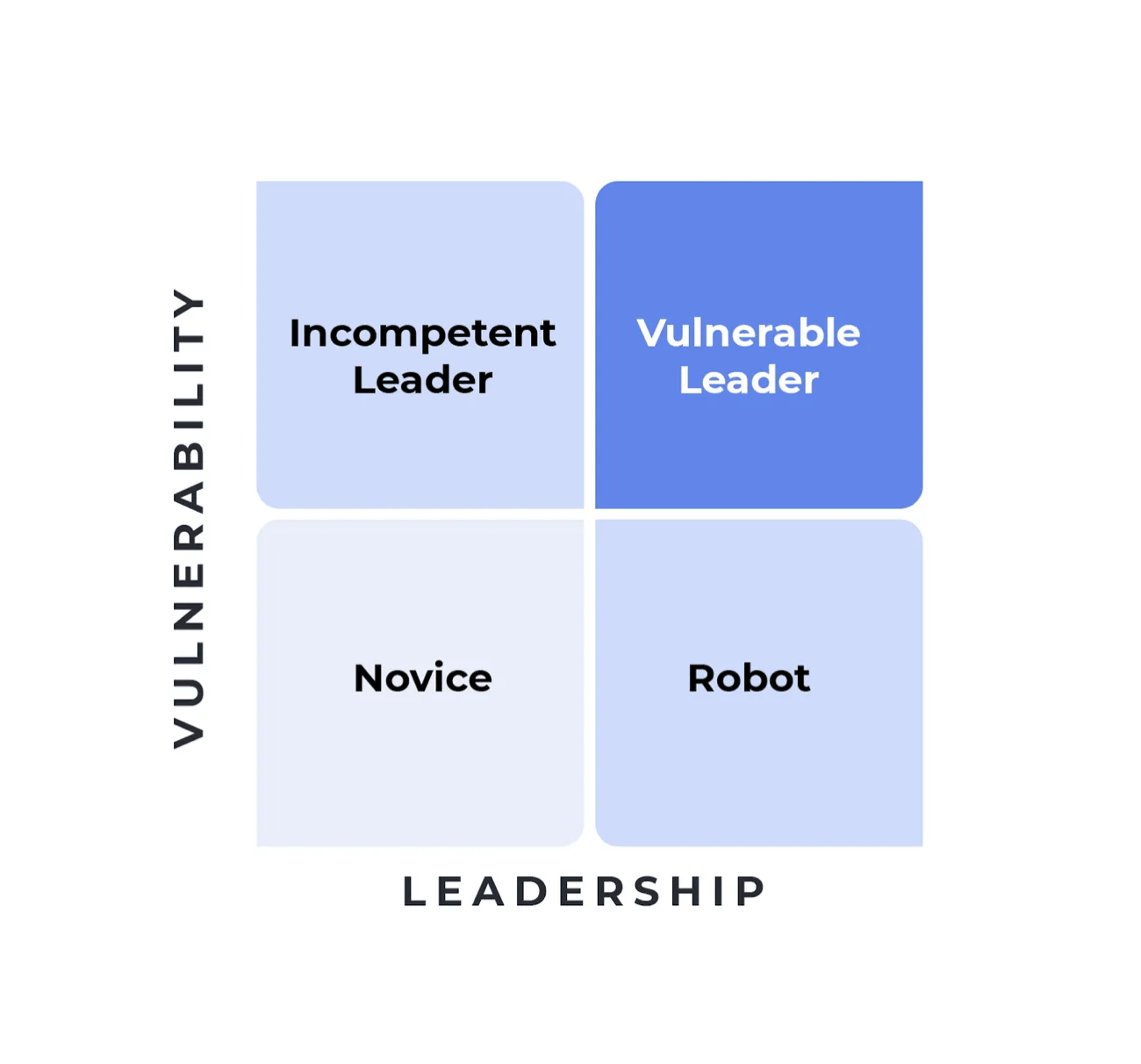
This is the relationship between leadership and vulnerability or competence and connection. Leaders need both.

Take a look at the following quadrant. vulnerability quadrants

The novice is someone who is either new in their leadership journey or someone who isn’t a leader yet. Therefore they have not yet established their leadership or vulnerability. The path they take here will determine what kind of a leader they end up as.

The robot is someone who is effective in leadership yet struggles with vulnerability. These can be thought of as more stereotypical leaders who got to where they are by focusing more on competence instead of connection.

The incompetent leader is someone who is vulnerable yet struggles with leadership. Perhaps this leader was once quite competent but then stopped learning and growing after becoming a leader. Another possibility is that this person became a leader simply by navigating through office politics and bureaucracy. They are good at the human aspects of work but should not be in a position where they are leading others. 

The vulnerable leader is someone who combines the elements of vulnerability and leadership to achieve positive change and outcomes. These are the leaders who are both good at their jobs and can connect with their people on a human level. 

Today you need both vulnerability and leadership to be successful.

Most of the literature and research out there does not address the potential of leadership when vulnerability is approached in the right way. 

Inside of organizations it’s clear that vulnerability alone is not enough to achieve the desired outcomes of the individuals, the team, or the business. Vulnerability is not always a good thing at work, especially if you are not highly competent at your job. Vulnerability for leaders is not the same as it is for everyone else.

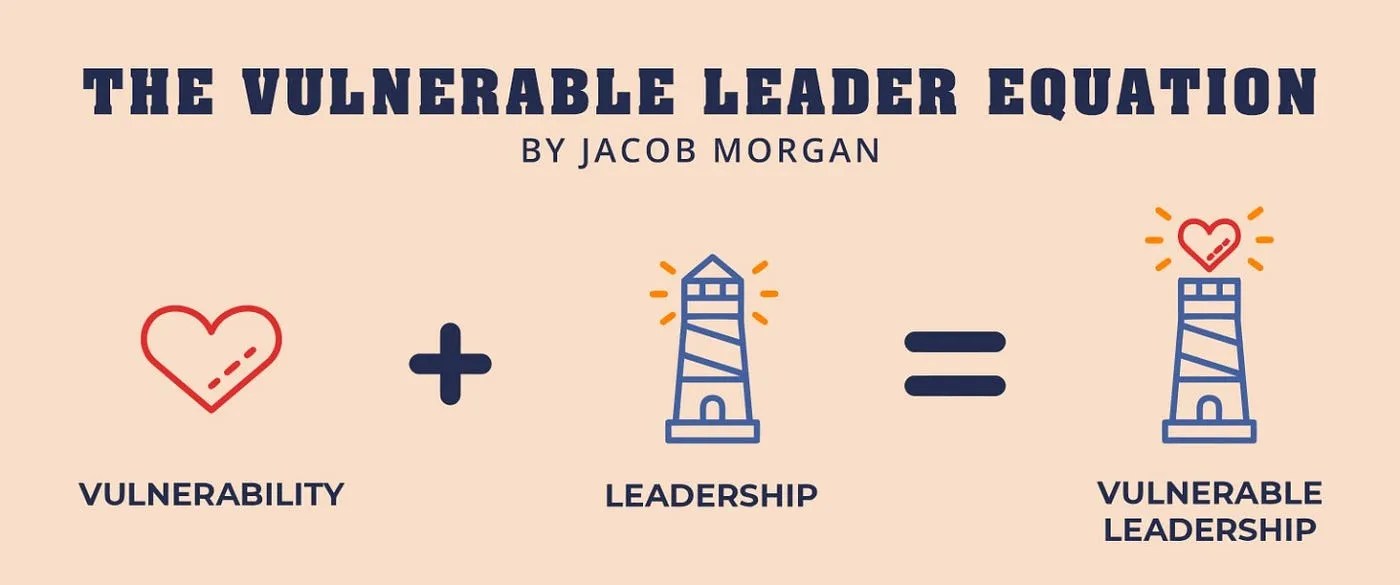
The solution is what I call The Vulnerable Leader Equation, which you can see below.

vulnerable leader equation

Leadership + Vulnerability = Leading With Vulnerability.

Whenever you are in a situation where you feel vulnerable or when you know vulnerability will be present, ask yourself, “What can I do to add leadership to the equation?”

This will be the best thing that you can do for your own career and everyone around you.

To learn more and discover how to put this into action, you can grab a copy of Leading With Vulnerability. 

jacob morgan bookJacob Morgan is the international best-selling author of 5 books including his most recent book, Leading With Vulnerability. He is also a keynote speaker, and professionally trained futurist. His passion and mission is to create great leaders, engaged employees, and future-ready organizations.

Did you enjoy this post? If so, I highly encourage you to take about 30 seconds to become a regular subscriber to this blog. It’s free, fun, practical, and only a few emails a week (I promise!). SIGN UP HERE to get the thoughtLEADERS blog conveniently delivered right to your inbox!

https://i0.wp.com/www.thoughtleadersllc.com/wp-content/uploads/2023/10/20231005-Three-Businesswomen.jpg?fit=1910%2C1276&ssl=1 1276 1910 Trevor Jones https://www.thoughtleadersllc.com/wp-content/uploads/2022/04/logo.png Trevor Jones2023-10-05 08:02:042023-10-05 03:25:23Why Vulnerability Can Hurt You At Work

The Importance of Celebrating Success

October 4, 2023/0 Comments/in Business Toolkit, Career, Leadership, Project Management, Strategy /by Trevor Jones

confetti

Success and failure are part of running a team day to day. You need to recognize and promote wins, because it’s going to build momentum for the team and make them feel like they’re accomplishing great things. 

There are a lot of great ways to acknowledge success. You can give people bonuses, provide them visibility opportunities, maybe do some public recognition, give people increased responsibilities, and even promotions. And all of those are very effective ways to celebrate success of your team members. But remember, just because you think something is valuable doesn’t mean the team member will. You need to understand what personally motivates them and then reward them accordingly. Because if you’re not thoughtful about it, something you think as a reward is going to be horrible from that person’s perspective.

For example, if you have somebody on your team who is very introverted and you decide that you’re going to take their success and celebrate it by putting that person on stage in front of a large audience, that introvert might really hate that situation, and they’ll feel very uncomfortable. And even though you thought you were rewarding them and celebrating their success, you’ve turned it into a bad experience.

Or, for example, you have somebody who’s very happy in their current role. They like their level of responsibilities because it allows them to have a proper work-life balance. You decide they’re doing such a great job and you want to celebrate that success, so you’re going to give them a promotion with more responsibilities. Now they’re pulling their hair out and they’re very stressed out and unhappy because they really enjoyed their old role. That promotion isn’t a way to celebrate success. It’s actually a punishment.

So as you’re thinking about celebrating success for your people, put yourself in their shoes and ask, “What would that individual really value?” Be sure that you communicate that success to the rest of the team. It helps build momentum and creates a culture of winning among those team members. People will feel proud to be associated with their teammates who are doing such great things.

Want to learn more about building high-performing teams? How about taking an entire course on it? Check out the video below to learn more about the course and get started. Or you can go directly to the course and start learning how to build high-performing teams. The entire course is available at LinkedIn Learning. Enjoy!

Did you enjoy this post? If so, I highly encourage you to take about 30 seconds to become a regular subscriber to this blog. It’s free, fun, practical, and only a few emails a week (I promise!). SIGN UP HERE to get the thoughtLEADERS blog conveniently delivered right to your inbox!

https://i0.wp.com/www.thoughtleadersllc.com/wp-content/uploads/2023/10/20231004-Confetti.jpg?fit=1920%2C1512&ssl=1 1512 1920 Trevor Jones https://www.thoughtleadersllc.com/wp-content/uploads/2022/04/logo.png Trevor Jones2023-10-04 06:32:422023-10-04 00:05:29The Importance of Celebrating Success
Page 16 of 46«‹1415161718›»

Get free blog posts by email NOW!

It’s the best 5 minutes a week you can spend on your development.

Subscribe HERE!

Get new posts FREE via RSS!
Follow thoughtLEADERS on LinkedInFollow thoughtLEADERS on twitter
This site contains affiliate links to products. We may receive a commission for purchases made through these links.
 

Check Out Our Courses

Our courses teach immediately applicable skills that have real impact on your business. From leadership to strategy and negotiation to conflict resolution, we have a broad set of course offerings that will drive immediate performance improvements.
OUR COURSES

Our Courses

Group of Business People Meeting
Puzzle Pieces
Glasses Looking Over Cityscape
Doors on a Wall
Cog Wheels
Man Reading Book
Fishing hook in the sea
Microphone in Lecture Hall
Charts on Blue Background
Wristwatch
Exploding Light Bulb
Man on Summit of Mountain
Lightning Bolts
Man Painting the Word Change on a Wall
Construction Cranes
Plant Growing in a Hand
High Performance Gears
Men Shaking Hands Closeup
Influence Definition
Sailboat at Sunset
Hanging light bulbs with glowing one isolated on dark blue background
Wagon Wheel
Risk
Strategic Client Engagement
Strategic Business Planning
Advanced Meeting Leadership
Building a Growth Mindset
Executive Communications
Structured Problem Solving
Creating Leadership Maxims
Leading inside the Box
Deliberate Decision Making
Simple Strategic Planning
Storytelling for Leaders
Storytelling for Sales
Executive Presence
Principles of Chart Design
Time Management Mastery
Breakthrough Innovation
Leadership Resilience
Conflict Resolution
Leading through Change
Project Management Reality
Coaching for Impact
High Performing Teams
Everything is Negotiable
Leading with Influence
Building Personal Resilience
thoughtLEADERSHIP
Engagement Management
Risk Management
Client Engagement
Strategic Business Planning
Advanced Meeting Leadership
Building a Growth Mindset
previous arrow
next arrow
 

eLearning Courses on TITAN

Structured Thought: Problem Solving
Puzzle Pieces
Structured Thought: Problem Solving

Clearly define a problem, scope all issues related to the problem, generate potential solutions, then analyze and select the best solution by using time-tested critical thinking methods and tools.

VIEW COURSE
Structured Thought and Communication
Group of Business People Meeting
Structured Thought and Communication

Craft clear and compelling recommendations that resonate with stakeholders. Get your ideas approved by using a proven method for delivering executive-level communications.

VIEW COURSE
Principles of Chart Design
Different Types of Line and Bar Charts
Principles of Chart Design

Create well-designed presentation charts that get your message across quickly and clearly to drive your audience to action. From data charts to concept charts, these methods help make your point.

VIEW COURSE
Engagement Management
Wagon Wheel
Engagement Management

Whether you’re an internal or external consultant or a project leader, learn proven methods, techniques, and processes to effectively lead consulting engagements that drive your client’s success.

VIEW COURSE
Strategic Business Planning
Cog Wheels
Strategic Business Planning

Use a straightforward and effective strategic planning process that shows how to craft a clear, compelling plan for your organization - not just one time, but on an ongoing basis year after year.

VIEW COURSE
Deliberate Decision Making

Make better, faster, and more effective decisions. Apply simple yet powerful decision making tools to define decision authority, manage risk, increase accountability, and drive execution.

VIEW COURSE
Everything is Negotiable
Men Shaking Hands
Everything is Negotiable

Become a better negotiator in all situations – from day to day interactions to hammering out large deals. Build the skills required to get what you want and strengthen relationships while you do.

VIEW COURSE
Breakthrough Innovation
Exploding Lightbulb
Breakthrough Innovation

Generate and select unique strategies that separate you from the competition. Construct bold and disruptive solutions then build and execute a plan for taking those strategies to market.

VIEW COURSE
Storytelling for Leaders
Man reading stories from a book
Storytelling for Leaders

Create business stories that inspire people, build connections with your audience, and ultimately advance your organization's goals by using a repeatable, straightforward method.

VIEW COURSE
Storytelling for Salespeople

Create and deliver stories that will take your sales efforts to the next level. Connect with and convince buyers in all situations using memorable stories. These stronger relationships drive more sales.

VIEW COURSE
Leading through Change

Lead your organization through the most challenging times using a proven change management process. Get people through the change and back to driving performance quickly and effectively.

VIEW COURSE
Building Leadership Resilience
Mountain Climbing Expedition
Building Leadership Resilience

Prepare your body and brain to be ready for and recover from your biggest challenges. Build approaches for overcoming stress, managing reactions to difficult events, and leading more effectively.

VIEW COURSE
Compelling Executive Presence

Build your ability to connect with your audience and convey your ideas in a clear and resonant way. Create meaningful connections between you and your audience to build buy-in.

VIEW COURSE
Coaching for Impact
Plant Growing in a Hand
Coaching for Impact: Foundation Course

Coach employees for performance and development more effectively by helping them identify and pursue their own solutions. Create the right environment and conditions to help them grow.

VIEW COURSE
Building Personal Resilience
Boat at Sunset
Building Personal Resilience

Build the habits and learn the behaviors required to manage stress, deal with adversity, and maintain your physical and mental wellbeing. Personal resilience is a key to your ongoing success.

VIEW COURSE
Time Management Mastery
Watches
Time Management Mastery

Learn techniques to manage your time, delegate, say “no,” and be more efficient. Balance your limited supply of time with the overwhelming demands that are placed on you every day.

VIEW COURSE
previous arrow
next arrow

Books You MUST Read

The Elegant Pitch
One Piece of Paper by Mike Figliuolo
Lead Inside the Box
10 Stories Great Leaders Tell
Getting Ahead
Sell with a Story
Lead with a Story
Mastering Communication at Work
The Hook
Innovative Leadership Fieldbook
Innovative Leaders Guide to Transforming Organizations
The Three Commitments of Leadership
The Littlest Green Beret
Storytelling in the Land of Oz
The Camino Way
Hiring Veterans
Disability is Human book
Race to Innovation
The Emergent Leader
Business is Simple
Business is Simple
The Elegant Pitch
One Piece of Paper by Mike Figliuolo
Lead Inside the Box
10 Stories Great Leaders Tell
Getting Ahead
Sell with a Story - Border
Lead with a Story
Leading from Your Best Self
Mastering Communication at Work
The Hook
Innovative Leadership Fieldbook
Innovative Leaders Guide to Transforming Organizations
20120318 Three Commitments
Leadership Vertigo
The Littlest Green Beret
Storytelling in the Land of Oz
The Camino Way
Hijacked by Your Brain
Outthink the Competition
Driving Innovation from Within
Hiring Veterans
Disability is Human
Race to Innovation
The Emergent Leader
Business is Simple
Global Mindset
previous arrow
next arrow
  • The Elegant Pitch
  • Disability is Human
  • Hiring Veterans
  • Race to Innovation
  • The Emergent Leader
  • Business is Simple
  • Global Mindset

Categories

This site contains affiliate links to products. We may receive a commission for purchases made through these links.

Our Course Offerings

Leadership Skills

Creating Your Leadership Maxims
Leading Inside the Box
Leading With Influence
Leading Through Change
Structured Problem Solving
Deliberate Decision Making
High Performing Teams
Simplified Strategic Planning
Strategic Business Planning
Coaching for Impact: Foundations
Coaching for Impact: Applications
Building Leadership Resilience
Engagement Management
Project Management Reality
Risk Management

Communication Skills

Communications: Foundations
Communications: Applications
Principles of Chart Design
Strategic Client Engagement
Storytelling for Leaders
Storytelling for Salespeople
Compelling Executive Presence
Advanced Meeting Leadership

Individual Skills

Conflict Resolution
Everything is Negotiable
Building a Growth Mindset
thoughtLEADERSHIP: Innovation
Building Personal Resilience
Time Management Mastery

Coaching & Consulting

©2026 thoughtLEADERS, LLC: Leadership Training for the Real World. thoughtLEADERS, LLC is a registered trademark of thoughtLEADERS, LLC.
  • Privacy Policy
  • Terms of Use
  • Cookie Policy
Scroll to top