


Why Vulnerability Can Hurt You At Work

Vulnerability in our personal lives is not the same as it is at work, and vulnerability for leaders is not the same as it is for everyone else.
Today’s guest post is by Jacob Morgan, author of Leading with Vulnerability: Unlock Your Greatest Superpower to Transform Yourself, Your Team, and Your Organization (CLICK HERE to get your copy).
We all know what vulnerability is because we have all at some point in our lives felt vulnerable, which according to Brené Brown is the feeling of risk, uncertainty, and emotional exposure. In our personal lives, the value of vulnerability is clear; it’s what allows us to create connections and relationships.
But what about at work? Does vulnerability play a role there where we have a very different dynamic of hierarchy, bosses, customers, employees, deadlines, projects, and money? And what about for leaders? Is vulnerability for them the same as it for everyone else?
To find out, I interviewed over 100 CEOs around the world from companies like American Airlines, GE, Edward Jones, Best Buy, Dow Chemical, and many others. I also teamed up with leadership firm DDI to survey around 14,000 employees. All of this was put together in my brand new book, Leading with Vulnerability: Unlock Your Greatest Superpower to Transform Yourself, Your Team, and Your Organization.
It’s clear that vulnerability in our personal lives is not the same as it is at work, and vulnerability for leaders is not the same as it is for everyone else. In fact, for leaders, vulnerability can actually cause more harm than good!
To understand why this is the case, consider why you were hired in your current role. You were hired because you have a set of capabilities, skills, and talents to do a job that the company needed help with. So what happens if after you get the job you show up to work each day talking about your mistakes, challenges, failures, and feelings? At some point those around you are going to say, “Maybe this isn’t a good fit.”
Vulnerability on its own is not the right approach. Instead, leaders (and all of us for that matter) need to combine vulnerability with leadership. You can think of vulnerability as exposing a gap, whereas leading with vulnerability is about exposing a gap and then demonstrating how you are trying to close that gap. For example, it’s the difference between saying “I’m sorry I made a mistake” versus, “I’m sorry I made a mistake, but here’s what I learned and here are three things I’m going to do in the future to make sure that mistake never happens again.”
This is the relationship between leadership and vulnerability or competence and connection. Leaders need both.
Take a look at the following quadrant. 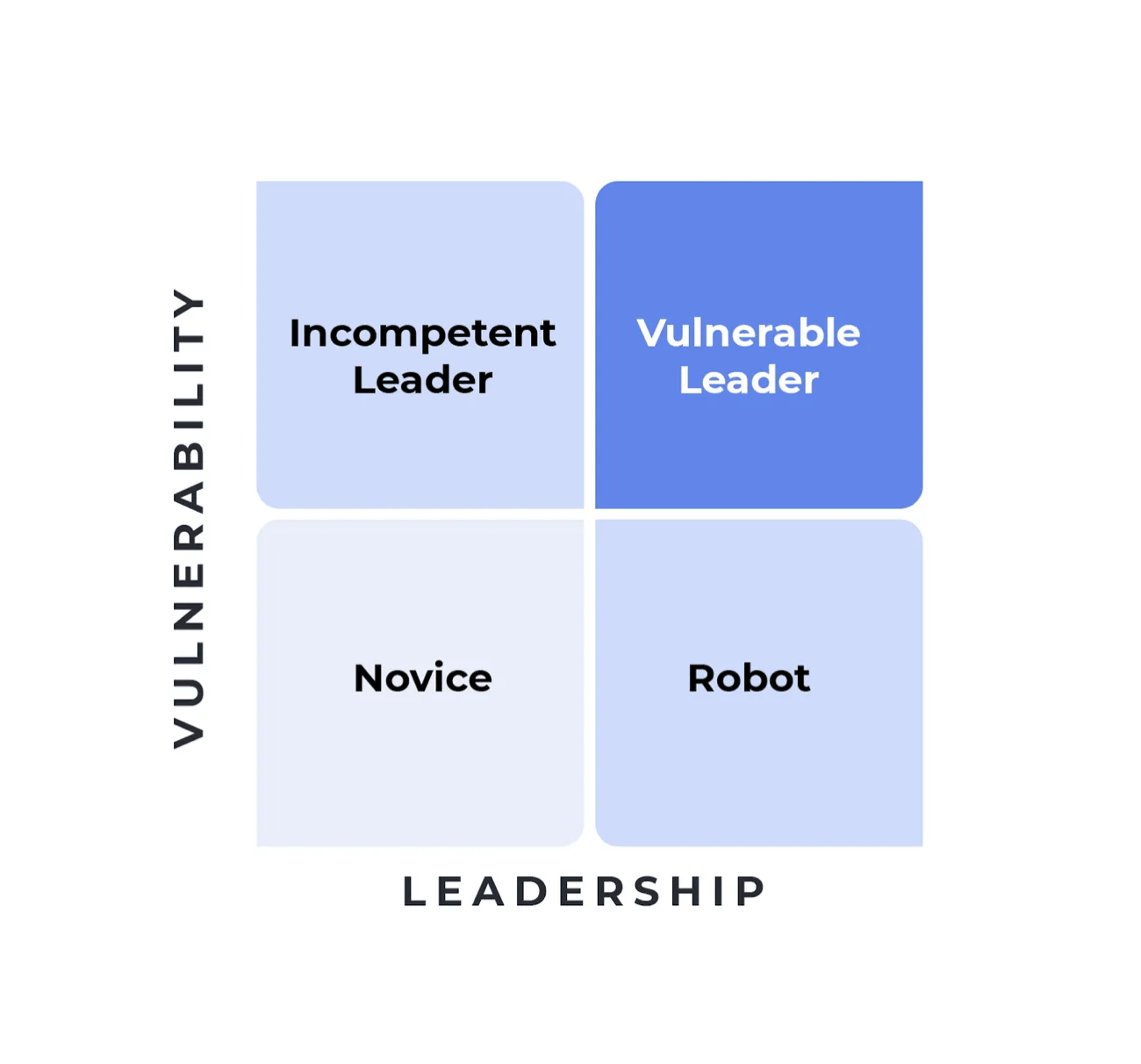
The novice is someone who is either new in their leadership journey or someone who isn’t a leader yet. Therefore they have not yet established their leadership or vulnerability. The path they take here will determine what kind of a leader they end up as.
The robot is someone who is effective in leadership yet struggles with vulnerability. These can be thought of as more stereotypical leaders who got to where they are by focusing more on competence instead of connection.
The incompetent leader is someone who is vulnerable yet struggles with leadership. Perhaps this leader was once quite competent but then stopped learning and growing after becoming a leader. Another possibility is that this person became a leader simply by navigating through office politics and bureaucracy. They are good at the human aspects of work but should not be in a position where they are leading others.
The vulnerable leader is someone who combines the elements of vulnerability and leadership to achieve positive change and outcomes. These are the leaders who are both good at their jobs and can connect with their people on a human level.
Today you need both vulnerability and leadership to be successful.
Most of the literature and research out there does not address the potential of leadership when vulnerability is approached in the right way.
Inside of organizations it’s clear that vulnerability alone is not enough to achieve the desired outcomes of the individuals, the team, or the business. Vulnerability is not always a good thing at work, especially if you are not highly competent at your job. Vulnerability for leaders is not the same as it is for everyone else.
The solution is what I call The Vulnerable Leader Equation, which you can see below.
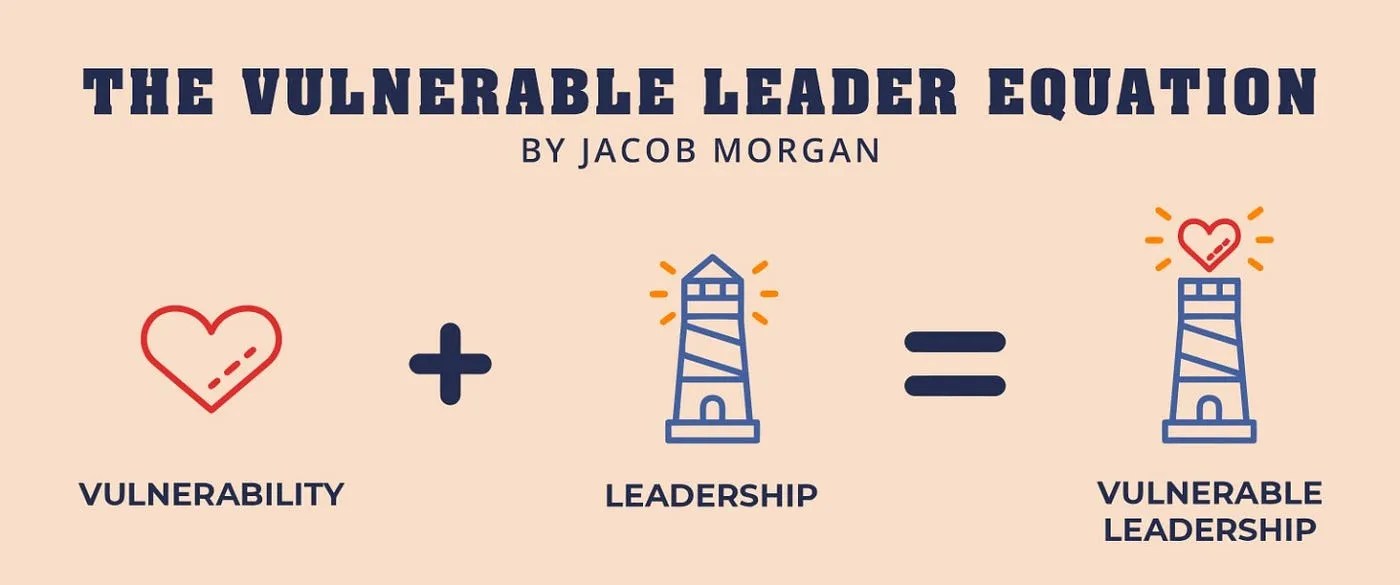
Leadership + Vulnerability = Leading With Vulnerability.
Whenever you are in a situation where you feel vulnerable or when you know vulnerability will be present, ask yourself, “What can I do to add leadership to the equation?”
This will be the best thing that you can do for your own career and everyone around you.
To learn more and discover how to put this into action, you can grab a copy of Leading With Vulnerability.
 Jacob Morgan is the international best-selling author of 5 books including his most recent book, Leading With Vulnerability. He is also a keynote speaker, and professionally trained futurist. His passion and mission is to create great leaders, engaged employees, and future-ready organizations.
Did you enjoy this post? If so, I highly encourage you to take about 30 seconds to become a regular subscriber to this blog. It’s free, fun, practical, and only a few emails a week (I promise!). SIGN UP HERE to get the thoughtLEADERS blog conveniently delivered right to your inbox!


This is a great article! I have been embracing vulnerability in my personal life and struggled with how to do the same at work. So far, I don’t think I’ve lost ground, but I definitely don’t want to be so vulnerable that I lose the respect of those I lead. Vulnerability has served to strengthen my connection with my team, especially in a hybrid work environment and I think it’s essential to engage people. However, I’m also starting to feel that oversharing or displaying too much emotion is a hindrance to leading by example. This was a great reminder and I’m considering getting the book to dive in deeper.