Your negotiation strategy can make or break a deal. Learning negotiation tactics is key to becoming a more strategic negotiator.
Over the years, I’ve learned some great negotiating techniques and tactics. I’d like to share them now.
The Invisible Man
The first is called The Invisible Man. You can use this technique when you’re in the heat of a deal and you don’t want to give an answer right now, or you don’t like the position that the other party is taking. You just say, “Well, I have to check with my colleagues before I can give you an answer.” That other party isn’t in the room, so you’ve pushed back the negotiation. You’ve bought yourself some time, and now you have the ability to go back to the other party and say, “I know you wanted a 20% discount, but I’ve spoken with my colleagues and the best we can do is 10%.” You’ve created an invisible authority that the other party has to negotiate against. Read more
https://i0.wp.com/www.thoughtleadersllc.com/wp-content/uploads/2024/09/20240904-Number-6.jpg?fit=1920%2C1280&ssl=112801920Trevor Joneshttps://www.thoughtleadersllc.com/wp-content/uploads/2022/04/logo.pngTrevor Jones2024-09-04 06:30:102024-09-04 01:30:126 Negotiation Techniques to Add to Your Playbook
It doesn’t make sense to try to manage every possible risk. Learn how to identify and focus on the most dangerous risks you face.
Today’s guest post is by Kim Wasson, a principal at thoughtLEADERS where she teaches our course on Risk Management.
If you’ve completed your risk brainstorming session you might have an extensive list of risks. It doesn’t make sense to try to manage every possible risk, especially the ones that are small or unlikely, so it’s important to figure out which ones are the most dangerous and focus on those.
To home in on the ones you want to address, look at two factors: Probability and Impact. Each risk on your list has a value for these two factors.
Probability is the likelihood that the risk will come to pass. It’s expressed as a percentage, from 0-100%. Your next step is to estimate the probability of each of the risks on your list. Don’t stop there though – something with a high probability still might not be worth the time and resources to address.
Impact is a measure of how bad it will be if the risk is realized. You can choose your measure of impact – as long as the measure is used consistently it will work. Many organizations use T-shirt sizes for risk – Small/Medium/Large. Some use a numeric scale – 1 to 10 where 10 is catastrophic and 1 is an inconvenience. And some make up their own – like Inconvenient, Difficult, Awful, Catastrophic. Use whatever makes sense to your organization to really understand what will happen if this risk comes to pass.
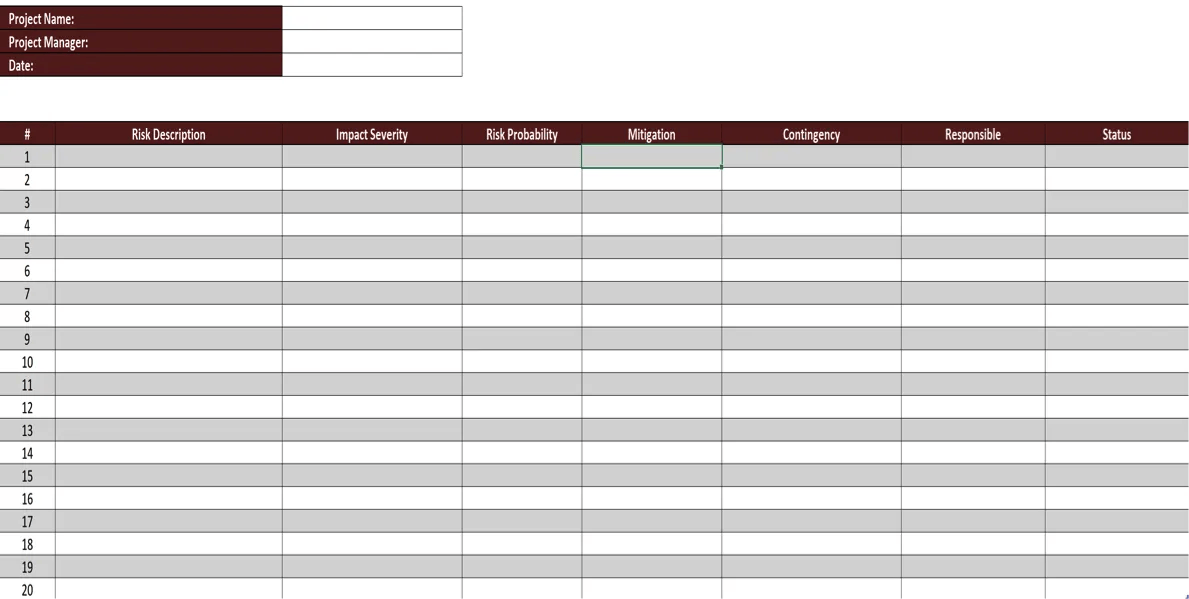
Now that you have some additional information on the risks, you’ll want to put them in what’s called a Risk Register. Typically these are spreadsheet type lists and they look something like this:
To start your risk log, put each risk identified in your brainstorming session on a line in the risk register. Even those that you decide you’re not really worried about should go in here – conditions change and you’ll want a reminder in case you need to reconsider whether you need to address something that previously wasn’t a problem.
Once you’ve loaded up your risk list determine the Probability and Impact of each risk.
Now that you have all of this information, decide which of the risks you want to track. You may want to try to either make the probability and/or impact less or create a plan in case the risk comes to pass (we’ll cover that in a later blog), but note which ones you’re going to track and who (‘responsible’) is going to be looking at them. You might even want to move the ones you’re not going to worry about – at least right now – into another section of the risk log.
Now you have a focus. Knowing which risks are the most potentially troublesome will help you use your resources wisely while still being prepared for trouble.
Did you enjoy this post? If so, I highly encourage you to take about 30 seconds to become a regular subscriber to this blog. It’s free, fun, practical, and only a few emails a week (I promise!). SIGN UP HERE to get the thoughtLEADERS blog conveniently delivered right to your inbox!
https://i0.wp.com/www.thoughtleadersllc.com/wp-content/uploads/2024/08/20240827-Danger-Sign.jpg?fit=1920%2C1280&ssl=112801920Trevor Joneshttps://www.thoughtleadersllc.com/wp-content/uploads/2022/04/logo.pngTrevor Jones2024-08-28 06:30:202024-08-27 17:46:30Focusing on the Biggest Risks
Learn the four decision-making styles and the factors that influence which style will be best for your situation.
When you make decisions, there are four decision-making styles that you can use. There’s an autocratic style, a participatory one, a democratic style, and a consensus-based decision-making style. Your choice of which of those four styles to use is driven by two factors.
The first factor is the urgency of making the decision. From low urgency (you’ve got plenty of time to make the call) to high urgency (we need a decision right now). The second dimension to consider is the size or impact of the decision, from small decisions that won’t have a large impact to big decisions that are going to have a huge impact. As you look at which style of decision-making to use, you need to consider both of these dimensions. Read more
https://i0.wp.com/www.thoughtleadersllc.com/wp-content/uploads/2024/08/20240816-Red-Door.jpg?fit=1920%2C1024&ssl=110241920Trevor Joneshttps://www.thoughtleadersllc.com/wp-content/uploads/2022/04/logo.pngTrevor Jones2024-08-21 06:30:562024-08-16 22:32:57Choosing a Decision-Making Style
Learn about four of the most common obstacles to creating a high-performance culture and how to overcome them.
You’ll face many common obstacles on your path to building a high-performance culture. Legacy culture issues, associates who resist the new culture, and processes or behaviors that don’t yet exist are going to slow you down. You need to work through these counter-culture moments and issues if you’re looking to change the overall culture of the organization. The more aware you are of what these pitfalls are, the more quickly you’re going to be able to overcome them.
Legacy culture issues
One of the four most common pitfalls I see is the legacy culture. “This is the way we’ve always done things.” Read more
https://i0.wp.com/www.thoughtleadersllc.com/wp-content/uploads/2021/12/20211208-Stone-Obstacle.jpg?fit=1920%2C1280&ssl=112801920Trevor Joneshttps://www.thoughtleadersllc.com/wp-content/uploads/2022/04/logo.pngTrevor Jones2024-08-14 06:30:492024-08-14 00:19:19Overcoming Obstacles to Creating a High-Performing Culture
One of the first steps you can take to create a high-performing culture is to assess what is and isn’t working in your current culture.
An assessment of your current culture gives you an understanding of the starting point for your journey toward building a high performance culture. This assessment includes evaluating what your current culture stands for, how people behave, and the incentives you have in place to drive behavior. Defining and explaining your culture can be difficult. It’s an intangible set of behaviors and a general feeling of what it’s like to be part of the organization. Identifying when people are or are not behaving in a manner consistent with your culture is an important element of assessing the culture you have. Let’s look at what goes into one of these cultural assessments. You need to ask yourself several questions. Read more
https://i0.wp.com/www.thoughtleadersllc.com/wp-content/uploads/2021/11/20211117-Office-Group.jpg?fit=1920%2C1280&ssl=112801920Trevor Joneshttps://www.thoughtleadersllc.com/wp-content/uploads/2022/04/logo.pngTrevor Jones2024-08-07 06:32:532024-08-06 03:13:34Assessing Your Organization’s Current Culture
Knowing the behaviors you want from your team and how they link to results is one of the keys to creating a strong culture.
Leaders who create a strong culture of outstanding performance will find that performance strengthens their culture. By strengthening the culture, the likelihood of better results and performance increases. This is known as a virtuous circle.
You need to be careful though—the dynamic works in the opposite direction as well. Bad behavior begets bad performance, which leads to more bad behavior, and ultimately a bad culture. I know one senior executive who always used to ask people, “How much money have you made me today?” That simple question flowed through all the behaviors in the organization. Everyone focused on financials, but it was at the expense of creating a great culture.
Let me share an example of how to build a virtuous circle. Read more
https://i0.wp.com/www.thoughtleadersllc.com/wp-content/uploads/2024/07/20240723-Ripples.jpg?fit=1920%2C1440&ssl=114401920Trevor Joneshttps://www.thoughtleadersllc.com/wp-content/uploads/2022/04/logo.pngTrevor Jones2024-07-31 06:30:402024-07-30 02:54:06Building a Virtuous Circle in Your Organization
Adaptability can propel your career with confidence and resilience by helping you learn how to be comfortable in changing environments and pivot quickly.
Today’s job market is characterized by rapid technological advancements, globalization, and shifting market demands, leading to constant changes. In this environment, the ability to adapt has transitioned from a desirable soft skill to an essential one.
Employers are increasingly seeking professionals who can navigate and excel in evolving circumstances. The phrase “what got you here won’t get you there” is far more relevant today than ever before. Skills that were valuable yesterday may become obsolete tomorrow. Understanding the significance of adaptability in this context is crucial for individuals looking to secure a strong foothold in the competitive job market.
Understanding adaptability and why it’s important
Adaptability in the modern workplace goes beyond mere flexibility; it means being able to respond dynamically to ever-evolving demands. Adaptability encapsulates the ability to swiftly pivot strategies, anticipate and embrace emerging trends, and capitalize on unexpected opportunities.
Within the fast-paced landscape of modern work environments, where technological innovations disrupt industries and globalization reshapes market dynamics, adaptability becomes a key indicator for success. Today’s professionals must possess the technical expertise relevant to their roles as well as the agility to navigate uncertainty and rapid change.
To be truly adaptable, one must go beyond just embracing change; it requires a deep understanding of oneself and others. Emotional intelligence plays a crucial role in this process. It’s about being attuned to one’s own emotions and those of others, recognizing how they influence thoughts and behaviors.
With emotional intelligence, individuals can navigate uncertainties with greater resilience, communicate effectively across diverse teams, and build stronger relationships. By integrating emotional intelligence into the mindset of adaptability, professionals not only develop the agility to face challenges but also the empathy to understand and support others through change.
In today’s dynamic workplace, where unpredictability is the norm, emotional intelligence becomes not just a soft skill but a strategic advantage for sustained career growth and success. By embracing change and proactively seeking opportunities for growth, adaptable professionals position themselves as invaluable assets to their employers. Additionally, this quality fosters a culture of resilience within teams and organizations, enabling them to weather storms and emerge stronger on the other side.
It is no wonder that in these changing times, employers increasingly prioritize adaptability when evaluating candidates, recognizing it as critical in fostering resilience and innovation within their organizations.
Strategies to stay resilient
To succeed in today’s dynamic job market, one must possess the resilience necessary to navigate uncertainties, embrace change, and emerge stronger. Here are some practical strategies to bolster your resilience and ensure the longevity of your career:
Embrace lifelong learning: Stay at the forefront of your field by consistently refreshing your skills and knowledge, and proactively pursuing avenues for professional growth, be it through online courses, workshops, or industry gatherings. Embracing a mindset of lifelong learning not only boosts your adaptability but also enriches your skill repertoire, rendering you an increasingly indispensable asset to potential employers.
Cultivate a growth mindset: Adopt a mindset that views challenges as opportunities for growth rather than obstacles to success. Embrace setbacks as learning experiences and focus on what you can control rather than dwelling on what you cannot. By reframing adversity as a chance to learn and improve, you’ll build the resilience needed to bounce back from setbacks even stronger.
Identify your support network: Surround yourself with a diverse network of colleagues, mentors, and peers who can provide guidance, encouragement, and support during challenging times. Lean on your network for advice, feedback, and perspective, and be willing to offer support in return. Building strong relationships within your professional community can provide a valuable safety net during periods of uncertainty.
Practice self-care: Prioritize your physical, mental, and emotional well-being to ensure you have the resilience to cope with stress and adversity. Make time for activities that nourish your body and soul, such as exercise, meditation, hobbies, and spending time with loved ones. Taking care of yourself allows you to recharge and approach challenges with renewed energy and perspective.
Stay agile and flexible: Remain adaptable in the face of change by staying open-minded and flexible in your approach to work, willing to pivot quickly when circumstances demand it, and seizing opportunities as they arise. Embracing change rather than resisting it allows you to position yourself as a proactive problem-solver who can thrive in any environment.
By adopting these strategies, you can cultivate the resilience necessary to confidently navigate the complexities of today’s job market. Rather than feeling daunted by challenges, you’ll be empowered to embrace them, fostering growth, and achieving success even during adversity.
Standing out and advancing
Mastering adaptability sets apart individuals in today’s job market by propelling them toward accelerated career advancement. By cultivating a mindset of flexibility and resilience, professionals position themselves as indispensable assets within their organizations. Those who confidently navigate uncertainty and embrace change as an opportunity for growth are often entrusted with greater responsibilities and leadership roles.
Remaining agile and open to new possibilities allows professionals to identify emerging trends, capitalize on shifting market dynamics, and innovate in ways that drive organizational success. As a result, they often find themselves at the forefront of industry advancements, shaping the future rather than merely reacting to it.
In addition to enhancing individual career prospects, mastering adaptability contributes to a culture of innovation and progress within organizations. Teams comprised of adaptable individuals are better equipped to tackle complex challenges, adapt to changing circumstances, and deliver impactful results. Organizations will stay ahead of the competition and thrive in even the most turbulent times by fostering a culture that values adaptability.
Paul Bramson is widely regarded as one of the most impactful and gifted keynote speakers and trainers globally. He consistently delivers compelling talks and training workshops that leave a lasting impression. Paul is recognized as a thought leader in the areas of communication, leadership, and sales. He has over 25 years of experience inspiring all levels of professionals, leaders, and teams. Paul’s ability to captivate and entertain audiences stems from his genuine passion, unique talents, and commitment to being better.
Did you enjoy this post? If so, I highly encourage you to take about 30 seconds to become a regular subscriber to this blog. It’s free, fun, practical, and only a few emails a week (I promise!). SIGN UP HERE to get the thoughtLEADERS blog conveniently delivered right to your inbox!
https://i0.wp.com/www.thoughtleadersllc.com/wp-content/uploads/2024/07/20240701-Adapt-or-Fail.jpg?fit=1920%2C1440&ssl=114401920Trevor Joneshttps://www.thoughtleadersllc.com/wp-content/uploads/2022/04/logo.pngTrevor Jones2024-07-01 08:00:182024-07-01 01:12:31Why Adaptability Makes You an Asset in Today’s Job Market
Dr. Sam Adeyemi offers 7 tried-and-true guidelines to create a more trusting workplace.
Today’s guest post is by Dr. Sam Adeyemi, author of Dear Leader: Your Flagship Guide to Successful Leadership.
What if I told you at least 90% of executives think trust affects their bottom line? You probably wouldn’t be surprised.
But, what if I also told you that only 21% of U.S. employees strongly agree they trust their leadership? Then, you might start listening.
These are seven tried-and-true guidelines for creating a more trusting workplace.
1. Practice what you preach.
The question of authenticity is not a new one. In fact, while the phrase “practice what you preach” is often associated with the Holy Bible, its true origins go as far back as Ancient Rome. Playwright Titus Plautus is the source of many pithy pieces of wisdom, so it should come as no surprise that we can follow the “practice what you preach” sentiment from Plautus through the Book of Matthew to George Bernard Shaw.
You’ve given your team a vision, but they need something concrete. They need an example. Don’t assume your team members understand how to get there. Instead, demonstrate it to them everyday by holding yourself to the same standards you hope to carry into the future.
2. The team is your strength.
A worker ant doesn’t get much bigger than half an inch. Alone, they aren’t capable of much. But, their teamwork is frighteningly powerful. The largest ant colony in the world stretches over 3,700 miles, and invasive fire ants cost the United States over $6 billion per year. Needless to say, ants appreciate the power of teamwork.
A trusting workplace understands that teamwork is its source of strength. Micromanagement, on the other hand, is the opposite of such an ant-like mindset. Micromanagement sends a clear message that you do not trust your team to succeed in their assigned roles. Conversely, an ant puts faith in the fact that the team is always stronger together.
3. Fear is the mind-killer.
These are the most famous words from Frank Herbert’s Dune, an epic science fiction story about a feudal interstellar society. In the book, the words are a small portion of “The Litany Against Fear,” a meditative poem of sorts that tells us “fear is the little-death that brings obliteration.” In this sense, fear is seen as something that kills the spirit, and the denizens of this world call upon this poem to steel themselves in the face of their greatest dangers.
Did you know that 85% of executives believe fear stifles innovation within their organization? Did you know that “fear of criticism” is 1.5 times less likely at companies with an innovative identity? Your best ideas can come from anywhere. So you need a working culture that is designed to remove fear from the room and set a standard of open exchange.
4. Everyone needs a plan.
I visit quite a few educational organizations in my travels, and there is one cartoon I see pinned up almost everywhere I go. The cartoon features a mustachioed man sitting at a desk to administer a “fair” exam to a diverse group of animals. The exam is to climb a tree, and the classroom is home to everything from a monkey to a goldfish.
Believe it or not, this metaphor is even more suited for the business world than the classroom. While students might at least have a common objective in mind, all of your team members are charting different courses and driven by different levels of ambition. As such, a trusting workplace prioritizes highly personalized development plans for everyone that are the product of simple conversations.
5. Even you should evolve.
Jonathan Harker is one of the primary victims of Bram Stoker’s Dracula. He is the first to meet the Count, and his slow discovery of the evils within the castle likely inspires many readers to yell at the page: “Get out of there!” Still, it isn’t until Harker stands in front of a mirror that he gets a true glimpse of reality. The Count has no reflection, and he is in the presence of a monster.
Self-improvement is no easy task. As leaders, it can be difficult to take an honest look at ourselves in the mirror. But it is often this self-examination that allows us to notice the monsters that are battling against our employee morale. Look those monsters in the eye and remove them from your leadership.
6. Start actively listening.
Carl Rogers originally wrote about active listening in 1951. At the time, Rogers was part of a more humanistic approach to psychology. Unlike many of his predecessors, he believed unhappy people were not broken, they were simply blocked. According to Rogers, a large part of the therapy that aligned with this perspective was built on active listening — just really hearing the person in distress.
Of course, this is much easier said than done. The average individual only remembers around 50% of a conversation they just had, and it’s this sort of failure that erodes trust between a leader and their team. On the contrary, listening intently can build stronger relationships and grant you invaluable insights into what’s working and what isn’t.
7. Show appreciation at every turn.
Are you aware of the power behind positive reinforcement? B.F. Skinner used food to get pigeons to guide airborne missiles during World War II. Today’s scientists use treats and clickers to soothe pigs during more complex medical procedures. And your mom once used a raise in your allowance to get you to clean up your room more than usual.
Employees were asked during a study what motivates them to go “above and beyond” at their organization. Guess what? Three of the top five responses were some version of positive reinforcement. People want to be acknowledged for a job well done and doing so creates more positivity within the workplace. Intrinsic motivation has its place, but a successful leader understands creating a trusting working culture begins and ends with saying “thank you.”
Atlanta-based Dr. Sam Adeyemi (SAY: Ah Day yeh me) is CEO of Sam Adeyemi, GLC, Inc. and founder and executive director of Daystar Leadership Academy (DLA). More than 45,000 alumni have graduated from DLA programs, and more than 3 million CEOs and high performing individuals follow him on top social media sites. Dr. Sam’s new book is “Dear Leader: Your Flagship Guide to Successful Leadership.” He holds a Doctorate in Strategic Leadership from Virginia’s Regent University, and is a member of the International Leadership Association. He and his wife, Nike (say Nee keh) have three children. Learn more at SamAdeyemi.com.
Did you enjoy this post? If so, I highly encourage you to take about 30 seconds to become a regular subscriber to this blog. It’s free, fun, practical, and only a few emails a week (I promise!). SIGN UP HERE to get the thoughtLEADERS blog conveniently delivered right to your inbox!
https://i0.wp.com/www.thoughtleadersllc.com/wp-content/uploads/2024/06/20240623-Colosseum.jpg?fit=1920%2C1280&ssl=112801920Trevor Joneshttps://www.thoughtleadersllc.com/wp-content/uploads/2022/04/logo.pngTrevor Jones2024-06-24 08:00:342024-06-23 00:45:19From Ants to Ancient Rome: 7 Guidelines for a More Trusting Workplace
Every business venture carries risk. Kim Wasson describes five factors to consider when diving into risk management.
Today’s guest post is by Kim Wasson, a principal at thoughtLEADERS where she teaches our course on Risk Management.
You know that managing risk is important. You know that the difference between dismal failure and a simple adjustment can be as straightforward as being prepared. You’re ready to start wrestling with risks.
But – where do you start? How do you even know what the risks might be?
It’s hard to know what might ruin your beautiful plan if you don’t have a good grasp of what the plan really is. Before you dive into risk management, be sure you know what you’re aiming for in these five dimensions:
Schedule: When do you need to be done? Be as specific as possible. ‘ASAP’ is a vague and moving target, so avoid that one. If your schedule is ‘Second Quarter’, know whether that means April 1 or June 30. It can be helpful to have both an optimum date and a drop-dead date.
Cost: How much are you willing to spend? A big range isn’t helpful for this exercise, so be conservative and pick a number. Cost can be in dollars, person-time/effort, equipment, anything that can translate to the price tag.
Output: What do things look like when you’re done? If you’re creating a product, what does it do, how big is it, what does it look like? If it’s an event, what is the runtime, décor, speakers, music, food – anything that has to do with what comes from your effort.
Quality: Quality often gets lost in the shuffle – moved aside to be sure the other goals are met. That’s not good news. Your first instinct may be to say you want absolute quality – probably realistic if you’re creating a medical device, but not so much for a recruiting event or a business software product.
Intangibles: There may be things that don’t fit into the other four goals, things like reputation. It may help to think of these in the reverse as well – what could be affected if we don’t make our other goals?
Now you have a plan to work with.
First, go through the plan yourself and ask yourself what could go wrong that could keep you from reaching each one of your goals. What could make the project late? (Rain? Freeway accidents? Resources not available? I’ll be honest with you, ‘pandemic’ wasn’t on anyone’s risk list a few years ago, but it does show up fairly often now) What could end up costing more? (Gas prices go up, resources are more expensive, the scope of the project increases) . Do this for each of the five areas and you’ll have a starter list.
Once you have your own initial list, hold a brainstorming session with folks who have knowledge about the plan and experience in what could go wrong. Don’t show your own list to this group until after you’re done brainstorming – it will help make the final list complete.
After your brainstorming session you may have a large and somewhat scary list of things that could go wrong. In the next blog post, we’ll help you pare down the list to the risks that make sense to address and track.
Did you enjoy this post? If so, I highly encourage you to take about 30 seconds to become a regular subscriber to this blog. It’s free, fun, practical, and only a few emails a week (I promise!). SIGN UP HERE to get the thoughtLEADERS blog conveniently delivered right to your inbox!
https://i0.wp.com/www.thoughtleadersllc.com/wp-content/uploads/2024/06/20240619-Dominos.jpg?fit=1280%2C853&ssl=18531280Trevor Joneshttps://www.thoughtleadersllc.com/wp-content/uploads/2022/04/logo.pngTrevor Jones2024-06-19 06:30:032024-06-19 02:52:49Where do you start managing risk?
Creative individuals in your organizations operating with clear standards and accountability can use advancing AI technology to innovate and supercharge productivity.
Today’s guest post is by John Warner, author of The Intelligence Tsunami: Get Off the Beach, Ride the Wave, or Get Washed Away.
As early as the 1906 Olympics, high jumpers knew that the “flop” technique allowed them to jump higher with their backs arched and their heads first over the bar. The flop allows the jumper’s center of gravity to stay under the bar. In the early landing pits with sand or piles of thin matting, jumpers had to land carefully to avoid breaking their necks. No jumpers used the technique in competition.
Until Dick Fosbury did. Realizing that the landing pits at the Mexico City Olympic Games had deep foam mats, on Sunday, October 20, 1968, the 21-year-old Oregon State University student won the gold medal by flopping backward over the bar. Competitive high jumping changed forever. To this day, his technique is known as the Fosbury Flop.
Good governance is essential for individuals to excel at the highest level. Track and field organizations create rules and standards for high jump competitions. Athletes like Dick train to these standards their entire lives. Athletes benefit from coaches who know the rules and physical infrastructure built to meet the standards. Officials enforce the rules to ensure the competitions are fair.
Dick excelled in part through hard, dedicated practice, but outstanding execution alone wasn’t enough. Dick creatively realized that a change in technology allowed him to innovate and create a competitive advantage. Today, almost all elite high jumpers use the Fosbury Flop. Those that don’t aren’t competitive at the highest level.
The Intelligence Tsunami results from the rapid advancement of artificial intelligence (AI) technology. Many employees are understandably anxious from reading frequent announcements of job losses caused by AI. But here’s the good news. With good governance that fosters innovation, The Intelligence Tsunami is an opportunity, not a threat.
Just as dedicated practice is essential for elite athletes, operational excellence is essential for leading organizations. But great execution alone is not enough to thrive during dramatic change. Create a culture of continuous learning and adaptability that empowers the “Dick Fosburys” in your organization to challenge the status quo and embrace new possibilities.
Empower Every Employee. Every employee, at all levels, should feel encouraged to innovate. Create safe spaces where employees feel comfortable sharing ideas, even if they seem unconventional – especially if they seem unconventional. Great ideas, like the Fosbury Flop, are obvious only in retrospect.
Build an Adaptable Workforce. Riding The Intelligence Tsunami is not solely about adopting new technologies but is fundamentally about cultivating an adaptable, creative workforce ready for the future. Focus on building a workforce that thrives in a changing landscape. This means continuous learning, not just about AI, but also about creativity and critical thinking. Encourage employees to develop new skills and step outside their comfort zones.
Make AI a Partner, not a Replacement. Set a vision where AI and machine learning are seen as tools to augment human capabilities, not replace them. AI can handle tedious, repetitive tasks, freeing up humans to focus on more complex, creative work. Rapid advancements in AI technologies represent a new kind of “deep foam matting” for your organization.
Provide Resources and Trust. Define what’s essential for your organization to excel. Provide the resources your team needs, from technology to training, and make sure they understand how they are accountable. Then let go and trust your team to excel. Create an environment where calculated risks and experimentation are encouraged. Your trust will empower employees to take ownership of their work and find innovative solutions.
Celebrate Success. The most iconic moments in the Olympic Games are the medal ceremonies. Celebrate your champions who excel at the highest level, taking your organization to new heights. Recognize and celebrate not just groundbreaking inventions but also the everyday problem-solving that keeps the organization progressing.
The Intelligence Tsunami is washing ashore with a vengeance. Like Dick Fosbury, creative individuals in your organizations operating with clear standards and accountability can use advancing AI technology to innovate and supercharge productivity. By unlocking creativity, embracing new technologies, and empowering your workforce, you can achieve gold-medal results.
Did you enjoy this post? If so, I highly encourage you to take about 30 seconds to become a regular subscriber to this blog. It’s free, fun, practical, and only a few emails a week (I promise!). SIGN UP HERE to get the thoughtLEADERS blog conveniently delivered right to your inbox!
https://i0.wp.com/www.thoughtleadersllc.com/wp-content/uploads/2024/06/20240617-Tsunami.jpg?fit=1920%2C1280&ssl=112801920Trevor Joneshttps://www.thoughtleadersllc.com/wp-content/uploads/2022/04/logo.pngTrevor Jones2024-06-17 08:02:262024-06-17 01:03:22Riding the Intelligence Tsunami: A Fosbury Flop for Your Workplace
A culture of inclusion makes employees feel valued. When employees feel like they belong, they are more likely to be engaged and motivated, resulting in higher productivity and lower turnover rates.
Today’s guest post is by Tiffani Martinez, Human Resource Director — Otter Public Relations
Gallup describes engaged employees as “involved in, enthusiastic about, and committed to their work and workplace,” but the reality is that over one-third of US employees are casually or actively looking for new work. This collective lack of engagement costs US employers $2.9 million every day, equating to roughly $1.1 billion each year.
Strong company culture and engagement start at the top, with leaders setting the tone and demonstrating the behaviors they want to see throughout their organization. Reports from Gallup have traced 70% of the factors influencing employee engagement directly to management.
Establishing a culture that values open communication, feedback, empowerment, and inclusion fosters an engaged staff. Lay the foundation, and you build a team of committed employees who go above and beyond to help your company achieve success.
The importance of open communication in company culture
Open communication is the cornerstone of a healthy and vibrant culture. It creates a workplace environment where employees feel valued and informed.
When leaders and managers openly share information about company goals, strategies, and challenges, employees can better understand the bigger picture and become more invested in their work. In doing so, they gain a sense of trust and align their efforts towards the company’s objectives.
Likewise, when your employees freely share information, ideas, and feedback, they foster an environment conducive to innovation and problem-solving. This collaboration helps break down silos and enhances cooperation within and across teams.
Change is inevitable, but a culture of open communication enables you to promptly disseminate information related to new strategies, processes, or organizational structures. As you provide clear communication and regular updates about the reasons behind the change, you help employees understand and adapt to the shifting circumstances. Open communication channels also provide opportunities for your employees to voice concerns and contribute valuable insights, ensuring a smoother transition.
Employee feedback drives improvement
When you allow your employees to provide feedback, you show that their opinions matter. This leads to increased engagement and motivation, as staff feels connected to the company’s vision and empowered to make a difference.
Valuing employee feedback not only creates a more engaged and motivated workforce but also uncovers valuable insights that can help you address critical areas of opportunity. This, in turn, leads to better processes, products, and a stronger working environment overall.
Since your employees work on the front lines every day, they have a unique perspective on how things operate. Their feedback is crucial to understanding the problems that prevent your organization from reaching its full potential.
Your staff is often the first to notice inefficiencies, bottlenecks, or problems with company culture. Employee surveys, focus groups, and suggestion programs can identify these critical issues and develop plans to address them. Analyzing and acting on feedback can allow you to improve processes, build a better working environment, and increase employee satisfaction.
Employee empowerment creates an inclusive community
One key element in a positive company culture is employee empowerment, which can often be achieved by regularly acknowledging their contributions through verbal praise, incentives, employee-of-the-month programs, or even performance-based bonuses. When you make your employees feel recognized and valued, they also feel engaged and motivated.
Empowered employees feel that their work is meaningful and that they have opportunities to grow and develop professionally. Invest in training programs, mentorship opportunities, and career advancement paths to invest in your staff’s long-term success.
Empowering employees means giving them the necessary authority and tools to perform their jobs effectively on a day-to-day basis. When you empower your employees with resources and autonomy, you will see that they feel a sense of ownership and accountability in their work because they become motivated to take initiative, make decisions, and solve problems without fear of repercussions.
Organic growth springs from a culture of inclusion
A truly inclusive culture goes beyond diversity. Strive to create a workplace environment where everyone feels valued, respected, and empowered to contribute their unique perspectives and ideas. Remember, inclusion is about building a workplace that encourages collaboration, empathy, and mutual respect, regardless of background or identity.
A culture of inclusion drives organic growth. When people from diverse backgrounds come together, their various experiences and perspectives lead to more creative and innovative solutions because they feel more comfortable sharing their ideas. With these diverse perspectives, inclusive teams also lead to more well-rounded decision-making. The inclusion of diverse voices reduces the risk of groupthink, enabling teams to consider a broader range of options and make more informed choices.
Most importantly, a culture of inclusion makes employees feel valued. When employees feel like they belong, they are more likely to be engaged and motivated, resulting in higher productivity and lower turnover rates.
When you embody the values you espouse and consistently act in line with your company’s culture as a leader, it sends a powerful message. A culture built on open communication, feedback, employee empowerment, and inclusion fosters engagement. Each day, you will see how positive company culture leads to happier and more motivated employees, but over time, you will also see how it impacts the overall success and growth of your organization.
Tiffani Martinez is a native Floridian. She graduated Magna Cum Laude from Keiser University with a BA in Business Management and a focus in Human Resource Management. Tiffani excels at putting the “human” back into “Human Resources.” She comes from a non-profit and Property and Casualty insurance background with focused knowledge of the needs of Florida residents. Her tenure in non-profit led her to manage one of the top 100 largest churches in the nation with more than 2,000 members. Her passion is in conflict management where she strives to take in all perspectives, ensuring all parties are respected and heard with fairness and empathy.
Did you enjoy this post? If so, I highly encourage you to take about 30 seconds to become a regular subscriber to this blog. It’s free, fun, practical, and only a few emails a week (I promise!). SIGN UP HERE to get the thoughtLEADERS blog conveniently delivered right to your inbox!
https://i0.wp.com/www.thoughtleadersllc.com/wp-content/uploads/2024/06/20240603-Man-and-Woman-Working-at-Desk.jpg?fit=1920%2C1332&ssl=113321920Trevor Joneshttps://www.thoughtleadersllc.com/wp-content/uploads/2022/04/logo.pngTrevor Jones2024-06-03 08:02:162024-06-03 02:50:14Best Practices for Cultivating Company Culture and Employee Engagement
Improve your team’s culture by celebrating your team members’ successes. Be careful, though…one person’s reward is another person’s punishment.
Success and failure are part of running a team day to day. You need to recognize and promote wins because it’s going to build momentum for the team and make them feel like they’re accomplishing great things.
There are a lot of great ways to acknowledge success. You can give people bonuses, provide them visibility opportunities, do some public recognition, give people increased responsibilities, and even promotions. All of these are very effective ways to celebrate the success of your team members. But remember…just because you think something is valuable doesn’t mean the team member will. You need to understand what personally motivates them and then reward them accordingly. If you’re not thoughtful about it, something you think of as a reward is going to be horrible from that person’s perspective.
For example, if you have somebody on your team who is very introverted and you decide that you’re going to take their success and celebrate it by putting that person on stage in front of a large audience, that introvert might really hate that situation and they’ll feel very uncomfortable. Even though you thought you were rewarding them and celebrating their success, you’ve turned it into a bad experience.
Or, for example, you have somebody who’s very happy in their current role. They like their level of responsibilities because it allows them to have a proper work-life balance. Let’s say you decide they’re doing a great job and you want to celebrate that success by giving them a promotion with more responsibilities. Now they’re pulling their hair out and they’re very stressed out and unhappy because they really enjoyed their old role. This promotion isn’t a good way to celebrate their success. It’s actually a punishment.
So as you’re thinking about celebrating success for your people, put yourself in their shoes and ask, “What would this individual really value?” Be sure that you communicate that success to the rest of the team. It helps build momentum and creates a culture of winning among those team members. People will feel proud to be associated with their teammates who are doing such great things.
Want to learn more about building high performing teams? How about taking an entire course on it? Go directly to the course and start learning how to build high performing teams. The entire course is available at LinkedIn Learning. Enjoy!
Did you enjoy this post? If so, I highly encourage you to take about 30 seconds to become a regular subscriber to this blog. It’s free, fun, practical, and only a few emails a week (I promise!). SIGN UP HERE to get the thoughtLEADERS blog conveniently delivered right to your inbox!
https://i0.wp.com/www.thoughtleadersllc.com/wp-content/uploads/2024/05/20240529-Yay-Balloons.jpg?fit=1920%2C1304&ssl=113041920Trevor Joneshttps://www.thoughtleadersllc.com/wp-content/uploads/2022/04/logo.pngTrevor Jones2024-05-29 06:32:312024-05-29 02:45:58How to Celebrate Your Team Members’ Successes