


Focusing on the Biggest Risks

It doesn’t make sense to try to manage every possible risk. Learn how to identify and focus on the most dangerous risks you face.
Today’s guest post is by Kim Wasson, a principal at thoughtLEADERS where she teaches our course on Risk Management.
If you’ve completed your risk brainstorming session you might have an extensive list of risks. It doesn’t make sense to try to manage every possible risk, especially the ones that are small or unlikely, so it’s important to figure out which ones are the most dangerous and focus on those.
To home in on the ones you want to address, look at two factors: Probability and Impact. Each risk on your list has a value for these two factors.
Probability is the likelihood that the risk will come to pass. It’s expressed as a percentage, from 0-100%. Your next step is to estimate the probability of each of the risks on your list. Don’t stop there though – something with a high probability still might not be worth the time and resources to address.
Impact is a measure of how bad it will be if the risk is realized. You can choose your measure of impact – as long as the measure is used consistently it will work. Many organizations use T-shirt sizes for risk – Small/Medium/Large. Some use a numeric scale – 1 to 10 where 10 is catastrophic and 1 is an inconvenience. And some make up their own – like Inconvenient, Difficult, Awful, Catastrophic. Use whatever makes sense to your organization to really understand what will happen if this risk comes to pass.
Now that you have some additional information on the risks, you’ll want to put them in what’s called a Risk Register. Typically these are spreadsheet type lists and they look something like this:
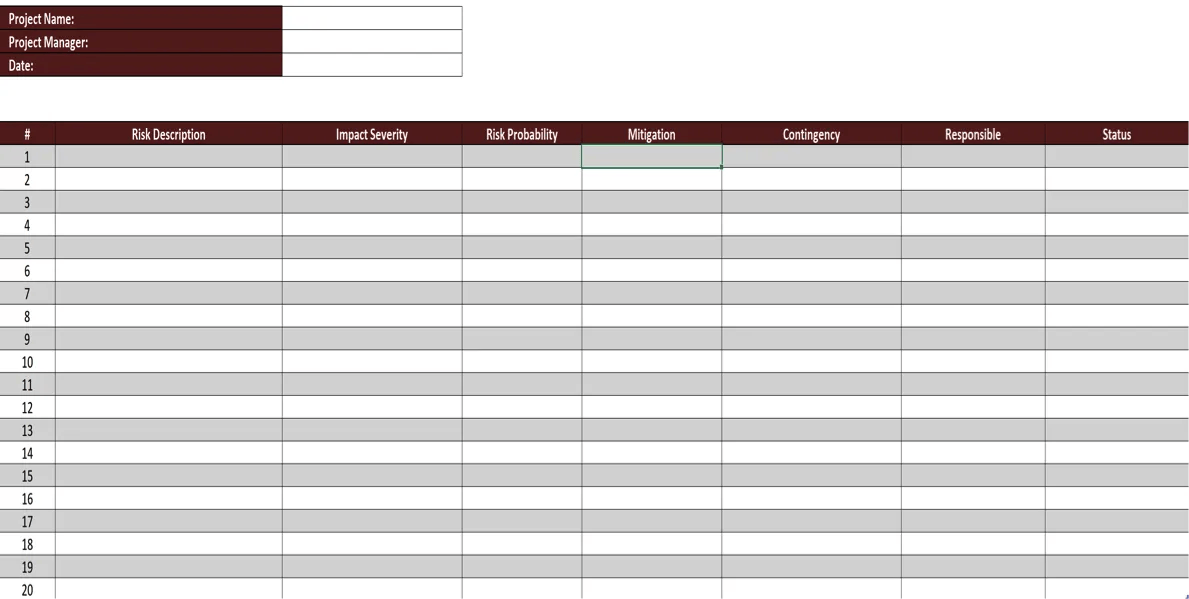
To start your risk log, put each risk identified in your brainstorming session on a line in the risk register. Even those that you decide you’re not really worried about should go in here – conditions change and you’ll want a reminder in case you need to reconsider whether you need to address something that previously wasn’t a problem.
Once you’ve loaded up your risk list determine the Probability and Impact of each risk.
Now that you have all of this information, decide which of the risks you want to track. You may want to try to either make the probability and/or impact less or create a plan in case the risk comes to pass (we’ll cover that in a later blog), but note which ones you’re going to track and who (‘responsible’) is going to be looking at them. You might even want to move the ones you’re not going to worry about – at least right now – into another section of the risk log.
Now you have a focus. Knowing which risks are the most potentially troublesome will help you use your resources wisely while still being prepared for trouble.
If you’d like to learn more, check out thoughtLEADERS LLC’s Risk Management course!
 – Kim Wasson is a principal at thoughtLEADERS where she teaches our course on Risk Management. If you’re interested in the course, please contact us. Kim is also the author of The Socially Intelligent Project Manager: Soft Skills That Prevent Hard Days (CLICK HERE to get your copy).
Did you enjoy this post? If so, I highly encourage you to take about 30 seconds to become a regular subscriber to this blog. It’s free, fun, practical, and only a few emails a week (I promise!). SIGN UP HERE to get the thoughtLEADERS blog conveniently delivered right to your inbox!


Leave a Reply
Want to join the discussion?Feel free to contribute!