Do you struggle to get your ideas approved? Follow the structured thought process to create better presentations.
When you have a recommendation you’re trying to get approved within your organization, there are going to be a lot of stakeholders you have to get your idea in front of. You’ll have to put it in front of your manager, maybe their boss, a director, and some vice presidents. Some of your ideas may even go all the way up to the C-suite. There’s something I like to call Figliuolo’s Law, which states:
“An individual’s annual compensation is inversely proportional to the number of slides they can look at before they have a stroke.”
I’ve worked with a CEO who said, “If it has a staple, I won’t read it.” I worked closely with another CEO and we went in to present. The other team went to present first. He picked up their presentation, he felt it for heft, and it was about 25 pages long. He threw it across the room and said, Read more
https://i0.wp.com/www.thoughtleadersllc.com/wp-content/uploads/2021/03/20210331-Presentation.jpg?fit=1920%2C1280&ssl=112801920Mike Figliuolohttps://www.thoughtleadersllc.com/wp-content/uploads/2022/04/logo.pngMike Figliuolo2021-03-31 06:30:522021-03-31 04:27:47What Makes a Presentation Unsuccessful?
Communication makes vision visible and attractive to others. It can inspire the visionary’s passion in others or drive people away. A poorly communicated vision is dead if not successfully shared with others.
Communication is the essential property of vision and visionary leadership whose primary role is to make vision a collective property, giving it away so others can participate in it. A vision’s strength is determined by how well it is communicated to others.
In practical terms, attracting investors is critical. Attracting as many supporters as possible is even more critical and far more difficult. Only by communicating as broadly and actively as possible does vision gain its full viability and functionality.
Three core elements define effective communication of a vision— Read more
https://i0.wp.com/www.thoughtleadersllc.com/wp-content/uploads/2021/02/20210222-Presentation.jpg?fit=1920%2C1280&ssl=112801920Mike Figliuolohttps://www.thoughtleadersllc.com/wp-content/uploads/2022/04/logo.pngMike Figliuolo2021-03-29 08:00:042021-02-23 23:39:26How to Communicate Vision To Make It Influential
Our reader poll today asks: What’s harder: working from the office or working from home?
Office: lots of distractions. I focus better at home and doing things on my own. 41.4%
Home: lots of distractions and temptations. I need the structure and social aspects of an office. 58.6%
Working from home is hard. Many of you reported being challenged working from home. It seems like a great opportunity until you actually try it. Distractions, lack of structure, and lack of coworker contact are all huge challenges. Having worked from home for 15+ years, I’d suggest a few things. 1. Set and maintain a schedule. Hit your desk at the same time every day. Finish work at the same time. 2. Manage family expectations. Tell them if your door is closed, you’re not there or available. 3. Have a hard break away from work at the end of the day to signal you’re “home” again. Work out. Take a walk. Make it a consistent routine. 4. Make time to socialize. Call or video chat with at least two coworkers per day. Carve out the time to do it. 10 to 15 minutes is all it takes. The more structure and routine you can build around working from home, the easier it is to avoid temptations and deal with distractions.
Do you agree with these poll results? Let us know in the comments below!
Did you enjoy this post? If so, I highly encourage you to take about 30 seconds to become a regular subscriber to this blog. It’s free, fun, practical, and only a few emails a week (I promise!). SIGN UP HERE to get the thoughtLEADERS blog conveniently delivered right to your inbox!
https://i0.wp.com/www.thoughtleadersllc.com/wp-content/uploads/2014/02/20140203-EKG-Pulse-Graph-with-Glowing-Blue-Line-e1657283333991.jpg?fit=445%2C162&ssl=1162445Mike Figliuolohttps://www.thoughtleadersllc.com/wp-content/uploads/2022/04/logo.pngMike Figliuolo2021-03-25 13:00:452021-02-03 22:22:15What’s harder: working from the office or working from home?
It’s easy for your team to get sidetracked if your strategy has a lot of moving parts. Learn how to prioritize your most meaningful work.
A consistent and regularly-scheduled prioritization process helps eliminate distractions and focus your efforts on the most meaningful projects. Some processes are formal while others are simply frequent conversations about priorities. Choose a process that’s appropriate for the size of your organization.
I’ve worked for two very different organizations. One was large and one was a small business unit. In the large one we had a very formal prioritization process. All departments were involved, and you had to have a very rigorous business case to get your idea on the list. In the small business unit it was an informal process. We achieved prioritization by allocating budget to different budget owners.
We then gave them discretion to choose their own priorities. In the large organization it was very rigorous, but sometimes we lacked agility. It kept us focused, but at the cost of innovating every once in a while. In the small organization it enabled a lot of distractions to happen. People pursued some pet projects. Pet projects and distractions should not be worked on if they haven’t been prioritized. They had a huge impact.
In the small business unit I was in we got a lot of small things done, but a lot of times they were disjointed, they lacked impact, and some of them weren’t even on strategy. Build a prioritization process that is appropriate for the size and complexity of your organization, and make sure that process is in charge of allocating resources accordingly.
Embedding prioritization
Prioritization processes work great for larger projects that require resource allocation. They don’t necessarily change behaviors related to more day-to-day activities. Embedding a prioritization mindset in your team will help everyone focus on the most meaningful work. When you talk about projects, refer back to the prioritization criteria so people know how you make decisions and that you expect them to do the same.
I had a great boss at one point who would meet with me every week to ask me what I was working on. If he saw I was working on something that was off-strategy, he’d ask for justification. He’d say, “Mike, how does this tie to the strategy?” He forced me to think through how the work I was doing tied to the overall strategy. If the work didn’t, he asked what I thought we should do about the project. Usually, I decided to kill it. I then modeled that behavior for my team. Prioritization became a way of life for us.
Ask people on your team what they’re working on. Have them explain how that work ties to the overall strategy. Ask them to make choices based on the strategy versus just telling them, “No, stop that project.” When they come up with the rationale on their own, they’re much more likely to stop doing non-strategic work and focus on the things that matter the most.
Stopping off-track work
When you come across work that isn’t high priority or is a distraction, it’s important to stop it quickly. Before stopping that work though, understand why people are working on it and why they thought it should be a focus. There may be a good reason they’re pursuing that project. It could be related to safety, regulations, or company policy. If there’s not a strong reason for the work and it’s clear that it’s a distraction, stop it immediately. Explain your rationale and refocus efforts on high-priority items that require additional resources.
I worked with one CEO who was very excited about making an acquisition. He had a lot of activity going on. He had people looking at the market and evaluating the target company. He was spinning up a lot of work. We went through a strategic planning session, and he realized this work was off strategy. It was a distraction. He immediately stopped all work on it. That sent a strong message to the organization that it’s okay to stop work in progress once you realize it’s off strategy.
When you stop off-track work, be sure to replace it with something more meaningful. You don’t want that individual feeling discouraged or unimportant because you stopped their project. Let them know, “Hey it’s about the project, it’s not about you. And by the way, now that you’re free, I want you to go work on this really high-priority strategic project.” Stopping off-track work is a key to achieving focus for your organization.
Want to learn more about strategic focus? How about taking an entire course on it? Go directly to the course and start learning how to improve your strategic focus. The entire course is available at LinkedIn Learning. Enjoy!
Did you enjoy this post? If so, I highly encourage you to take about 30 seconds to become a regular subscriber to this blog. It’s free, fun, practical, and only a few emails a week (I promise!). SIGN UP HERE to get the thoughtLEADERS blog conveniently delivered right to your inbox!
https://i0.wp.com/www.thoughtleadersllc.com/wp-content/uploads/2021/03/20210324-Meeting-Sticky-Notes.jpg?fit=1920%2C1280&ssl=112801920Mike Figliuolohttps://www.thoughtleadersllc.com/wp-content/uploads/2022/04/logo.pngMike Figliuolo2021-03-24 06:30:552021-03-24 01:01:14How to Prioritize Your Team’s Work and Improve Focus
Zebras are horse-like creatures with beautifully striped coats that fascinate children and adults alike. Zebras have a distinct advantage over humans in one particularly important area of life: how they manage stress. To understand this phenomenon, we need to begin with the concept of interference. In my book, Unleash the Peak Performer Within You, I share the Performance Formula.Simply stated, it reads:
Performance = Skill – Interference
What is Interference?
Interference is a term representing anything that prevents your skills from taking over to produce a high level of productivity and performance. A short list of potential interference includes anxiety, ADD, emotional control problems, and poor sleep. There are many more sources of interference, and they all get in the way of good performance. Eliminating or reducing your interference represents a direct path to improved performance.
As you begin the journey of learning how to reduce interference and change your health trajectory, understanding and strengthening your autonomic nervous system is vital.
The Autonomic Nervous System
What is the autonomic nervous system (ANS)? The ANS is a branch of your nervous system that regulates involuntary functions and is constantly assessing the environment around you and sending information to the brain. This ongoing process keeps you healthy and safe and goes unnoticed as you go about your day. Its goal is to balance your body to its environment.
Functions such as heart rate, salivary secretions, eye dilation, digestion, and adrenaline release are governed by your ANS.
Your ANS has two branches, each at one extreme of functioning. These branches are called parasympathetic (rest and digest) and sympathetic (fright, fight, or flight).
An example from animals is in order…
Stress Responses: Humans vs. Animals
When a zebra is being chased by a lion, its blood flow concentrates to core life-sustaining organs. Digestion slows and heart rate increases. When you face a stressful situation, your body will do the same thing.
Once a zebra has eluded the lion, it returns to a “rest and digest” state or parasympathetic response. This is when the body returns to balance with its environment.
Animals are always one-to-one with their environment. This is where the difference between humans and animals becomes evident. Animals live on instinct. We are different; we are capable of conscious thought.
When you experience stress, your sympathetic branch of the ANS is activated. It’s what’s commonly referred to as a “fight-or-flight” response. It’s okay when a mortal danger presents itself. It’s not okay when you chronically respond to everyday life this way.
In fact, when you unproductively manage stress in this way, it leads to common and preventable disease such as type II diabetes, cardiovascular disease, and high blood pressure to name a few.
Because we are self-aware and have the power of creating theater of the mind, humans can and do ruminate about past events and worry about future concerns. We can literally invent stress in our minds by looking back or ahead.
The fascinating thing about this is that your body doesn’t differentiate between real events playing out in front of you, such as a stranger threatening you, and an event playing out in your mind. Either way, you end up with a stress response. When the conversations you are having with yourself are chronically stressful, you are putting yourself into chronic stress.
The research is settled: chronic stress and chronic debilitating disease are highly correlated. Learning to manage stress properly is one thing you can do to significantly improve your health today and tomorrow.
So now you know why zebras don’t get ulcers, but people do! Our habit of unwittingly placing ourselves in a state where our bodies think a lion is chasing us drives a cascade of reactions in our brains and bodies that make us physically and mentally sick. Our ability to perform at a high level is then severely compromised.
Chronic stress, and all its negative consequences, represents serious interference. Learning to manage stress well will reduce your interference and improve your performance.
How to Reduce Interference
Strategies to improve your autonomic nervous system balance include heart rate variability training, deep diaphragm breathing, optimizing sleep, daily movement, and practicing gratitude. Additionally, learning how to properly process thoughts and not hang onto them, leading to endless ruminations, is key.
The next best step is to assess imbalances in your autonomic nervous system, then seek training from a qualified organization and provider to help you regain control. The goal is to become your own best coach and learn to self-regulate your responses to life’s events. In doing so, your nervous system will then work for you rather than against you. When it does, you will live healthier and become a peak performer based on your definition of success and performance!
Did you enjoy this post? If so, I highly encourage you to take about 30 seconds to become a regular subscriber to this blog. It’s free, fun, practical, and only a few emails a week (I promise!). SIGN UP HERE to get the thoughtLEADERS blog conveniently delivered right to your inbox!
https://i0.wp.com/www.thoughtleadersllc.com/wp-content/uploads/2021/02/20210218-Zebra.jpg?fit=1280%2C853&ssl=18531280Mike Figliuolohttps://www.thoughtleadersllc.com/wp-content/uploads/2022/04/logo.pngMike Figliuolo2021-03-22 08:00:282021-02-21 19:12:34Why Zebras Don’t Get Ulcers But People Do
Our reader poll today asks: How do you react when you receive unsolicited and unexpected negative feedback?
I ignore it. I didn’t ask for it in the first place. 2.3%
I get defensive. I explain why the feedback is invalid. 8.7%
I sit with it for a while. I have to stew on it before responding or acting. 77.7%
I embrace it. I love all kinds of feedback whenever it’s provided. 11.3%
Feedback is a gift that must be considered. When receiving unsolicited negative feedback, the overwhelming majority of you try to pause and sit with it before reacting. That’s a wise approach. It gives you time to get out of instinctive and emotional reactive mode. Many times we’ll feel attached when we receive such feedback and it triggers fight or flight mechanisms. By pausing, you get out of the reptilian brain reactions and instead can consider the feedback in a more measured way. That gives you the benefit of being able to parse which portions of the feedback are fair and valid and which ones you’ll choose not to accept. No one likes being surprised with negative feedback. One implication of all this for you as leaders is to be sure you don’t put team members or other colleagues in this fight or flight moment and, when you do provide constructive feedback, give them the courtesy of time to sit back and reflect on it as well.
Do you agree with these poll results? Let us know in the comments below!
Did you enjoy this post? If so, I highly encourage you to take about 30 seconds to become a regular subscriber to this blog. It’s free, fun, practical, and only a few emails a week (I promise!). SIGN UP HERE to get the thoughtLEADERS blog conveniently delivered right to your inbox!
https://i0.wp.com/www.thoughtleadersllc.com/wp-content/uploads/2014/02/20140203-EKG-Pulse-Graph-with-Glowing-Blue-Line-e1657283333991.jpg?fit=445%2C162&ssl=1162445Mike Figliuolohttps://www.thoughtleadersllc.com/wp-content/uploads/2022/04/logo.pngMike Figliuolo2021-03-18 13:00:522021-02-03 22:19:59How do you react when you receive unsolicited and unexpected negative feedback?
Make sure your team has a clear understanding of how their goals relate to your organization’s broader vision and mission.
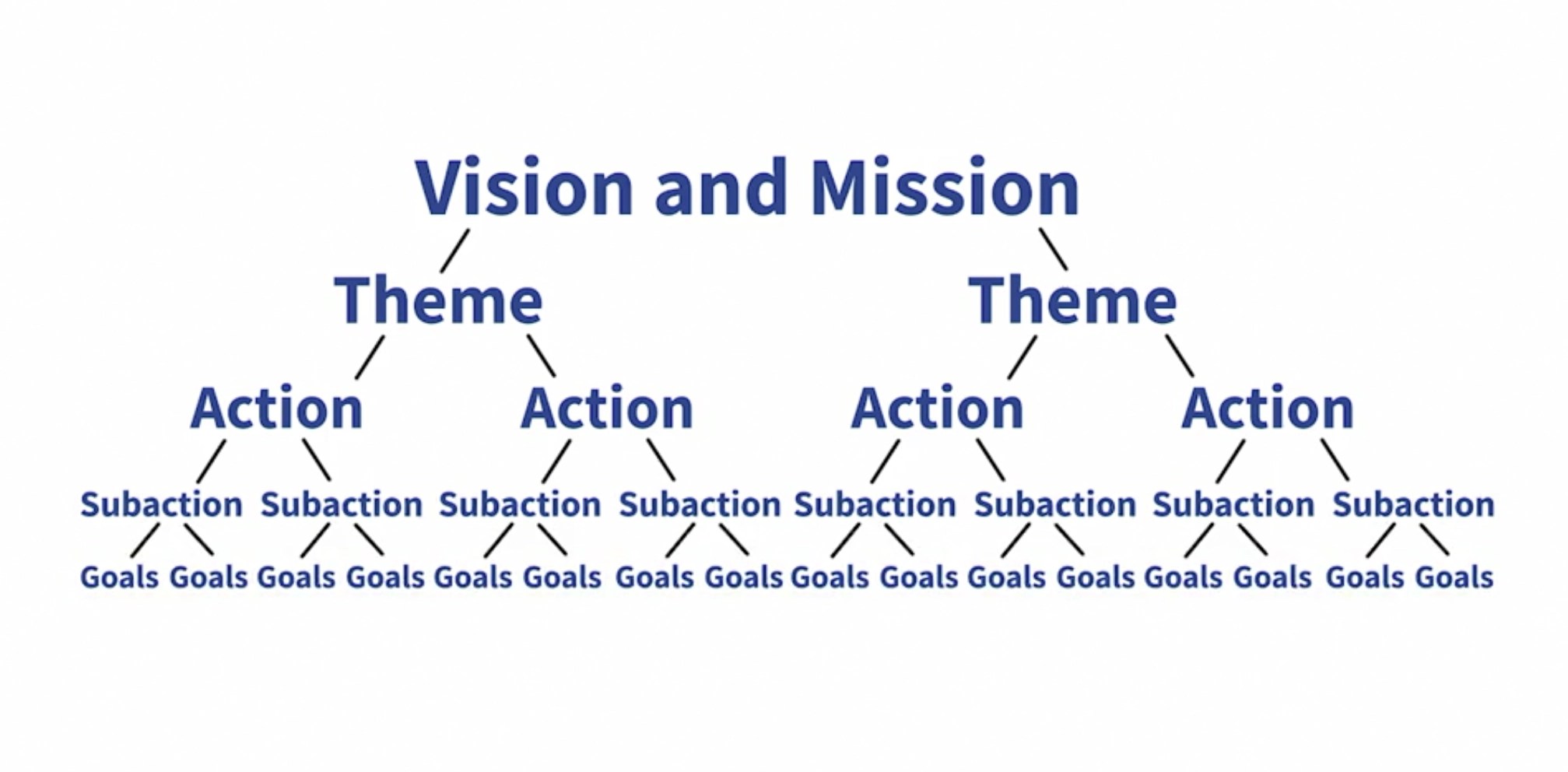
For a goal to be relevant, it has to tie to the broader purpose and goals of the entire organization. Your strategy is going to help drive that. The strategy consists of a desired future state and definition of how you’re going to get there. You should break that strategy down into smaller, interim goals on that path. Every goal that gets set in the organization should be linked to that broader element of your strategy.
How to Tie Your Goals to the Broader Mission
How do you do that? Take a look at your vision and your mission. Look at where you’re going as an organization. Break that down into major themes over the course of the strategic planning period. For each theme, break that down into actions you’ll have to take to achieve that theme. For each action, break that down into sub-actions until you can set an individual goal for each of those actions.
Case Study: Lawn and Garden Company
I worked for a lawn and garden company at one point and I was in the strategic planning group. We said we’re no longer going to just be a lawn and garden company. We’re going to move into outdoor living. It was a much broader expansion strategy.
For each part of the organization, we set goals that were tied to that outdoor living strategy. Our consumer package goods business had goals for new product line expansion and getting into new categories. Our services business had goals for offering new services. Even in the strategy group, we had goals for achieving that outdoor living strategy.
We had goals for how many acquisitions we would do and what categories we were going to enter. For each acquisition, we had goals related to targets we were going to make offers to. We had a time for when we were going to make the offer. We had deadlines for making a deal. We had deadlines and goals around integration, execution of the plan, and expansion of those businesses once they were acquired.
Every single one of those goals tied to a broader strategic theme, and those themes tied to the broader strategy of getting into outdoor living. We all knew how we were contributing to the broader strategy. Therefore, our goals made sense and they were meaningful and relevant to the mission of the organization.
When you set your goals, make sure that you can go from strategy to themes to actions to goals, and then explain to the members of your team how those goals roll up to the broader strategy. It will give their work meaning and help them understand how they fit in.
Want to learn more about goal setting? How about taking an entire course on it? Check out the video below to learn more about the course and get started. Or you can go directly to the course and start learning how to set better goals. The entire course is available at LinkedIn Learning. Enjoy!
Did you enjoy this post? If so, I highly encourage you to take about 30 seconds to become a regular subscriber to this blog. It’s free, fun, practical, and only a few emails a week (I promise!). SIGN UP HERE to get the thoughtLEADERS blog conveniently delivered right to your inbox!
https://i0.wp.com/www.thoughtleadersllc.com/wp-content/uploads/2021/03/20210316-Chain-Links.jpg?fit=1920%2C1285&ssl=112851920Mike Figliuolohttps://www.thoughtleadersllc.com/wp-content/uploads/2022/04/logo.pngMike Figliuolo2021-03-17 06:30:042021-03-16 20:40:59How to Link Your Goals to Your Strategy
Our reader poll today asks: How do you deal with procrastinators on your team?
I give them artificial deadlines to create a buffer so things aren’t last minute. 26%
I break tasks down for them and set smaller interim milestones. 34%
I allocate time-sensitive work to other team members to avoid issues with this person.6%
I give them the deadline and step back. It’s up to them whether they hit it or not. 28%
I fuel the last-minute frenzy because I’m also a procrastinator. 6%
Soon! I promise… Procrastination kills quality, increases stress, and generally can make work much less enjoyable. If you have procrastinators on your team, it seems the preferred approach is to either set artificial deadlines to force actions sooner or break tasks down into smaller chunks with interim milestones. While the former approach can work, it only works for a while until the procrastinator gets wise to your game. Once they know the deadline isn’t a real deadline, you’re back in the same jam. Consider setting smaller interim milestones. Coach them on how to break down their own work. Try to get to the root of the issue and coach them on it. Is it that they overestimate their capabilities? Underestimate a task’s complexity? Fail to account for common roadblocks? Lack the ability to break big projects into small tasks? Once you understand the root of their issues, you can help them improve their skills in that area. So what are you waiting for? Go help your procrastinators deal with their challenges. Now.
Do you agree with these poll results? Let us know in the comments below!
Did you enjoy this post? If so, I highly encourage you to take about 30 seconds to become a regular subscriber to this blog. It’s free, fun, practical, and only a few emails a week (I promise!). SIGN UP HERE to get the thoughtLEADERS blog conveniently delivered right to your inbox!
https://i0.wp.com/www.thoughtleadersllc.com/wp-content/uploads/2014/02/20140203-EKG-Pulse-Graph-with-Glowing-Blue-Line-e1657283333991.jpg?fit=445%2C162&ssl=1162445Mike Figliuolohttps://www.thoughtleadersllc.com/wp-content/uploads/2022/04/logo.pngMike Figliuolo2021-03-11 13:00:372021-02-03 22:17:22How do you deal with procrastinators on your team?
Assembling a high-performing team involves more than just finding great talent. Follow this 7-step formula to develop the team of your dreams.
As a leader, one of your most critical responsibilities is to turn your team into what can be considered a high-performing team. And to do that, there are seven elements that you need to bring together to turn your team from one that just exists to one that’s considered high-performing:
https://i0.wp.com/www.thoughtleadersllc.com/wp-content/uploads/2021/03/20210310-Team-with-Laptops.jpg?fit=1920%2C1260&ssl=112601920Mike Figliuolohttps://www.thoughtleadersllc.com/wp-content/uploads/2022/04/logo.pngMike Figliuolo2021-03-10 06:30:332021-03-10 02:35:24The 7 Aspects of High-Performing Teams
One common struggle entrepreneurs face is that they spend too much of their day putting out fires. That leaves them less time to do the most important work in their business. It also stretches them thin from a personal perspective, so they end up overworked, stressed out, and unfulfilled.
Are you spending all day putting out fires?
Do you struggle to get ahead with your workload because there’s so much on your to-do list?
Have you spent years telling yourself that you need to better train team members but haven’t had a break long enough to do so because you are putting out so many fires?
If you answer yes to any of these questions, congratulations. You’re your company’s best firefighter. This role is important because it can keep a company going for a long time. Fires come up in every business. These businesses need firefighters on the inside to prevent those fires from spreading.
So many business owners I coach complain to me that they spend all their days “putting out fires.” I get it. That’s how I felt for my entire first decade at Diversified Industrial Staffing, too. I spent every day putting out fire after fire, keeping the business open for nearly a decade before the flames got too big for me to control any longer. Every day, it was fire after fire. I’d swoop in and save the day and then move onto the next fire. That was my Groundhog Day. I’d head to the office, put out fires all day, and head home. The next day, I’d head to the office, put out more fires, and head home. I’d do that day after day until everything collapsed.
The first step to getting out of that stressful routine is to shift your mindset. Sure, you will likely remain your company’s best firefighter. That’s not an issue. Fires will pop up in entrepreneurship. But if you’re going to be your company’s best firefighter, you can’t just put out fires and then move on. Firefighters do much more than that. You need to complete the work of a firefighter.
Firefighters don’t just put out the flames of a burning structure and then head back to the station. They also take time to research the cause of the fire and, if there are signs of arson, work with law enforcement to prosecute the arsonists.
If we know we are our companies’ best firefighters, we must shift our mindset and complete the work to identify the cause of the fire. When Greg worked with me to continue the job at Diversified Industrial Staffing, I learned that my fires were all caused by arson. We had someone inside the company who kept starting fires. Thus, the solution was to either get rid of the arsonist or prevent them from being able to start fires in the future.
Unfortunately, I learned that the arsonist at Diversified Industrial Staffing was me. If not for me, I wouldn’t have had so many fires to put out. When I realized that, everything changed. Instead of seeing myself as the hero who swept in and put out fires to keep the company going, I visualized myself starting a bunch of fires and then running around putting them out until the fires grew too big for me to handle. I loved the jolt of adrenaline solving the problems. I felt like I had accomplished something that day. It was a fool’s dream.
It’s not just me, either. When I work with leaders who are overwhelmed by putting out fires all day, I ask them to shift their mindset from putting out fires to completing the job. Virtually every time, my clients realize they were their company’s chief arsonists too. Some of them identified other arsonists as well, but every single one of them realized they could quickly improve their company if they just stopped starting fires themselves.
You don’t have to find yourself crumpled on the pavement (or worse) to recognize that something has to change in your business, either. Sure, a setback could be as large as bankruptcy, or it could be as small as a mishandled meeting. What they have in common is a gut-wrenching, hair-raising feeling of regret, fear, and self-doubt that stops us in our tracks and stunts our growth. But many times, we feel overwhelmed by putting out fires all day because we don’t do the work it takes to prevent fires in the first place.
As leaders, we can be the best firefighters—while also being the chief arsonists. Think about it: the scary but joyous feeling we, as entrepreneurs, get from putting out a fire can be very visceral, like a spike of dopamine. Often, we lack self-awareness around the “rush” it gives us. So we will be subversive and act as an arsonist, which is self-sabotaging long term, in exchange for the rush of putting out the fire and being seen as the savior, the only one who can put out the fire. But we can make the complex simple by merely doing something different.
As straightforward as it might sound to identify the source of fires before moving on, you won’t be able to do it if you don’t shift your mindset. It takes awareness, discipline, and continuous practice to do so. Otherwise, the stress and relief of fighting and extinguishing fires will send us right back into our own versions of Groundhog Day.
Todd Palmer is a highly sought-after speaker, executive coach, and longtime CEO of Diversified Industrial Staffing. With the mindset shifts and business techniques shared in his new book From Suck to Success: A Guide to Extraordinary Entrepreneurship, he transformed his company into one of the fastest growing companies in America, landing it onto the INC 5000 list an impressive six times.
Did you enjoy this post? If so, I highly encourage you to take about 30 seconds to become a regular subscriber to this blog. It’s free, fun, practical, and only a few emails a week (I promise!). SIGN UP HERE to get the thoughtLEADERS blog conveniently delivered right to your inbox!
https://i0.wp.com/www.thoughtleadersllc.com/wp-content/uploads/2021/02/20210206-Firefighters.jpg?fit=1920%2C1280&ssl=112801920Mike Figliuolohttps://www.thoughtleadersllc.com/wp-content/uploads/2022/04/logo.pngMike Figliuolo2021-03-08 08:00:012021-02-06 18:36:50Entrepreneurs: The Best Firefighter and Chief Arsonist
Our reader poll today asks: How effectively do the leaders in your organization manage change?
Extremely: We’re change management experts. 8%
Very well: We do a solid job of managing change. 31%
Marginally: We do OK but could do much better. 36%
Not well: We struggle with managing change.14%
Poorly: We have no idea how to manage change. 10%
Change requires focused effort. Most people focus on the change itself versus thinking through how they’ll manage the change and get people through it. Just because you implement a new system, launch the new product, or move to the new office, that doesn’t mean the change is done. If you’re not carefully planning for how to help your people deal with the change, you run the risk of attrition, project failure, and lower performance across the board. 60% of you report you’re marginal, at best, at managing change. The next time a major change effort comes along, invest the time in planning for that change and dedicating resources to getting your people through it.
Do you agree with these poll results? Let us know in the comments below!
Did you enjoy this post? If so, I highly encourage you to take about 30 seconds to become a regular subscriber to this blog. It’s free, fun, practical, and only a few emails a week (I promise!). SIGN UP HERE to get the thoughtLEADERS blog conveniently delivered right to your inbox!
https://i0.wp.com/www.thoughtleadersllc.com/wp-content/uploads/2014/02/20140203-EKG-Pulse-Graph-with-Glowing-Blue-Line-e1657283333991.jpg?fit=445%2C162&ssl=1162445Mike Figliuolohttps://www.thoughtleadersllc.com/wp-content/uploads/2022/04/logo.pngMike Figliuolo2021-03-04 13:00:252021-02-03 22:15:14How effectively do the leaders in your organization manage change?
Transform your business by completely rethinking how it works. Analyzing your business model, revenue, and costs can lead you to innovative solutions.
When you go to generate new ideas to run things better, you need to think critically about the way your business runs. I like to look at three things: a business model blowup, a revenue blowup, and a cost blowup.
On the business model blowup, fundamentally rethink how you go to market. And rethink what your market actually is. You’re going to challenge the entire business model for the way you deliver products and services. On the revenue blowup side, how do you dramatically expand the products, your pricing, the geography, and the reach of your business? And on the cost blowup, how do you fundamentally eliminate drag from the business to become more efficient?
https://i0.wp.com/www.thoughtleadersllc.com/wp-content/uploads/2021/03/20210303-Whiteboard-Sticky-Notes.jpg?fit=1920%2C1304&ssl=113041920Mike Figliuolohttps://www.thoughtleadersllc.com/wp-content/uploads/2022/04/logo.pngMike Figliuolo2021-03-03 06:30:292021-03-03 01:08:52Challenge How Your Business Operates