Our reader poll today asks: I view turnover on my team as:
An indication that something is wrong 21.83%
A natural dynamic — it’s the circle of life 50.17%
A healthy event that brings in new ideas 21.82%
I don’t experience turnover 6.18%
Turnover is natural and healthy. 72% of respondents believe turnover is healthy, natural, and can improve the organization. For the 22% of you who see turnover as an indicator that something is wrong, that can absolutely be the case too. People don’t leave jobs – they leave bosses. If turnover is rising, don’t be content to simply say it’s natural and healthy. At least question why people are departing. If it’s because they’re being presented with great opportunities or because of life changes in their personal lives, your assessment that things are okay is probably accurate. But if people are unwilling to share the reasons for their departure or they point to issues with culture and leadership, it’s time to take a long look in the mirror and ask yourself what you’re doing to contribute to an environment they’re departing from. The faster you can make any required changes, that faster the bleeding will stop.
Did you enjoy this post? If so, I highly encourage you to take about 30 seconds to become a regular subscriber to this blog. It’s free, fun, practical, and only a few emails a week (I promise!). SIGN UP HERE to get the thoughtLEADERS blog conveniently delivered right to your inbox!
https://i0.wp.com/www.thoughtleadersllc.com/wp-content/uploads/2021/05/20140203-EKG-Pulse-Graph-with-Glowing-Blue-Line-Narrow.jpg?fit=833%2C258&ssl=1258833Trevor Joneshttps://www.thoughtleadersllc.com/wp-content/uploads/2022/04/logo.pngTrevor Jones2024-08-29 13:00:502024-08-14 00:37:22I view turnover on my team as:
It doesn’t make sense to try to manage every possible risk. Learn how to identify and focus on the most dangerous risks you face.
Today’s guest post is by Kim Wasson, a principal at thoughtLEADERS where she teaches our course on Risk Management.
If you’ve completed your risk brainstorming session you might have an extensive list of risks. It doesn’t make sense to try to manage every possible risk, especially the ones that are small or unlikely, so it’s important to figure out which ones are the most dangerous and focus on those.
To home in on the ones you want to address, look at two factors: Probability and Impact. Each risk on your list has a value for these two factors.
Probability is the likelihood that the risk will come to pass. It’s expressed as a percentage, from 0-100%. Your next step is to estimate the probability of each of the risks on your list. Don’t stop there though – something with a high probability still might not be worth the time and resources to address.
Impact is a measure of how bad it will be if the risk is realized. You can choose your measure of impact – as long as the measure is used consistently it will work. Many organizations use T-shirt sizes for risk – Small/Medium/Large. Some use a numeric scale – 1 to 10 where 10 is catastrophic and 1 is an inconvenience. And some make up their own – like Inconvenient, Difficult, Awful, Catastrophic. Use whatever makes sense to your organization to really understand what will happen if this risk comes to pass.
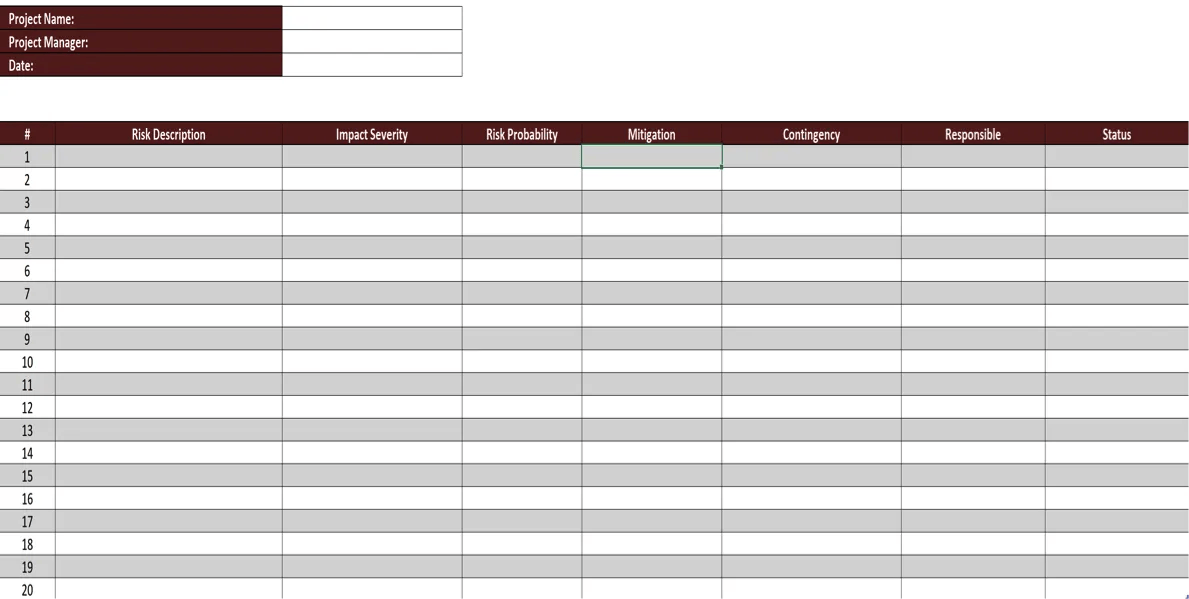
Now that you have some additional information on the risks, you’ll want to put them in what’s called a Risk Register. Typically these are spreadsheet type lists and they look something like this:
To start your risk log, put each risk identified in your brainstorming session on a line in the risk register. Even those that you decide you’re not really worried about should go in here – conditions change and you’ll want a reminder in case you need to reconsider whether you need to address something that previously wasn’t a problem.
Once you’ve loaded up your risk list determine the Probability and Impact of each risk.
Now that you have all of this information, decide which of the risks you want to track. You may want to try to either make the probability and/or impact less or create a plan in case the risk comes to pass (we’ll cover that in a later blog), but note which ones you’re going to track and who (‘responsible’) is going to be looking at them. You might even want to move the ones you’re not going to worry about – at least right now – into another section of the risk log.
Now you have a focus. Knowing which risks are the most potentially troublesome will help you use your resources wisely while still being prepared for trouble.
Did you enjoy this post? If so, I highly encourage you to take about 30 seconds to become a regular subscriber to this blog. It’s free, fun, practical, and only a few emails a week (I promise!). SIGN UP HERE to get the thoughtLEADERS blog conveniently delivered right to your inbox!
https://i0.wp.com/www.thoughtleadersllc.com/wp-content/uploads/2024/08/20240827-Danger-Sign.jpg?fit=1920%2C1280&ssl=112801920Trevor Joneshttps://www.thoughtleadersllc.com/wp-content/uploads/2022/04/logo.pngTrevor Jones2024-08-28 06:30:202024-08-27 17:46:30Focusing on the Biggest Risks
Our reader poll today asks: How well do you manage stakeholders across your organization?
Very well: I communicate very effectively with them and build strong relationships 28.69%
Well: I communicate with them frequently and have decent relationships 54.10%
Not well: I struggle to communicate with them and have weak relationships 10.66%
Poorly: I barely know who my key stakeholders are 6.55%
Stakeholders get things done. 82% of you report having good relationships with your stakeholders across your organization. That’s how things get done. These relationships take time and effort to build. For those of you in the 18% who are struggling to build them, recognize you need to make a concerted effort to spend time with them. This might feel like “unproductive” time if you’re not discussing specific projects or initiatives but investing in the relationship itself will make future project and initiative conversations move more quickly. You’ll also find these relationships can improve your career trajectory and your levels of workplace satisfaction because of increased connectedness within the organization. Get to work now. Reach out to those stakeholders and have a call, a coffee, or a conversation. These are long-term investments that definitely pay off.
Did you enjoy this post? If so, I highly encourage you to take about 30 seconds to become a regular subscriber to this blog. It’s free, fun, practical, and only a few emails a week (I promise!). SIGN UP HERE to get the thoughtLEADERS blog conveniently delivered right to your inbox!
https://i0.wp.com/www.thoughtleadersllc.com/wp-content/uploads/2021/05/20140203-EKG-Pulse-Graph-with-Glowing-Blue-Line-Narrow.jpg?fit=833%2C258&ssl=1258833Trevor Joneshttps://www.thoughtleadersllc.com/wp-content/uploads/2022/04/logo.pngTrevor Jones2024-08-22 13:00:592024-08-14 00:28:36How well do you manage stakeholders across your organization?
Learn the four decision-making styles and the factors that influence which style will be best for your situation.
When you make decisions, there are four decision-making styles that you can use. There’s an autocratic style, a participatory one, a democratic style, and a consensus-based decision-making style. Your choice of which of those four styles to use is driven by two factors.
The first factor is the urgency of making the decision. From low urgency (you’ve got plenty of time to make the call) to high urgency (we need a decision right now). The second dimension to consider is the size or impact of the decision, from small decisions that won’t have a large impact to big decisions that are going to have a huge impact. As you look at which style of decision-making to use, you need to consider both of these dimensions. Read more
https://i0.wp.com/www.thoughtleadersllc.com/wp-content/uploads/2024/08/20240816-Red-Door.jpg?fit=1920%2C1024&ssl=110241920Trevor Joneshttps://www.thoughtleadersllc.com/wp-content/uploads/2022/04/logo.pngTrevor Jones2024-08-21 06:30:562024-08-16 22:32:57Choosing a Decision-Making Style
Our reader poll today asks: How often do you make significant investments in your own professional development?
At least once a month 29.39%
Once per quarter 16.12%
A couple of times a year 27.96%
Once a year 11.84%
Almost never 14.69%
Making time for yourself. There’s always an excuse not to invest in your own professional development. You might say you’re too busy, don’t have the resources, can’t find any offerings that help you grow, or can’t afford to take the time away from work. In all these situations, you’re prioritizing your employer’s needs over your own. If you’re not investing in yourself, you’re falling behind all the other professionals who are making those investments. A full 27% of you fall in the camp of not investing in yourself enough to even stay on par with your peers. Carve out the time for your development. It can come in many forms – reading, going to training, taking an eLearning course, or working with a coach or mentor are all viable ways to keep your skills sharp. Plus, your improved skills benefit your employer in the form of you being a more effective leader and employee. You have to prioritize yourself because, left to its own devices, your employer will likely prioritize short-term deliverables that benefit the company over long-term professional growth for you.
Did you enjoy this post? If so, I highly encourage you to take about 30 seconds to become a regular subscriber to this blog. It’s free, fun, practical, and only a few emails a week (I promise!). SIGN UP HERE to get the thoughtLEADERS blog conveniently delivered right to your inbox!
https://i0.wp.com/www.thoughtleadersllc.com/wp-content/uploads/2021/05/20140203-EKG-Pulse-Graph-with-Glowing-Blue-Line-Narrow.jpg?fit=833%2C258&ssl=1258833Trevor Joneshttps://www.thoughtleadersllc.com/wp-content/uploads/2022/04/logo.pngTrevor Jones2024-08-15 13:00:392024-08-14 00:25:35How often do you make significant investments in your own professional development?
Learn about four of the most common obstacles to creating a high-performance culture and how to overcome them.
You’ll face many common obstacles on your path to building a high-performance culture. Legacy culture issues, associates who resist the new culture, and processes or behaviors that don’t yet exist are going to slow you down. You need to work through these counter-culture moments and issues if you’re looking to change the overall culture of the organization. The more aware you are of what these pitfalls are, the more quickly you’re going to be able to overcome them.
Legacy culture issues
One of the four most common pitfalls I see is the legacy culture. “This is the way we’ve always done things.” Read more
https://i0.wp.com/www.thoughtleadersllc.com/wp-content/uploads/2021/12/20211208-Stone-Obstacle.jpg?fit=1920%2C1280&ssl=112801920Trevor Joneshttps://www.thoughtleadersllc.com/wp-content/uploads/2022/04/logo.pngTrevor Jones2024-08-14 06:30:492024-08-14 00:19:19Overcoming Obstacles to Creating a High-Performing Culture
Our reader poll today asks: How would you describe your team members’ expectations on getting promoted?
They are frustrated they haven’t been promoted already 23.93%
They believe they’re ready to be promoted now 20.86%
They believe they’ll be ready for promotion in a year or less 9.82%
They think they’re more than a year away from a promotion 7.37%
They have no idea when or how they’ll get promoted 24.53%
They expect they’ll never get promoted 13.49%
Providing clarity on promotions. 63% of you report that you’re in a dangerous situation. 24% have people who think they should have already been promoted. They’re a flight risk because they’ll seek a promotion at another company. 25% have no idea when they’ll get promoted. They’re both a flight risk where they’ll go to a situation where there’s more promotion clarity or they’ll lose motivation because they feel like they’re not advancing their careers. 14% believe their job is a dead end. Eventually they’ll leave for somewhere where they can continue to grow. Your job as their leader is to communicate frequently and realistically about promotion paths and probabilities. Don’t sugar-coat it and give them false expectations because that will be even more disheartening when the promotion doesn’t happen. Be explicit about the performance you need to see as well as when opportunities will open up. You owe them that candor and it will help you manage expectations appropriately.
Did you enjoy this post? If so, I highly encourage you to take about 30 seconds to become a regular subscriber to this blog. It’s free, fun, practical, and only a few emails a week (I promise!). SIGN UP HERE to get the thoughtLEADERS blog conveniently delivered right to your inbox!
https://i0.wp.com/www.thoughtleadersllc.com/wp-content/uploads/2021/05/20140203-EKG-Pulse-Graph-with-Glowing-Blue-Line-Narrow.jpg?fit=833%2C258&ssl=1258833Trevor Joneshttps://www.thoughtleadersllc.com/wp-content/uploads/2022/04/logo.pngTrevor Jones2024-08-08 13:00:252024-07-15 00:12:45How would you describe your team members’ expectations on getting promoted?
One of the first steps you can take to create a high-performing culture is to assess what is and isn’t working in your current culture.
An assessment of your current culture gives you an understanding of the starting point for your journey toward building a high performance culture. This assessment includes evaluating what your current culture stands for, how people behave, and the incentives you have in place to drive behavior. Defining and explaining your culture can be difficult. It’s an intangible set of behaviors and a general feeling of what it’s like to be part of the organization. Identifying when people are or are not behaving in a manner consistent with your culture is an important element of assessing the culture you have. Let’s look at what goes into one of these cultural assessments. You need to ask yourself several questions. Read more
https://i0.wp.com/www.thoughtleadersllc.com/wp-content/uploads/2021/11/20211117-Office-Group.jpg?fit=1920%2C1280&ssl=112801920Trevor Joneshttps://www.thoughtleadersllc.com/wp-content/uploads/2022/04/logo.pngTrevor Jones2024-08-07 06:32:532024-08-06 03:13:34Assessing Your Organization’s Current Culture
Our reader poll today asks: How well do your team members understand how other parts of your organization work?
Extremely well – everyone understands all other company functions 6.29%
Very well – they understand most of the other critical functions 23.68%
Well – they understand functions close to them but not most others 48.30%
Not very well – they lack a basic understanding of other functional team roles 17.39%
Not at all – I’m lucky they understand what our function does 4.34%
Provide a broader understanding. It’s great to see that 80% of you report that your team members understand the important parts of your organization outside their own team or function. That obviously improves coordination, helps them appreciate knock-on effects of their work, and makes them better prepared to take on larger or different roles as their careers progress. For those of you reporting that your teams aren’t familiar with other functions, put together a plan for how you can build their knowledge. Are there cross-functional projects you can put them on? Are there online courses they can take to understand other functions? Can you create mentorship opportunities with leaders from other areas? The better your team members understand what the rest of the organization does, the more their own roles make sense to them and the better positioned they are to grow in their careers.
Did you enjoy this post? If so, I highly encourage you to take about 30 seconds to become a regular subscriber to this blog. It’s free, fun, practical, and only a few emails a week (I promise!). SIGN UP HERE to get the thoughtLEADERS blog conveniently delivered right to your inbox!
https://i0.wp.com/www.thoughtleadersllc.com/wp-content/uploads/2021/05/20140203-EKG-Pulse-Graph-with-Glowing-Blue-Line-Narrow.jpg?fit=833%2C258&ssl=1258833Trevor Joneshttps://www.thoughtleadersllc.com/wp-content/uploads/2022/04/logo.pngTrevor Jones2024-08-01 13:00:532024-07-15 00:10:09How well do your team members understand how other parts of your organization work?
Knowing the behaviors you want from your team and how they link to results is one of the keys to creating a strong culture.
Leaders who create a strong culture of outstanding performance will find that performance strengthens their culture. By strengthening the culture, the likelihood of better results and performance increases. This is known as a virtuous circle.
You need to be careful though—the dynamic works in the opposite direction as well. Bad behavior begets bad performance, which leads to more bad behavior, and ultimately a bad culture. I know one senior executive who always used to ask people, “How much money have you made me today?” That simple question flowed through all the behaviors in the organization. Everyone focused on financials, but it was at the expense of creating a great culture.
Let me share an example of how to build a virtuous circle. Read more
https://i0.wp.com/www.thoughtleadersllc.com/wp-content/uploads/2024/07/20240723-Ripples.jpg?fit=1920%2C1440&ssl=114401920Trevor Joneshttps://www.thoughtleadersllc.com/wp-content/uploads/2022/04/logo.pngTrevor Jones2024-07-31 06:30:402024-07-30 02:54:06Building a Virtuous Circle in Your Organization
Our reader poll today asks: Which of the following behaviors do you find to be the most frustrating to experience from a subordinate?
They’re disrespectful to you 14.18%
They’re ungrateful for what you do for them 7.09%
They’re argumentative about the work you ask for 11.02%
They’re passive-aggressive and don’t do their work 27.82%
They lie to you 39.89%
Don’t Lie and Do Your Job. The top frustrations noted are lying (40%) and not doing assigned work (39%) either by overtly opposing it or passive-aggressively not complying with instructions. The question for you leaders is why are your people lying to you or not complying with doing the work you’re assigning them? Are they afraid to tell the truth and deal with consequences? Are they avoiding rules or standards that hinder them doing their job well? Are they not well enough trained or equipped to do the work? Are your instructions unclear? Do they lack the context for why their work is important? It’s easy to look at your subordinates and highlight which of their behaviors frustrate you. It’s harder to take a step back and ask how you might be doing things that contribute to them demonstrating those behaviors. Take a moment and have an open conversation with them to understand what’s driving these dynamics. You might be surprised to find that their behavior is being driven by yours.
Did you enjoy this post? If so, I highly encourage you to take about 30 seconds to become a regular subscriber to this blog. It’s free, fun, practical, and only a few emails a week (I promise!). SIGN UP HERE to get the thoughtLEADERS blog conveniently delivered right to your inbox!
https://i0.wp.com/www.thoughtleadersllc.com/wp-content/uploads/2021/05/20140203-EKG-Pulse-Graph-with-Glowing-Blue-Line-Narrow.jpg?fit=833%2C258&ssl=1258833Trevor Joneshttps://www.thoughtleadersllc.com/wp-content/uploads/2022/04/logo.pngTrevor Jones2024-07-25 13:00:062024-07-15 00:07:37Which of the following behaviors do you find to be the most frustrating to experience from a subordinate?
Our reader poll today asks: How do you spend the majority of your weekends?
Relaxing with family/friends 34.64%
Pursuing individual activities 25.91%
Resting and catching your breath 18.98%
Working and catching up 13.25%
Some other activity 7.22%
Most are relaxing on weekends. It’s encouraging to see that 80% of you are spending time with family, friends, pursuing activities on your own, or just taking a break from work (and I’ll assume the other 7% are doing non-work things). For the 13% who spend their weekends/free time working, consider the cost and the impacts. You’ll never get that time back and you may be neglecting your own self-care and contributing to burnout. Work during free time also takes a toll on personal relationships which can contribute to isolation, depression, and further burnout. It’s unlikely your employer is paying you for those extra hours too so basically you’re decreasing your pay by 15-30% by giving away that free labor. Find time for you. You deserve it and you need it. The work will still be there on Monday morning when you get paid to do it.
Did you enjoy this post? If so, I highly encourage you to take about 30 seconds to become a regular subscriber to this blog. It’s free, fun, practical, and only a few emails a week (I promise!). SIGN UP HERE to get the thoughtLEADERS blog conveniently delivered right to your inbox!
https://i0.wp.com/www.thoughtleadersllc.com/wp-content/uploads/2021/05/20140203-EKG-Pulse-Graph-with-Glowing-Blue-Line-Narrow.jpg?fit=833%2C258&ssl=1258833Trevor Joneshttps://www.thoughtleadersllc.com/wp-content/uploads/2022/04/logo.pngTrevor Jones2024-07-18 13:00:382024-07-15 00:03:51How do you spend the majority of your weekends?