


Four Resilience Skills You Need to Overcome Challenges and Thrive During Challenging Times

Your resilience as a leader makes or breaks your ability to inspire followership.
Today’s guest post is by Maureen Metcalf, CEO of Innovative Leadership Institute, and a Principal here at thoughtLEADERS.
Leaders face unprecedented challenges as change accelerates; they rush to learn about AI while finding additional market pressures and supply chain disruption. Additionally, they struggle to attract and retain talent and keep them engaged. No matter your sector and career role, you are likely facing more challenges than your current skills can handle. Depression and anxiety are at an all-time high, and we see little change in this trend.
How you navigate those challenges sets you apart from others. Helen Keller, Mahatma Gandhi, Martin Luther King, Jr., and most recently, Greta Thunberg — have embodied the resilience that helped them rebound from setbacks and thrive during and after adversity, including overcoming dire obstacles and challenges.
What Is Resilience?
Resilience: The capacity to adapt to challenges and difficulties; mental flexibility in facing obstacles or external demands. That’s the technical definition. In practice, there’s more nuance to resilience for a leader. First, its strength depends greatly on your physical, psychological, and social well-being. Second, resilience can be amplified by antifragility, a relatively new term that means bouncing back from challenges and improving because of them. Third, you must also be adaptable in your leadership approach and remain focused on your strategic goals (although how you attain them is flexible).
Addressing all aspects of resilience is critical to managing stress and increasing your baseline capacity to function in stressful environments. The goal of resilience is to “thrive” — becoming stronger after facing adversity and challenges.
Resilience can be developed and strengthened over time. As a leader, facing challenges and obstacles is inevitable. Your ability to bounce back is critical to success.
Why Is Resilience Important?
Resilience is essential for leaders because it helps us navigate difficult situations and overcome challenges. Resilient leaders can maintain their focus and motivation amid setbacks and adversity. They’re also better equipped to adapt to change — an ever-present constant in today’s work environment.
Among the elements essential to leadership, resilience is unique; it integrates psychological beliefs and physical actions, creating the foundation of a leader’s inner stability.
This foundation enables you to demonstrate fluidity and endurance as you adapt to ongoing change. There’s a beneficial side effect: your resilience is contagious; it infects the people around you, positively impacting others.
Resilience also builds trust and credibility with your team. Demonstrating it shows your team you can handle challenges and setbacks, inspiring confidence in your leadership.
Resilient leaders set an example for their team, showing them how to bounce back from whatever difficulties cross their path. Underlying resilience is the necessity of being physically and emotionally healthy to do an excellent job as a leader. In addition to physical and emotional health, the resilient leader has a clear sense of life purpose, exceptional emotional intelligence, and strong supportive relationships.
Those are deeply personal traits; as a result, for most people, enhancing resilience requires personal change.
Our Resilience Model has four categories:
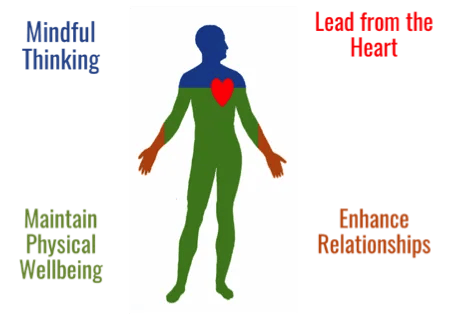
– Improve Physical Well-Being
– Mindful Thinking
– Lead from the Heart
– Enhance Relationships
These categories are interlinked and must be balanced to create long-term resilience.
Our client leaders often say they are too busy to care for themselves. Finding the balance between self-care and meeting our daily commitments is challenging! Yet, leaders are their own most essential instruments of leadership, so caring for yourself is crucial. Most people fall short of their fitness and self-care goals and, over the long term, make choices for or against resilience and personal health. These choices are sneaky: “I don’t have time for lunch today,” or “It’s easier if I schedule these meetings in place of my morning walk this week.” Those little decisions are cumulative; eventually, they take over. Make it a habit to prioritize self-care daily.
Contrary to your let’s-skip-it-today thoughts, a little downtime to “sharpen your saw” boosts productivity and your leadership influence. Fortunately, as you improve your resilience, you will think more clearly and have a more significant and positive impact on your interactions with others. Investing in resilience supports the entire organization’s effectiveness.
 Maureen Metcalf is the CEO of Innovative Leadership Institute, bringing over 25 years of business experience to the table as she helps professionals grow well beyond their own expectations. Her work is focused on helping leaders innovate how they lead while transforming their organizations. She’s also a principal here at thoughtLEADERS. She teaches our programs on building personal resilience. Contact us if you’re interested in bringing the course into your organization.
Want to learn more about resilience? How about taking an entire course on it? Go directly to the course and start learning how to bounce back from disruption and thrive during uncertainty. The entire course is available here. As a taste, you can take our free online assessment to understand your current level of resilience and your gaps.
Did you enjoy this post? If so, I highly encourage you to take about 30 seconds to become a regular subscriber to this blog. It’s free, fun, practical, and only a few emails a week (I promise!). SIGN UP HERE to get the thoughtLEADERS blog conveniently delivered right to your inbox!


Excellent Post. It works in business and in life. I am placing on my Facebook Feed page.