


New Roles Aren’t Cause For Losing Old Skills

When leaders take on more responsibility it’s important not to lose all the skills and qualities that got them there.
Today’s post is by Graeme Findlay, author of Evolve (CLICK HERE to get your copy).
Ahmed, the Vice President for Manufacturing in a large pharmaceutical company could hardly sit still as frustration boiled over. He sat opposite me, stabbing his finger at the circular diagram on the desk between us and exclaimed “I don’t understand it, twelve months of concerted effort and I’ve gone backwards … BACKWARDS!”
Ahmed had just received his latest 360-degree feedback report. I had recently started working with Ahmed as his executive coach and this was our first full coaching session. I thought it might be our last as Ahmed raged against the futility of trying to improve his leadership over the last twelve months. He had been slapped in the face with evidence that his determined efforts had come to nought. There was no way forward with Ahmed in his agitated state so I suggested that we go for a walk. I hardly said a word for the first twenty minutes as Ahmed talked out his frustration. Then we got to the heart of the matter.
Ahmed had been promoted to the position of Vice President eighteen months earlier from the position of Site Manager for one of the company’s premier manufacturing sites. His promotion was based on a spectacularly successful performance turnaround at the site. Under Ahmed’s leadership, production at the plant had increased almost 40%, with improved safety and quality outcomes. With this success recognized throughout the company, Ahmed approached his new job with vigor – he was now responsible for the company’s entire portfolio of manufacturing sites.
When Ahmed evaluated his new role, he was clever: “What got me here, won’t get me there” he told me. His last role was heavily focused on operation, which suited his natural strengths. His new role required a more strategic approach.
The first 360-degree assessment confirmed to Ahmed that he was on the right track in re-evaluating his approach. He scored highly in the dimensions that related to his success at operations management. The survey indicated that he was very strong at rapidly responding to events, maintaining focus on tasks, and holding people to account. Additionally, he scored strongly in the relationships and teamworking dimensions. Other areas however, confirmed his own assessment that he needed to develop new skills. For example, he rated poorly in visionary thinking, creativity, and systems thinking.
Twelve months later, Ahmed received sobering news from his latest report. His scores for vision, purpose and creativity had gone nowhere. This would have been frustrating on its own. But combined as it was, with backwards movement on his operational management scores, it was devastating. Ahmed might have put this down to the anomalies associated with conducting the survey across a different population, except that he had another inconvenient piece of information – the performance of the sites within his portfolio had declined under his tenure. Little wonder that he was frustrated.
Ahmed had made a classic mistake in his approach to new responsibilities. By moving from an operational role to a more strategic role, Ahmed thought he needed to give up his strengths in operational management in order to develop new strengths in visionary thinking and creativity. “I was very strong on disciplined operations and at holding people to account, but as a result, I was inhibiting their creativity. So, I changed my approach and I have been trying to engage them more through our common vision,” Ahmed said to me as I started to explore with him.
Different leadership capabilities do not compete with each other. It is never the case that your strengths need to be compromised to allow space for you to develop other capabilities. In fact, the opposite is true. Different leadership capabilities complement and build on each other. Far from needing to sacrifice his strength at operations management, Ahmed needed to use it as the foundation to develop additional capabilities.
One way to think about this is through the Differential Voice Framework. This framework explores leadership through four different levels of leadership capabilities. The higher-level capabilities are only successful if founded on the lower-level capabilities. Moving from most foundational to most complex, the four capabilities are: the Heartfelt voice, the Command voice, the Prosocial voice, and the Futurizing voice. Ahmed wanted to develop his futurizing voice – the ability to create new futures through enrolling people in a vision and creative thinking. As the highest-level voice, the futurizing voice depends on the other three voices being in place. Ahmed needed to use his strengths at building close-knit teams within a caring environment (his Heartfelt voice) and driving accountability and operational discipline (his Command voice) as the foundation for expanding his futurizing voice. Instead, he inadvertently sabotaged himself.
Today, Ahmed has harnessed his Heartfelt voice and his Command voice to become a very different leader. Not only have Ahmed’s new capabilities delivered better operational performance for the organization, but they have laid a solid foundation for Ahmed to explore his Prosocial voice and his Futurizing voice. Ahmed looks back on the episode as his ‘wasted year’, but I disagree. I see it as a year invested in developing his insight into leadership; a gift that will endure for the rest of his career.
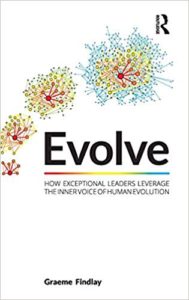 Graeme Findlay is author of Evolve: How Exceptional Leader Leverage The Inner Voice of Human Evolution (CLICK HERE to get your copy) and an Associate Fellow at the University of Oxford Saïd Business School. He consults to industry as an executive coach and change management advisor.
For more information, please visit www.graemefindlay.com
Did you enjoy this post? If so, I highly encourage you to take about 30 seconds to become a regular subscriber to this blog. It’s free, fun, practical, and only a few emails a week (I promise!). SIGN UP HERE to get the thoughtLEADERS blog conveniently delivered right to your inbox!


Leave a Reply
Want to join the discussion?Feel free to contribute!