


How Leaders Can Develop Innovative Cultures

Social design aims to create conditions in which the things you want to happen, happen more easily.
Today’s post is by Cheryl Heller, author of The Intergalactic Design Guide (CLICK HERE to get your copy).
Social Design is the design of relationships; the creation of new social conditions intended to increase agency, health, creativity, equity, social justice, resilience, and connection to nature.
In cities, corporations, or any type of community, if the culture is a creative one, innovative ideas are generated there. In a culture aligned by social values, those values drive action over time. In a culture where people have a sense of agency and possibility, possibilities are repeatedly found. These attributes become the norm. It is the inverse of a culture where only certain people or departments are viewed as innovative or dictate social values, dependent on isolated events or interventions to create lasting change. Social design aims to create conditions in which the things you want to happen, happen more easily.
When applied to specific issues and places, desired outcomes are defined with precision, as concretely and fully as possible.
The skills required for social design are a toolkit of sorts, the kind a very good carpenter might carry, filled with some favorite old implements with worn handles and patina, and some new ones that are shiny and sharp. A number of these skills have been part of the designer’s art forever: like synthesizing complex information and making it accessible; visualizing data and invisible systems so that insights and revelations and connections are available to everyone; reframing problems and questions to uncover root causes instead of symptoms; abductive reasoning and sideways creative thinking; giving ideas physical form or representation, and then making them desirable – engaging and delighting people with the beauty or functionality of whatever has been created.
Other parts of social design have been incorporated from neighboring fields: the notion of “human centered” evolved from the “user centered” shift in technology development, when a user’s experience with products and services became the driving force for their design. And the idea that the best solutions are emergent rather than predicted or controlled – the use of prototypes and observation of people’s response as a way to iterate solutions instead of an “answer” decided upon in advance and force-fitted, comes from the study of living systems – the way nature works to “test” new ideas. It’s the same insight that led to the Lean Startup (Eric Reis, The Lean Startup, Currency, 2011) method for entrepreneurs that’s slowly replacing our reliance on traditional five year business plans.
Empathy is sometimes treated like a rarefied skill requiring special instruction to learn, like cross country skiing with rifles or turning out a perfect soufflé. In fact, except for sociopaths, it’s a universal human instinct that occurs naturally. We just have to stop our own persistent internal chatter long enough to pay close, non-judging, attention to someone else. Put more simply, it happens every time we listen to another person (or another species) with an open mind. This does not mean distorting reason with unchecked emotion. It simply means learning to listen, which comes from nothing more than time and practice at seeing and feeling things from a perspective other than our own.
Similarly, “collaboration,” and “co-creation,” are often overused, and can signal trendiness instead of rigor. The infatuation with brainstorming sessions has often made them a “cheap” substitute for a deeper, more disciplined approach. Brainstorming or “ideating” are decidedly more difficult to do successfully than to say, since it takes preparation and strategy to develop a thoughtful, informed and iterative creative process. It is also a fallacy that prioritizing co-creation means that nothing can happen unless a committee is present and everyone is involved in every conversation. Or, that ideas aren’t valid unless they’re open source. Within the many conversations and exchanges of ideas in the social design process, there is ample time and space, in fact a need, for the brilliance of individual minds, as well as the power of the collective.
Research (The New Groupthink, The New York Times) makes the case that “group think” is actually not as effective as individuals creating on their own. It is certainly not the panacea that some of its promoters have made it out to be. It turns out creativity happens most reliably, and most acutely, in isolation. Relatedly, it is generally true that the most creative people are introverts. The opportunity, in social design, is to find a way to incorporate the best of all personalities and ways of thinking.
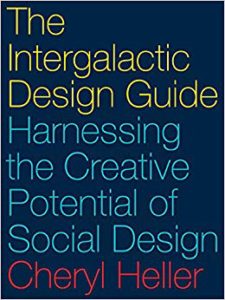
Cheryl Heller is the founding chair of the first MFA program in Design for Social Innovation at the School of Visual Arts in Manhattan and is president of the design lab CommonWise. She is the author of The Intergalactic Design Guide: Harnessing the Creative Potential of Social Design (CLICK HERE to get your copy).
Did you enjoy this post? If so, I highly encourage you to take about 30 seconds to become a regular subscriber to this blog. It’s free, fun, practical, and only a few emails a week (I promise!). SIGN UP HERE to get the thoughtLEADERS blog conveniently delivered right to your inbox!
Leave a Reply
Want to join the discussion?Feel free to contribute!