


RAPTURE – Build a Compelling Narrative for Your Personal Brand
 Creating a compelling narrative around your personal brand is easier if you use the RAPTURE approach to defining and communicating it.
Today’s post is by Jeremy Goldman and Ali B. Zagat, authors of Getting to Like (CLICK HERE to get your copy).
Career advice used to center on the maxim to “do what you love.” But more and more, there’s a shift toward the idea that following your bliss is not the best way to go when it comes to your career. First of all, you run the risk of growing weary of a favorite hobby. For example, Ali loves to bake bread to relax, and make cakes and pies for her friends’ birthdays, but would not want to be a professional baker. It’s perfectly okay to use skills and strengths that you enjoy, but it’s okay to keep that as an accent rather than your focus.
How do you find the exact spot where the thing that you love and the thing that other people will care about—and pay for—overlap? If the thing that you’re excited to wake up for in the morning is the same thing that makes someone say, “Wow, this is something that is truly worthwhile and helpful to me,” then that intersection is where you should be focusing your time and energy.
Once you get psyched up to build your brand, you’ll want to make big changes all at once, so it can be hard to hold yourself to taking small, strategic steps. But in order to get to this new place in your life, there are a few vital points you must first consider. Here is our framework:
RAPTURE
Humans have a natural desire to tell stories to ourselves and to each other. Unless you develop a cohesive narrative, it’s easy for your audience to form a haphazard perception of what you’re doing. If you’re making a big change, you have to find a way to describe that transition to other people. You don’t have to seek universal approval, but in order to get job opportunities and client referrals, to be recognized and really embraced in your new role, you need to think about how you’re presenting this trajectory to your audience.
All compelling narratives have a few things in common. You want to enchant and delight your audience. In fact, you might just say that you want to leave them in RAPTURE, the acronym we use for thinking about developing compelling narratives:
Relevant: The story of your brand should center around its most core components, the strongest and most unique features.
Authentic: You need to believe in your narrative and come across as genuine. If you’re not moved by your brand ideals, how could you expect to move others?
Persuasive: Your narrative needs to be compelling enough to draw others in.
Timely: As your brand develops, so should your narrative. It is not a fixed construct, and needs to evolve as your brand changes shape. You should not be working with a brand statement that’s out of date.
Understandable: Be clear and direct. Vague descriptions or convoluted brand statements make a bad first impression. People should not have to work to understand what you’re saying; they should recognize your intentions from the get-go.
Relatable: People trust those with whom they can empathize. They need to be able to imagine themselves in your shoes if your aim is to have them support you.
Educational: Your brand statement is, essentially, your elevator pitch. It should say something to your audience about what you do and who you are.
RAPTURE is especially important if you’re in the midst of a career transition. You need to control your narrative and be able to explain your transition in a way that makes sense. Why are you going from one thing to another? How does your past experience add value to your new endeavor?
The best way to show this progression is by creating content. Whether you like to blog, create videos, or make podcasts—doing something shows people that you’re committed to and aligned with your new trajectory. Depending on the nature of the transition, there may be doubts about your ability to be effective in your new area, so take every opportunity to prove that you’re serious and committed to your new direction.
Once you’re started down that path, how do you know when your plan is working? There can be lag time between when you start to put yourself out there and when you start to get feedback, and the way that you deal with this gap is incredibly important.
As uncomfortable as this time may be, follow the advice of the great Winston Churchill: “When you’re going through hell, keep going.” (There’s some debate if Churchill actually said it, but either way, it’s a pretty good rallying cry.) Expect some ups and downs, because bouts of uncertainty are normal during a period of transition. But once you’ve committed to your new path, it’s time to embrace it. The more you immerse yourself in your new identity, the better.
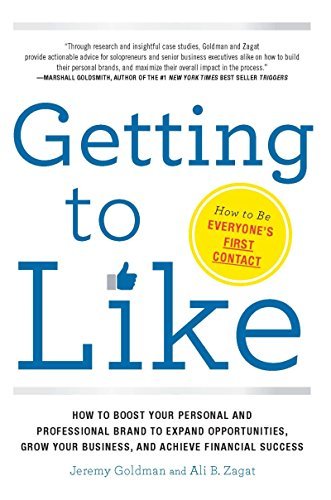 – Jeremy Goldman and Ali B. Zagat are the authors of Getting to Like: How to Boost Your Personal and Professional Brand to Expand Opportunities, Grow Your Business, and Achieve Financial Success (CLICK HERE to get your copy).
Jeremy Goldman, founder and CEO of award-winning futureproofing firm Firebrand Group, has more than 15 years of experience helping companies improve their digital marketing and social media strategies. He has led digital marketing for a number of brands, including Jurlique, Kiehl’s Since 1851, and Unilever. He lives in New York City.
Ali B. Zagat is a seasoned writer, editor, and content strategist. She has more than 10 years of experience creating digital and social media content and campaigns for mainstream and niche brands alike, including Creed, Dwell, Rodale’s, Birchbox, and Anthropologie. She lives in Philadelphia.
Did you enjoy this post? If so, I highly encourage you to take about 30 seconds to become a regular subscriber to this blog. It’s free, fun, practical, and only a few emails a week (I promise!). SIGN UP HERE to get the thoughtLEADERS blog conveniently delivered right to your inbox!
Photo: Branded by Derek Gavey
Leave a Reply
Want to join the discussion?Feel free to contribute!