


Memory and the Power of Decision-Making
 The way to stand out and get people to take action is to be memorable. People act on what they remember. Differentiating your business is the key to being remembered.
Today’s post is from Carmen Simon, author of Impossible to Ignore (CLICK HERE to get your copy).
Would you tour a museum naked? You may consider it if you visit the Museum of Old and New Art (MONA) in Tasmania, Australia.
MONA is an extremely innovative museum, increasing its financial viability each year and disturbing many conventions in the art world. While typical museums are above ground, this one is underground. While typical museums are easy to access, this one is on an isolated island, in a working-class district.
You don’t access MONA by ascending massive staircases or passing between marble columns. You enter it via a tennis court. Art exhibits conventionally have labels. MONA has none. There are no signs or directions, no logical route that visitors must take, and nothing is displayed across a timeline. The museum is a theater of curiosities, from a sculpture of a grossly fattened red Porsche, to rotting cow carcasses, to a library with blank books. Dark walls dominate with the intent to undermine the standard white gallery. An Australian magazine called MONA “a mash up between the lost city of Petra and a late night out in Berlin.” The museum’s daring themes of sex and death are in blunt contrast to the people of Hobart, Tasmania’s capital, who are modest and courteous. For an extra thrill, you can join the “naturist” tour in the buff after 9 p.m. The guards and guides will also be naked.
At some point, we all create something and hope that other people will act on it: read it, listen to it, like it, buy it, or recommend it to others. At some point, we want to influence people’s choices. But how do we get others to act in our favor in an age of increasing competition, complexity, and noise?
People act on what they remember. Not on what they forget.
The concept of memory is refueling the efforts of scholars and neuroscientists who are deepening the understanding of human behavior. The latest scientific findings place memory at the heart of adaptive behavior and decision making. Scientists are also increasingly worried that our society is being stripped of the responsibility to remember much. We have increasingly more devices and programs that remember for us. Our phones store people’s numbers, social apps remind us of birthdays, slides prompt us on what to say in presentations, and more recently, plants can use Twitter to remind us to water them. At this rate, we are grooming generations of amnesiacs.
It is useful to have machines that remember things for us, but—at least for now—humans are responsible for evolving our society, and organic memory is at the core of what happens next. Particularly in business, if we don’t have a systematic way of getting others to remember what is important, we have to rediscover the formula for success every day.
Forgetting hurts business. Before MONA, Walsh had bought a two-acre property with two houses on it and converted one of them into a small museum. He remembers creating a venue that was “elegant, white, understated, and, basically, generic.” In other words, forgettable. Does this resemble business content you see?
He liberated the original bland museum by turning it into a venue that people could rent for work events or social functions. He enjoyed watching people experience parties within the context of a museum and that combination stayed on his mind when imagining MONA. He kept asking obsessively, “What will happen if I alter the purpose of visiting a museum?” “What would get people through the doors?” “What will be memorable?” He even asked, “What if no one comes?”
These questions are natural because when we aspire to be a part of people’s future decisions, we implicitly ask what the future will bring. The attempt to anticipate the future is mandatory in understanding how to influence others’ memory. This is because all neurologically intact people are relentlessly on fast-forward. The brain has evolved to be a prediction engine because natural selection favors those who can accurately predict the future. At some point this morning, did you predict how your day would unfold, when your body might need food, and what you might do in the evening? And did you select specific actions based on these predictions in such a way as to maximize rewards?
What matters most is what happens next.
Scientists have compiled a list of stimuli that are biologically rewarding (whether seeking something pleasant or avoiding something unpleasant) and that elicit reflexive responses. Think of the automatic responses you have to sweet taste, putrefying odor, proper body temperature, pain, physical touch, snakes, flowers, an aggressive tone, play, courtship, sex, crying infants, sleep, novelty, altruism, or control over your own actions. These stimuli are considered primary reinforcers, meaning that they are prewired, not learned, and generate an automatic response. Contrast them with secondary reinforcers, such as money or promotions, which are learned and which require, at least initially, cognitive effort to generate action.
Is it even possible to influence other people’s memory when we can barely take care of our own? It is possible because we now have more brain science research we can apply and, we naturally put more effort into leaving an impression. For example, business people, for most part, don’t go to work and think, “Today I will spend 30 minutes to improve my memory.” But they do think, “Today, I am going to spend 30 minutes to figure out how to win Customer X.” When they ask that question, that’s implicitly a question about how to influence someone else’s memory because people make choices based on what they remember. So we can already count on the fact that we are more likely to put effort into influencing other people’s memory than working on our own.
In addition, it is not that practical to study individual memory in isolation anyway; improving our own memory is nice but not sufficient to live in prosperous way. People function and evolve in complex systems. Even when we use autobiographical memory and reflect on individual experiences, many of those are a result of interacting with others. Behavior and success are shaped by social memory. It is not only possible to influence other people’s memory; it is crucial to human progress. When we share great ideas, and others remember and act on them, we progress. When we have great ideas and others forget them, we stagnate.
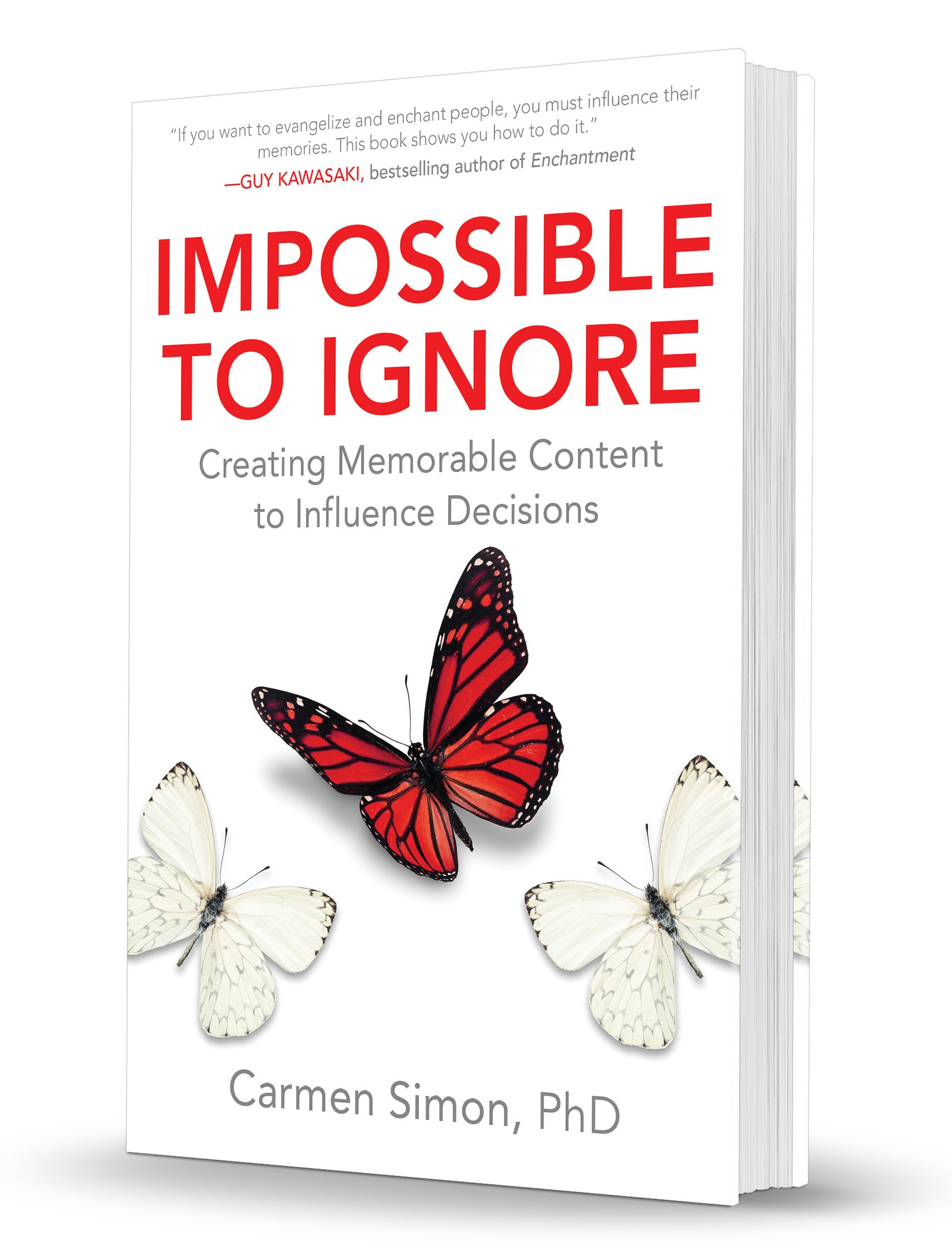 Carmen Simon, PhD, is changing how the world communicates. A cognitive scientist, she has helped America’s most visible brands craft memorable messages by focusing on how the brain works. Carmen is the cofounder of Rexi Media, a presentation design and training company. She holds doctorates in both instructional technology and cognitive psychology, and is a recognized expert in presentation design, delivery, and audience engagement. Read more at www.reximedia.com. She’s the author of Impossible to Ignore (CLICK HERE to get your copy).
Did you enjoy this post? If so, I highly encourage you to take about 30 seconds to become a regular subscriber to this blog. It’s free, fun, practical, and only a few emails a week (I promise!). SIGN UP HERE to get the thoughtLEADERS blog conveniently delivered right to your inbox!
Leave a Reply
Want to join the discussion?Feel free to contribute!