


Ultimate Influence Via the Parry
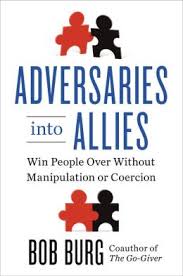 Today’s post is by Bob Burg, author of Adversaries into Allies: Win People Over Without Manipulation or Coercion (CLICK HERE to get your copy).
“Who is mighty? That person who can control their own emotions and make, of an enemy, a friend.” – Talmud
Our 16th U.S. President, Abraham Lincoln was one of the best when it came to turning adversaries into allies.
“…{On one occasion}, when another official sharply criticized Lincoln’s judgment, the president responded to a reporter’s interrogation by saying he had great respect for the other man, and if this official had concerns about him, there must be some truth to it. Such discretion disarmed divisiveness that was intended to draw Lincoln into side-skirmishes, it won the hearts of his friends and foes and it allowed Lincoln to maintain focus on more important issues.”
What Lincoln did was to utilize the tactic of “deflection.” This means to softly “parry” a challenge or accusation, deflecting it into another direction where it misses entirely.
This is actually a common boxing move. When one fighter throws a jab the intended target will, very coolly, simply wait until the punch almost reaches him. He’ll then just parry it away with a very slight flick of the wrist. Harmless.
Lincoln did it. You can, too.
Use The Other Person’s Force… To Your Advantage
When someone says something to you, or about you, don’t fight it, battle it, or try and stop it. It won’t work. In fact, it typically will have only the opposite effect of drawing you more heavily into the confrontation and providing fodder for the conflict. Instead, do what Lincoln did. Compliment the offender and leave him and his comment without power to harm you. You can do this one of two ways:
1. If you’re told what someone said about you, then, like Lincoln, express your admiration for that person and suggest that, “If Pat said it, it’s something I should at least look into.”
This will totally disarm the person who just related Pat’s words. He or she cannot argue with you, because you did not argue with them. They can’t debate the point, because you’ve politely refused to debate. And (perhaps, most importantly), they cannot quote your “defensive” response to anyone else, including Pat, because you did not respond defensively.
Your kind and complimentary words will probably also make their way back to Pat, who will now have a newly-found respect for you.
2. If something is being told to you that is meant to be offensive or disruptive, directly acknowledge to the person that he/she may just have a point and it’s something you need to consider.
If that’s not appropriate, simply thank the person for bringing it up.
Don’t Confuse This With Being A Doormat
Please understand: I’m not saying not to answer and/or stick up for yourself. Taking a definite position might be very necessary. What the deflection does, however, is keep it impersonal. It allows for positive detachment so that the answer can be of best service to everyone and not indicative of negative personal feelings.
Here are two practice exercises you can do over the next week to strengthen yourself in this area:
1. Work on deflection via parrying every time you are confronted, regardless of the lightness or seriousness of the confrontation.
2. Watch other people during their conflicts and observe how they handle a “left jab.” Do they deflect it with a classy parry, or do they get caught up in trying to “stop” the verbal punch? How does the option they took work out for them? Note the ones who are most effective and use them as a model.
Perhaps this exercise is most powerful!
Mentally rehearse a situation in which someone verbally attacks or criticizes you or passes along a similar remark from someone else as in the example with President Lincoln.
See yourself, in your mind’s eye, responding with calmness and serenity, completely in control of your own emotions. Your response is a perfect parry; a smooth deflection that leaves everyone feeling good about themselves and the situation. Imagine how terrific you feel afterwards.
If you can do it in your mind, you can do it in a real-life situation.
Just as an astronaut training for a mission goes through numerous simulated missions before ever actually going into space, you’ll find rehearsing in your mind before the event ever takes place puts you nine steps ahead of the game…in a ten-step game.
Once you quickly become really proficient at this, you’ll find it to be one of the most self-empowering (not to mention, fun!) aspects of your interpersonal communications.
And, you’ll be the one that others see as a master of people skills and persuasion, and a person of ultimate influence.
– Bob Burg is the author of Adversaries into Allies: Win People Over Without Manipulation or Coercion (CLICK HERE to get your copy).
Did you enjoy this post? If so, I highly encourage you to take about 30 seconds to become a regular subscriber to this blog. It’s free, fun, practical, and only a couple of emails a week (I promise!). SIGN UP HERE to get the thoughtLEADERS blog delivered to your inbox every week!
Excellent advice Bob. I’m sure it’s not coincidence that I just started reading your book this morning then saw this post. Thanks for sharing.
Brian