


Five Steps to Becoming an Authentic Leader
 Today’s post is by Maureen Metcalf – a thoughtLEADERS instructor and author of The Innovative Leadership Fieldbook. and the newly-released Innovative Leaders Guide to Transforming Organizations (CLICK HERE to get your copy). Here’s Maureen:
Authentic leadership is getting lots of attention in the press today and yet many people have the question what does it mean and how might I get there?
Let’s look at authentic leadership starting with a recent Forbes article, “Authenticity: Your Greatest Leadership Asset,” leadership guru, Warren Bennis, says: “…letting the self-emerge is the essential task of leaders. Indeed, leadership is, first and foremost, all about you. People often have a misguided notion that leadership is about everyone else. But if a leader hasn’t journeyed inside first to get clear on his or her values, strengths, passion and vision, their lack of authentic grounding will cause them to behave in inconsistent ways, eroding trust and undermining their leadership effectiveness.”
Now, let’s look at an example of a highly skilled leader, Bill, who is facing a challenging employee situation. Self-aware, Bill makes a concerted effort to create an environment in which each of his team members can be their most effective at work. He has assembled a diverse staff with unique skills and a lot of idiosyncrasies. Bill has worked hard to help this staff of stars come together as a cohesive team.
One morning he arrived to find an obviously upset employee sitting in his office. He has a conversation with the employee who is clearly concerned about the condescending behavior of another colleague. The upset employee, Michelle, suggests that the work environment Bill created is hostile and clearly not supportive of her doing her best work. She feels belittled by her colleague and is seeking Bill’s support to ensure the office in which they work is conducive to delivering top quality service to their clients.
As she leaves, Bill thinks about his leadership style. He asks himself if his style has created an environment that promotes a positive work environment for all employees. Is he allowing some people to treat others in a negative or unsupportive way? Is there anything he should do differently to promote a more productive and supportive environment? Bill’s instincts say he has created a positive environment but now he hears from a valued employee that he may not be doing as well as he thought. Fundamentally, the question for Bill becomes – is his authentic leadership style supportive of organizational success? Does he need to refine his style or develop as a leader to be both authentic and create a positive environment?
The question that comes to mind is: How can leaders be authentic and encourage others to do the same while concurrently meeting the needs of the overall team and organization?
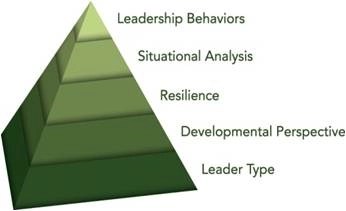 Now let’s turn to innovative leadership and how it can help leaders become more authentic. As you examine the pyramid you will notice five key elements. By using these elements you can become a more authentic and effective leader:
1. Understand your leadership type by taking an assessment to understand yourself; then, learn about your colleagues’ types. By knowing who you are and who they are, you can create an environment in which people are able to comfortably be themselves and create a common language where they understand one another. In an environment such as this, the balance allows colleagues to be who they are and aligned with the culture of the overall group.
2. Understand the concept of developmental perspective (complexity of thinking, emotional intelligence and behavior) and learn how to take the perspective of many different levels. By understanding the level of your colleagues and meeting them where they are, you are showing the highest degree of respect and appreciation. The golden rule of authentic leadership could be “treat people as they need to be treated to perform at their best.” Since we are all unique, treating others as you want to be treated may create some significant problems in a leadership role.
3. Building resilience includes developing a strong sense of emotional intelligence. Emotional intelligence includes self-awareness, knowing your strengths and preferences. It also includes understanding others’ strengths and preferences, and demonstrating the flexibility to respond to another’s level appropriately.
4. Using situational analysis can increase your ability to adjust your communication and behavior to the cultural norms and behavioral expectations of the organization. This means you can read the situation quickly and respond accordingly. If you are an introvert and prefer to process solo, you will benefit—as will your team—when you can expand your capacity to process with the group where necessary. This is particularly helpful if you are surrounded by extroverts who process “out loud” with others. This does not mean you change your innate preference or act in a way that is not genuine, but rather you expand your ability to do both. It is a bit like learning to swing forehand and backhand in tennis. You’ll continue to have preferences, but, by expanding your abilities, you can be both authentic and agile.
5. Tailoring leadership behavior means behaving in a manner that is authentic to you, and appropriate to the organization and situations in which you find yourself. To do this well it means you need access to a broad range of behaviors to match the situations you encounter.
The antidote to being forced to make the choice between being authentic and responding appropriately to many diverse situations is to expand your “range of behaviors” and increase your comfort with this broader range. To lead effectively, working with a broad range of stakeholder groups from different companies, cultures, and often countries, it is important to have access to a broad range of authentic behaviors and be able to quickly diagnose which will be most effective in each situation.
 To learn more about innovative leadership and the process of implementing transformative change, we recommend the Innovative Leadership Fieldbook and the Innovative Leaders Guide to Transforming Organizations.
– Maureen Metcalf at thoughtLEADERS, LLC
Maureen is the President of Metcalf & Associates, Inc., bringing 26 years of business experience to the table as she helps professionals grow well beyond their own expectations. She is recognized as a thought leader who demonstrates strategic vision coupled with the ability to analyze, develop, and implement successful strategies for profitability, growth and sustainability. Her work is focused on helping leaders innovate how they lead while transforming their organizations. She’s also a member of the thoughtLEADERS team. Read more of her work on her blog.
Leave a Reply
Want to join the discussion?Feel free to contribute!