


Training Your Inner Matrix for Career Success

Train your Inner Matrix to improve personal mastery in leadership, increase your potential for money and happiness, and enhance personal growth and development.
Today’s post is by Joey Klein, CEO of Inner Matrix Systems and author of the new book The Inner Matrix: Leveraging the Art & Science of Personal Mastery to Create Real Life Results (CLICK HERE to get your copy).
Whether you are seeking personal mastery in leadership, hoping to sharpen your skills in conflict resolution, or looking to take your career to the next level, understanding the relationship between your emotions and the actions you take is key.
Nick didn’t expect to be fired from his job, but when his boss broke the news, Nick did not react in the way you might expect. He didn’t wallow in self-pity or unworthiness. He didn’t decide he was a failure or a loser. He didn’t ask the seemingly obvious questions like, “What am I going to do now? How will I provide for my family? How can I possibly go on?” On the contrary, Nick walked out of his boss’s office feeling like a new man—excited and exhilarated by the prospect of new opportunities. What was Nick’s secret?
In the months leading up to the day he was let go from his job, Nick had been training his emotional state to align with his desired outcomes. In other words, Nick had been honing his Inner Matrix.
What is the Inner Matrix? Simply put, your Inner Matrix is your unique set of emotion and thought patterns that drive your actions. We all react to the people and events in our lives from an emotional state. The emotional states in which we are living create stories that drive the actions we take in response to those people and events. For example, when Beth was a little girl, her mother gave her cookies when she was feeling sad or scared. Now, as an adult, Beth associates cookies with comfort and safety. When she is feeling sad or scared, Beth reaches for the Oreos. Her emotional state drives her actions. And we can take it a step further. Beth believes she is overweight and out of shape. She’s been trying to cut back on sugar, so the action of reaching for the cookies triggers the emotion of shame which tells the story, “I can’t stop myself from eating the cookies; therefore, I’m a weak person; therefore, I’m a bad person.” Those thoughts fuel the emotions of sadness, or even fear, which in turn drive the desire to eat more cookies. Beth is caught in an emotion loop. The good news is, with training and practice, Beth’s Inner Matrix can be reconfigured and she can activate a new, more positive emotion loop.
Let’s go back to our friend, Nick (a real person, but not his real name). Nick had been considering a career change but he wasn’t exactly sure how to go about it. He knew he wanted to make more money, work with people he enjoyed being around, and to be part of an expansive culture. All things that his current job did not offer. Rather than hammering out a thousand applications to a thousand different companies, hoping to land on something that matched his criteria, Nick decided to create the conditions within himself that would attract the outcome he was looking for. He started by defining the emotional state from which he would operate. For Nick, that emotion was inspiration. He thought about all of the positive results he wanted to cultivate for himself. He wrote them down, he imagined them, and he trained the emotion of inspiration as it pertained to his job. Day after day, he started coming into work feeling more inspired, more energetic, and more passionate. These new emotions were not part of the culture in which he was currently working. And so, the fateful day came when he was called into the boss’s office. Nick was presented with a fact: You are no longer employed. But because of his training, Nick was able to avoid telling himself the story that he was a failure. Instead he told himself the story of an opportunity to make his life better, that losing this job was a sign that better things are coming. His emotional state was aligned with the outcomes he was choosing to create. He had attuned his Inner Matrix to achieve the results he desired.
Whether you are looking to advance your career or improve performance in your current job, you too can train yourself to create any outcome in three simple steps: 1. Recognize the patterns in your Inner Matrix that are creating less than optimal results. 2. Stop those patterns. 3. Train new patterns that align with your desired results.
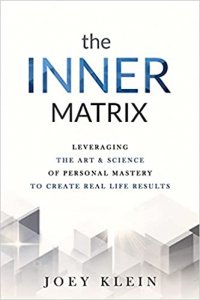 Joey Klein is the founder and CEO of Inner Matrix Systems, a company that trains high achievers in the art and science of personal mastery. He is the author of the new book, The Inner Matrix: Leveraging the Art & Science of Personal Mastery to Create Real Life Results.
Did you enjoy this post? If so, I highly encourage you to take about 30 seconds to become a regular subscriber to this blog. It’s free, fun, practical, and only a few emails a week (I promise!). SIGN UP HERE to get the thoughtLEADERS blog conveniently delivered right to your inbox!


Leave a Reply
Want to join the discussion?Feel free to contribute!