


The Same Personality Trait Can Define Two Very Different Leaders

Personality and leadership are inextricably linked. Two people with the same personality trait can be two very different leaders.
Today’s post is by Ron Warren, author of Personality at Work (CLICK HERE to get your copy).
Personality and Leadership
Personality and leadership are inextricably linked. Think of how many professionals experience your personality through your everyday behavior. Moreover, your personality is multi-dimensional – the whole is far greater than the sum of its parts. Two people with the same personality trait can be two very different leaders depending on the mix of their other traits. A perfect story to illustrate this is the two Steves from Silicon Valley.
Silicon Valley Grit
Steve Wozniak and Steve Jobs spent almost ten years in garages working together and tinkering with and mastering electronics projects. What drove them was their shared Grit – a blend of Conscientiousness, Achievement Drive, and Innovation – the behavioral drivers that focused their IQ and intellectual curiosity and was the common denominator on which their relationship and Apple Computer were built.
Note that my definition of Grit is broader than Angela Duckworth’s that is much more focused on conscientiousness. Yet historically, psychologists have also used Grit to describe intrinsic drive, achievement motivation, persistence, passion and inquisitiveness.
Dominance and Deference
Aside from Grit, Woz and Jobs differed in almost every other aspect of personality, which made their overall personalities strikingly different:
Jobs wanted to be in control, in the lead. Beside his formidable Grit, Jobs was extremely dominating – inflexible, aggressive, controlling, and competitive. These domineering traits – not his Grit – led Jobs to see a binary world (great or crap, his way or the wrong way), be self-centered and be incapable and/or unwilling to collaborate with others. Empathy is rare in dominating personalities, but Jobs was also hostile – mean, nasty, and ungracious – the exact opposite behaviors of social and emotional intelligence.
Woz, aspired to be a great engineer, not a great leader. Woz channeled 100% of his Grit into the engineering; he wanted to be on a team, not lead a team. Woz’s ambitions were all about building technology and the technology community, not building power or status as a company leader. He saw formal authority as clashing with his introverted, generous, accommodating nature. Woz was raised to be suspicious of the “company-man” and to believe power corrupts.
Woz recognized Jobs’s talent for promoting, networking, marketing and funding – the exact situations where Woz was uncomfortable and wanted to avoid. Because Woz was accommodating and just wanted to do great work, he was a perfect complement to the stubborn visionary, the controlling and competitive natural showman, Jobs. Woz’s deferential personality, his shyness and introversion all led him to consciously opt out of leadership at Apple and created the space that Steve Jobs filled.
EQ and Social Intelligence
Aside from Grit, dominating and deferential behaviors, there is an important behavioral dimension in which neither Woz nor Jobs excelled: EQ and social intelligence. Neither had the social and emotional intelligence needed – though for different reasons – to effectively manage one’s self and interpersonal relationships necessary for high performance leadership.
Jobs was too dominating and Woz too deferring. Jobs’ bossy, authoritarian style suffocated teamwork and communications and eroded morale. Woz’s shy, unassertive, conflict-avoidant personality impaired his ability to speak up, address conflict constructively and fill a team leadership role. When Jobs mistreated others, Woz might feel awful about it as these behaviors conflicted with Woz’s values and beliefs, but he did not speak up, assert himself and be a leader. So Jobs seized the lead, Woz colluded-by-accommodation and the behavioral fabric of an Apple culture was weaved: in the behaviors demonstrated and tolerated by leadership.
The most successful leaders have Grit and EQ but far more leaders and aspiring leaders have prominent deference and/or domineering behaviors. Just like Woz and Jobs (and myself), 75% of professionals have prominent dominance and/or deference traits that negatively impact performance.
A 360 Framework
In our assessment work at LMAP LLC, we’ve identified six personality traits that drive high performance and seven traits that derail effectiveness. In Figure 1 below, the Drivers are Grit (Conscientiousness, Achievement Drive, and Innovation) and EQ (Openness to Feedback, Helpfulness, and Sociability); the Derailers are Deference (Approval Needs, Deference, Tension) and Dominance (Rigidity, Hostility, Need to Control and Competitiveness). Figure 1 is from an LMAP 360 that plots scores for a leader’s performance drivers and derailers onto a circular graph called a circumplex which represents the statistical interrelationships of the traits.

Figure 1. A circumplex of drivers and derailers. Used with permission, ©2017 by LMAP, LLC
Leading Talented Professionals
Steve Jobs not only aspired to be a great leader, but by many measures, he became one, albeit with shortcomings. The early Apple story speaks to Grit, Dominance, and Deference – and some serious shortcomings in social intelligence and EQ. Only after leaving Apple – and under a very specific set of conditions – did Jobs learn about effective Team Leadership behaviors from John Lasseter and Ed Catmull at Pixar. But that’s another story.
And the lesson of this story? Super-smart, very talented, professionals with a Gritty and Domineering style point to Steve Jobs as evidence that domineering behaviors can be a foundation for great leadership… If it worked for Steve Jobs, why won’t it work for me? In short, if like Steve Jobs you have a Gritty, Hostile Domineering style and $100M at age 25 – expressing Hostile Domineering behaviors might be a risk you can afford to take. But do not overlook the fact that it was Jobs’ hostile, domineering behavior at Apple – smart and Gritty though he was – that derailed him out of a job and left him to self-fund his next decade of work at NeXt and Pixar. For the rest of us, we would do well by learning to utilize more of our personality drivers and mitigate our derailing traits.
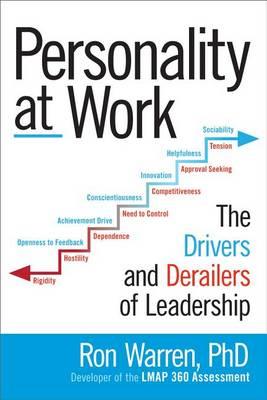 – Ron Warren, Ph.D. is the developer of the LMAP360 Assessment, used by top education institutions and corporations worldwide, and author of Personality at Work: The Drivers and Derailers of Leadership (CLICK HERE to get your copy). For more information please visit www.LMAPInc.com.
Did you enjoy this post? If so, I highly encourage you to take about 30 seconds to become a regular subscriber to this blog. It’s free, fun, practical, and only a few emails a week (I promise!). SIGN UP HERE to get the thoughtLEADERS blog conveniently delivered right to your inbox!
Photo: File:Steve Wozniak playing Defender.jpg by Al Luckow
ok ok ! guess i need to actually read that book on my nightstand :)
Personality and leadership are two different aspects. The chart depicting the various traits are quite interesting. Regards