


How Good Leaders Keep Their Top Talent

Retaining top talent should be at the top of a leader’s priority list. Doing so requires engagement, recognition, and caring. Those investments pay off in improved performance.
Today’s post is by Jill Lublin, author of The Profit of Kindness (CLICK HERE to get your copy).
High-performing employees contribute extensively in achieving business results. Hence, companies have designed programs from benefits and compensation to training and development to retain them. Despite this, according to the Harvard Business Review article by Jean Martin and Conrad Schmidt, 12% of all the high potentials in the companies they studied were actively searching for a new job. What should a good leader do, then?
1. Good leaders connect to their employees.
Good leaders know how to communicate the mission of the company and its importance to the employees’ daily work. They can articulate how the workers’ functions consequently impact their stakeholders. They give their staff a sense of autonomy by letting them make decisions and offer solutions, create a challenging atmosphere. And in doing so, they pay attention to their people and ultimately make them engaged—they become productive, provide better service and stay longer. The Corporate Leadership Council learned that highly engaged employees were 87% less likely to leave their companies than their disengaged counterparts.
2. Good leaders are grateful to all.
A study conducted by the American Psychological Association, which observed 1,700 employees, concluded that half of them intended to look for new jobs because they felt underappreciated and undervalued. Good leaders, then, must know how to praise their subordinates—whether with a simple “thank you” sent through an email or written on a post-it note, to huge gestures like providing support in time of need or public acknowledgement of the worker’s contribution. They know how to recognize people based on their personalities and character and are willing to do it amply.
3. Good leaders have patience.
In the fast-paced world of business, being in control means getting the results based on a tight-sealed plan. Reality bites. There will always be situations that get out of hand. Employees will not always deliver in a manner their supervisor wants them to or by the designated timeline. But a good leader knows that these are natural tendencies that should be handled with patience. She knows that any situation can be turned into an opportunity; that as much as she could orchestrate her team, she should also give them a turn in problem-solving; and while it may be easy to berate, mentoring is the best way to keep people empowered and engaged.
4. Good leaders are flexible.
With the workforce mainly composed of the Sandwich Generation—who are caught between caring for their aging parents and putting their kids through school—and Millennials—who, according to one study by Deloitte, place good work-life balance as the top criteria when choosing an employer—good leaders know that they should offer a working arrangement that is flexible enough to accommodate the personal needs of their employees. In return, as the FlexJobs fourth annual Super Study has proven, employees given flexibility are most likely to stay loyal and productive, and have higher morale and good quality of life.
5. Good leaders are filled with generosity.
Among all the perks businesses could offer, the best reward is time. Good leaders take time to sit with their people during lunch or coffee breaks and not just manage behind a desk. They allot time for career discussions and offer mentoring opportunities. Dropping everything to hear and understand their subordinate is one effective motivator. As Gallup discovered, engagement drops to 2% among teams with managers who neglect their employees.
6. Good leaders are compassionate.
In a highly competitive world, empathy seems to be a rare commodity though demonstrated to be a beneficial one. Businessolver learned that 33% of employees would change to more empathetic employers for equal pay while 20% would switch for less. Good leaders make their team feel valued – that they matter not just as workers but as human beings. This, in turn, develops employees into individuals who are willing to extend the same compassion to their clients and peers.
7. Good leaders spread positivity.
Lindon Crow, President of Productive Learning, says, as a leader, the way one walks through the door has the potential for leaving a trail of carnage or a trail of inspiration and motivation. The manager’s expectations are seriously considered by employees. Hence, when they perceive a negative behavior, an adverse change in their mood and performance can be expected. As reported by Gallup, 67% of employees are happier and more productive when managers focus on the positive aspects of their performance.
These are the seven pathways of kindness that good leaders follow to earn high-achieving and loyal employees. These are what make companies experience a 240% increase in performance-related results. These are what make 59% of employees less likely to look for a job with a different organization in the next 12 months. Kindness does create profit in the form of retaining top talent.
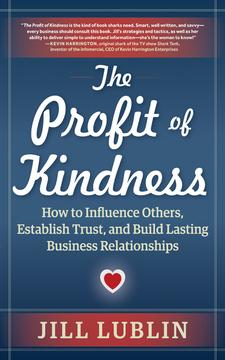 – Jill Lublin is the author of The Profit of Kindness: How to Influence Others, Establish Trust, and Build Lasting Business Relationships (CLICK HERE to get your copy). Jill is an international speaker on the topics of radical influence, publicity, networking, kindness and referrals. She is CEO of a strategic consulting firm and has over 20 years of experience working with over 100,000 people plus national and international media.
Did you enjoy this post? If so, I highly encourage you to take about 30 seconds to become a regular subscriber to this blog. It’s free, fun, practical, and only a few emails a week (I promise!). SIGN UP HERE to get the thoughtLEADERS blog conveniently delivered right to your inbox!
Photo: The Talent In Neon!!! by maryalena
Thank for this, it is really resonating with me right now and something I need to pass onto my managers. I’m not sure that they will listen, which is part of the problem, but great advice that I will certainly try and take on board.
You can lead a horse to water… I applaud you trying to help others see the light. The better ones will. Good luck!