


4 Steps to Transform Big Man Leadership Into Change Agent Leadership
 Moving from “big man leadership” to demonstrating “change agent leadership” requires you to approach your work in new ways. Here are 4 steps to making that transformation.
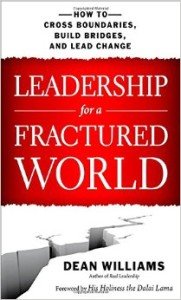
Today’s post is by Dean Williams, author of Leadership for a Fractured World (CLICK HERE to get your copy).
Leadership for a fractured world is a complex topic, and no single theory can do it justice. Traditional big man leadership that relies on prominence (“look to me”), dominance (“listen to me”) and tribalizing (“follow me”) to get things done, isn’t working anymore.
Leaders who are global change agents, men and women who can act with or without formal positional authority to mobilize diverse factions to face reality, participate in interdependent problem solving, and contribute to innovative solutions with focus and speed.
Big man leaders operate within the boundaries—they protect boundaries and manage boundaries, while global change agents lead by 1) crossing boundaries, 2) busting boundaries, 3) transcending boundaries, and 4) building bridges.
Crossing boundaries
This is about crossing the cultural, gender, geographic, structural, and professional boundaries that separate people and groups. Interdependent problems necessitate that multiple groups in a social system be mobilized as problems cannot be brought to resolution by one group acting alone or in isolation. Leadership, therefore, must be exercised not just into your own group, but into various groups and factions connected to the challenge.
I recently met with some managers of a large, multinational Silicon Valley IT company. They explained how a group of senior managers in the headquarters were reluctant to cross boundaries and connect with important regional and international offices to include them in important problem solving process. Protecting turf and resources had become more important to them than promoting interdependent problem solving.
Busting boundaries
The second capacity for global change agents requires intervening to break up maladaptive practices and counterproductive boundaries that perpetuate silos and tribalism. Groups by nature are tribal and seek to preserve their prevailing boundaries, even at the expense of facing reality and adapting to changed conditions.
Boundaries play an important function in protecting groups and sustaining a group culture. A boundary, however, becomes an impediment when it reduces the flow of information and resources and keeps people from facing changed conditions, dealing with threats, and taking advantage of unique and emerging opportunities.
For example, in 2014 General Motors CEO Mary Barra was called before Congress to explain how a faulty ignition switch led to numerous accidents and more than 2.6 million vehicles being recalled. She made reference to an independent analysis which revealed that GM had serious cultural flaws such as the withholding of and even the distortion of information, and the “GM nod” and the “GM salute.” The “nod” was used by managers to indicate they agreed there was a problem but there would be no intention to follow through. The “salute” was the crossing of the arms followed by a finger pointing outward to divert responsibility elsewhere.
People hid behind their boundaries and perpetuated counterproductive behaviors. These practices threatened the company’s credibility, profitability, and customer safety. There was insufficient change agent leadership at all levels of the organization to call attention to the maladaptive practices and bust the boundaries that had produced the errors.
Transcending boundaries
Transcending boundaries is about helping people leave the safety and confines of their home boundary and embark on an adventure of discovery—the discovery of new solutions and opportunities. The adventure might require going into the great unknown in search of creativity and innovation through the engagement of diverse people and groups.
Diversity of perspectives, experience, style, and culture can be a rich resource for the promotion of creative problem solving. However, harnessing the power of diversity is problematic.
The default behavior of groups is fundamentally tribal as people generally prefer their own kind and find it difficult interacting with those who are significantly different—it takes effort. The global change agent, like an alchemist, approaches the challenge by experimenting to discover what the appropriate mix of diversity might be in order to generate a breakthrough result.
In the context of a pharmaceutical company, scientists, engineers, managers, and sales staff from different cultural and professional environments must now work together for product development, supply chain innovation, and marketing and distribution in ways they have never done before. This is a unique adventure that requires leaving the orderly and familiar world that they have become quite comfortable operating in and traversing into unfamiliar territory with no guarantee of success but the possibility of great gains.
Building bridges
Building bridges, the fourth capacity for global change agents, requires reducing the mystery or enmity between groups on behalf of a shared sense of purpose. Humans are fragile creatures, but also competitive creatures. Their feelings easily get hurt, and like chimpanzees they seem to enjoy political game playing and the creation of coalitions to advance the interests of their faction often at the expense of others.
This leads to fractures in groups and organizations—deep divides and hairline fractures which can expand at any time—where people refuse to collaborate and actively sabotage the intentions of others. The change agent helps groups build bridges of trust and understanding, reduce the mystery of who they are for one another, and establish a connection that opens up a new possibility for shared accomplishment.
This is what Henry Kissinger and President Richard Nixon did in 1972 when they visited China and started the bridge building process that led to a significant thawing of, and eventual end to, the cold-war relationship that did little good for either country.
Becoming a global change agent is not easy, but it is essential work that companies must encourage and nurture. They neglect this work at their own peril.
– Dean Williams is the author of the newly released book Leadership for a Fractured World (CLICK HERE to get your copy) and teaches leadership at the Harvard Kennedy School of Government. He can be reached at dean@GlobalLeadership.net.
Did you enjoy this post? If so, I highly encourage you to take about 30 seconds to become a regular subscriber to this blog. It’s free, fun, practical, and only a few emails a week (I promise!). SIGN UP HERE to get the thoughtLEADERS blog conveniently delivered right to your inbox!
Leave a Reply
Want to join the discussion?Feel free to contribute!