


When Your Growth Strategy Becomes a To-Do List

How CEOs can stop confusing busyness with progress and focus on what actually moves the needle.
Today’s post is by Matt Andersen, Westlake Securities, CEO, author of Intentional Growth.
A few months ago I was sitting with the leadership team of a distribution company, conducting a review of everything they had on their plate. They pulled up a slide with 22 items on it. Each had a project leader, timeline, and status update. Each was color-coded and professionally formatted.
I asked them to set it aside and tell me without looking at the items list, what the company needed to look like in three years for them to consider it a success. Each person had a different answer. As alarming as this was, it is a problem we keep running into. It has become more common than most leadership teams want to admit. The list was real but none of it was connected to a shared picture of where the company was actually going. They were just executing, but not toward a common shared outcome.
I’ve spent over 27 years advising founders and CEOs through growth, capital raises, and transactions. The companies that achieve the best outcomes, whether that’s a premium sale, strong growth capital terms, or just sustained performance over time, almost never got there by doing more. What really moved the needle was being relentlessly clear about what they were doing and why.
The issue isn’t effort. Most leadership teams I work with are working incredibly hard. The issue is that the effort without a defined destination produces activity, not progress. And in a business, activity can disguise itself as progress right up until the moment you realize the needle hasn’t moved.
Start with the destination
Typically, a leadership team gets together, identifies a to-do list, assigns owners and timelines, and then spends the next 6 to 12 months executing against that list. Revenue stays steady, sometimes grows a little. People are busy. The quarterly updates look fine. Then at some point, someone asks whether the business is better positioned than it was a year ago, and the honest answer is no.
The reason is almost always the same. The list was built without a clear and shared destination. When you don’t know exactly where you’re going, everything seems like it might help. New markets, new products, new hires, new tools. It’s all potentially relevant, so it all goes on the list. But then the list becomes the strategy, which is not the same thing as having a defined short mid and long term plan.
A real growth strategy starts with a specific, honest answer to a hard question –
What does this business need to look like in three to five years, and what are the two or three items that will genuinely determine whether we get there?
Focus on what matters most
Not 22 things. Two or three. The key priorities that actually matter and will move the needle. That question is harder to answer than it sounds, and most leadership teams avoid it because the answer requires making real choices, which means ruling things out. It’s much more comfortable to keep everything on the list and let the team figure out what to prioritize. The problem is that when everything is a priority, nothing is.
The companies I’ve watched build real value in condensed timelines share a pattern. They spend time on the destination before they spend time on the tactics. They get specific about what success looks like, how to measure it, and what has to be true to get there. And then, they use that to filter everything else.
Stay focused on the outcome
This is harder to maintain than it is to set up. The pressure to add initiatives never stops. Someone reads an article about a competitor and wants to respond. A customer asks for something new and it feels wrong to say no. A smart person on the team has a genuinely good idea and it feels like such a shame to ignore it. All of that is real, and it doesn’t go away.
But the leaders who hold the line, who keep filtering back to the desired outcome, tend to end up somewhere specific. And the ones who don’t tend to end up with a very impressive to-do list and a business that looks about the same as it did two years ago.
The distribution company I mentioned eventually did the work. We spent half a day getting the leadership team aligned on the next three years and what it would take to get them there. The list went from 22 items to 4, and some attractive items came off the list. While it was uncomfortable, a year later, the business was meaningfully better positioned, and the leadership team knew why.
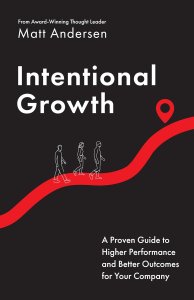 Matt Andersen is an award-winning CEO, investment banker, and internationally recognized keynote speaker who has spent more than 25 years helping founders, CEOs, and business owners build stronger, more valuable companies. Matt is the bestselling author of Completing the Deal. In his latest book, Intentional Growth: A Proven Guide to Higher Performance and Better Outcomes for Your Company, he challenges leaders to rethink traditional growth strategies by starting with the desired outcome and reverse engineering the decisions, resources, and execution needed to achieve it.
Did you enjoy this post? If so, I highly encourage you to take about 30 seconds to become a regular subscriber to this blog. It’s free, fun, practical, and only a few emails a week (I promise!). SIGN UP HERE to get the thoughtLEADERS blog conveniently delivered right to your inbox!


Leave a Reply
Want to join the discussion?Feel free to contribute!