


Rendezvous with Emotion: And its Vital Role in Decision Making

Finding an emotional anchor within work is not something to shy away from, but rather something to actively search for.
Today’s post is by Raghu Kalé, author of Loyalty and Sacrifice (CLICK HERE to get your copy).
The mental make-up of the human mind is an enigma. Understanding reality has a bearing in comprehension. As a communications professional, I have grappled with what provokes audiences into believing a proposition, and what douses their suspicions and doubts. Emotion has a vital role in decision making, which is best described through my own experiences.
Making short films is a hobby — and I’ve used it effectively over the years. The watershed moment was the stringent budget cuts that were self-imposed by my CEO after the tragedy of 9/11 that caused worldwide disruptions and tremendous anxiety. It was self-imposed because I was part of the CEO’s office of a premier luxury hospitality brand – The Taj Hotels Resorts and Palaces. Actions speak louder than words. The directive by my boss, who was the CEO, said it all: “We can’t be seen as doing this, find a way to be responsible.” I recall walking out from his office to my room next door and sinking back in my chair with a depressed feeling. That is when I determined that there was no need to engage an agency with high costs of production. Technology permits so much to be done, and with my background in advertising, communications, and my creative capabilities, I started my love affair with short films. Today, I have a score of 200+ short films that I produced primarily to obtain efficiency in my communication budgets and prevent transmission loss of the message and agency delays. Eager requests soon came in from many colleagues, sometimes seeking help for short films for corporate pitches, business development, and marketing. They were keen to drop one digit from the far right for a 10x advantage in their expense budget or were running thin on deadlines.
Finding an emotional anchor is like spotting six differences in two identical pictures. It is a challenge hidden in plain sight. Now, let us review and see if you can place the emotional anchor: This narrative has many layers wherein emotion has a hidden anchor in the decision-making somewhere. Anxiety plummeted enterprises in a few months of recession after 9/11. Stock markets around the world panicked. While everyone got a hard mandate of cost reduction in a measurable percentage drop, I got a soft mandate to find a way to be responsible. My CEO was sensitive. I was allowed to decide what an appropriate drop in my budget was. I was depressed because I wanted to get things done. I took an empowered decision: I anchored in to produce films by directly hiring studios and writing scripts. A decision rooted in emotion finds its way into channeling that energy into a passion. Potential energy turns into kinetic energy. It is never easy to spot emotional anchors that influence the decision-making process; often, it is elusive.
By 2008 I was working in New York and witnessed the economic downturn that sent shockwaves of panic, and many around the world downsized. The Tata conglomerate that I worked for has a 150-year legacy today. The Taj Hotels, where I worked decided not to downsize but, rather, to adopt temporary cuts. While the industry rampantly laid off, we did furloughs rather than layoffs. We agreed on 10% and 15% cuts for executives, no cuts for rank and file or middle management, and promised to restore salaries by altering them for cost of living adjustments (COLA). Now I understand the difference between panic and urgency. Both are hidden emotional responses — one is a constructive passion for adhering to the values of the organization, and the other for passionately guarding the profitability alone.
Extraordinary stories about frontline associates at Taj Hotels Resorts and Palaces going beyond the call of duty seem to be never-ending and confirm emotions persist at many levels. What explains the feeling that pushes people to endanger their own lives for another person or cause? When The Taj Hotel in Mumbai was under siege, its employees formed a human shield to evacuate guests to safety. This indeed is a subject of a Harvard case study and continues to baffle the students as they analyze the case as part of their learning engagement. As a communications professional, one must be able to see these hidden facets of an organization. Visualizing a picture of an organization is an art form. These conjure up numerous art forms, like watching a canvas left behind after it’s all done by Claude Monet, Vincent van Gogh, Jean-Michel Basquiat—sometimes even Dilbert—and so on. Each decision has its anchor in some emotion.
In 2007, I was tricked by my colleague, when I had visited Mumbai. He was heading a strategic support services Business Excellence division for the conglomerate. I was expected to head back to the US. He requested a session with the team on climate crisis 48 hours before I was supposed to take a nonstop 16-hour flight back to New York. The ploy was to spring a surprise upon me during the meeting and get me to commit to making a short film. The term “climate change” was not in vogue; instead, “global warming” was. We had left-brain conversations in the meeting – how fast the carbon footprint was rising, what is needed to mitigate its reversal, and so on. Everyone had watched Al Gore’s campaign-propelled documentary ‘An Inconvenient Truth.’ My question was simple – “Who is the audience?” The response came quickly: “We have to educate the senior leadership about the urgency.” I reacted: “As if they don’t already know?” After some pondering, I took a very radical view. I agreed to make the film. Instead, I suggested that a group of children be shortlisted and brought to the studio, and I would have long conversations with them, as they are the custodians of the future. I wanted to extract the relevant soundbites from these children. The idea was to stir up emotions in order to create passionate engagement with the subject of climate change. If only we could touch the hearts of the leadership of over 100 companies. And so — Down to Earth — the short film was shot in Mumbai, Edited in the USA and Screened in Thailand for the leadership of the Tata conglomerate.
Emotion is all-pervasive in most decisions; politicians know this rather well. Corporate leaders sometimes miss out on the pretty picture conjured up by the collage of decision making coming from its boardrooms and executive offices. Sometimes this collage can resemble the Renaissance art of Leonardo da Vinci and in some instances, appear to be the Dadaist art movement of Marcel Duchamp.
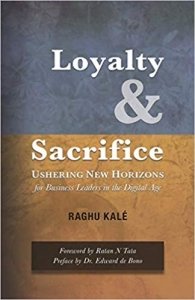 Raghu Kalé is an accomplished communications professional who has positively impacted business outcomes by supporting corporate and operational strategy. Formerly the Vice President in the Office of the Brand Custodian of Tata Sons, Mr. Kalé has supported brand and marketing thought leadership initiatives for over 25 years. Loyalty & Sacrifice: Ushering New Horizons for Business Leaders in the Digital Age is his first book (CLICK HERE to get your copy).
Did you enjoy this post? If so, I highly encourage you to take about 30 seconds to become a regular subscriber to this blog. It’s free, fun, practical, and only a few emails a week (I promise!). SIGN UP HERE to get the thoughtLEADERS blog conveniently delivered right to your inbox!


Leave a Reply
Want to join the discussion?Feel free to contribute!