• Contact
  • My Account
  • Log In
  • 0Shopping Cart
thoughtLEADERS, LLC: Leadership Training for the Real World
  • About
  • Services
  • eLearning
  • Team
  • Blog
  • Clients
  • Books
  • Contact
  • Menu Menu

Build your skills! Take our eLearning courses on TITAN!

World-class eLearning courses with videos, exercises, downloads, and a certificate of completion. Get started today!

Structured Thought: Problem Solving
Structured Thought and Communication
Strategic Business Planning
Principles of Chart Design eLearning Course
Engagement Management
Deliberate Decision Making
Breakthrough Innovation
Everything is Negotiable
Leading through Change
Storytelling for Leaders
Storytelling for Salespeople
Building Leadership Resilience
Compelling Executive Presence
Coaching for Impact
Building Personal Resilience
Wide Banner SPS
Wide Banner STC
Wide Banner SBP
Wide Banner PCD
Wide Banner ENM
Wide Banner DDM
Wide Banner BTI
Wide Banner EIN
Wide Banner LTC
Wide Banner SFL
Wide Banner SFS
Wide Banner BLR
Wide Banner CEP
Wide Banner CFI
Wide Banner BPR
Wide Banner TMM
previous arrow
next arrow

3 Things You Should NEVER Say When Presenting
February 5, 2014/7 Comments/in Business Toolkit, Communications /by Mike Figliuolo

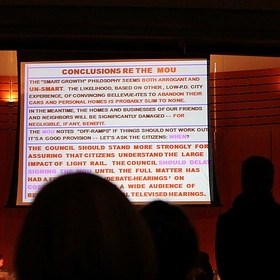
Terrible PowerPoint SlidePowerPoint is the devil’s instrument and when you use it, you risk becoming a musician in his demonic orchestra.  All of us are required to give presentations in some form or fashion at various points in our careers.  If you’d like to succeed in those efforts, there are three things you should NEVER say when you’re presenting.

I’ve witnessed my fair share of presentations (and given more of them than I care to count).  I’ve personally made all of these mistakes at one point or another.  I’ve also seen others make all of these mistakes, many times with ugly results.  I’d like to spare all of you the same fate.

First, remember why you’re presenting in the first place.  You’re likely either teaching/sharing information or trying to influence someone to make a decision on something.  You are NOT there to show off your wickedawesome PowerPoint skillz that killz.  To convey that information and influence that decision, you need to get your point across clearly and concisely (which we help people with all the time – CLICK HERE if you’d like some help too).  Given those two purposes, be mindful of what you say and how you say it as well as the information you use to make your case.

If you’d prefer to fail miserably instead, say or do any of the following three things:

“I know you guys probably can’t see this chart but…”  Seriously?  You’re going to put up a chart that’s overly complicated with tiny little words and letters and then publicly and proactively acknowledge your audience can’t see it?  Are you high?

The fix: look at all your charts before you present.  Take a tour of the room you’re presenting in.  Put your slides up on the screen and stand in the back of the room.  If you can’t read them, neither can your audience.  Simplify them (which is something we also teach people to do – learn more here).

“As you can see on page 47…”  47 pages?  Are you kidding me?  How many times have you gone into a presentation with a 30 to 50 page presentation and walked out having only covered a small fraction of those pages?  Take the hint.  You can’t cover that much material.  If you try to, your audience will either die of boredom or become homicidal.

The fix: have a clear, well-structured story (which you can easily learn how to do).  Also do some basic page ratio math.  Personally I calculate that I can cover one page for every three minutes I have in a meeting.  This includes title page, tracker/agenda slides, and any other pages I plan on showing.  Additionally, for any meeting, only plan to take up 2/3 of the time for your presentation and leave time for questions.  In other words, if you have an hour, plan to speak for 40 minutes.  For 40 minutes, you should have a maximum of 13 slides (assuming you talk as fast as I tend to).

“Our speakers for today’s 30 minute meeting include Bill, Susan, Kim, Frank, Henry, Jill, and Bobbie.”  No!  All too often we want to give everyone “air time” in front of our senior stakeholders because everyone wants “visibility.”  It’s childish, insecure, and inefficient.  Your audience knows all of you worked on the presentation and content therein.  Not everyone needs a speaking part.  It breaks up the flow of your story/recommendation, creates “time friction” (lost time as you transition between presenters), and comes across as clunky and amateurish.

The fix: Grow up and let go of your personal agenda and insecurities.  Pick your best speakers (one or two at the most).  Let them drive the flow and trust that the audience will mentally give everyone credit.  List everyone on the title slide.  Also, have speakers reference the work of other team members to give them credit (e.g., “In the analysis Bill did, you can clearly see the massive insights he came to in that ginormous cranium of his because he’s the smartest man alive even if he’s not up here speaking to you right now.”).  By picking your best speakers, your content will take center stage and your recommendation will be made more clearly instead of getting your audience to focus on the clown car show of you handing off the clicker to 38 different speakers.

Remember – you’re holding the meeting to influence people.  Think about things from your audience’s perspective.  Focus on the most critical information only.  Realize the presentation isn’t about you personally – it’s about getting the decision or outcome you’re most interested in.  Don’t fall prey to the above varieties of stupidity.  If someone on your team is advocating any of the above idiocy, please forward them this blog post.

– Mike Figliuolo at thoughtLEADERS, LLC

Did you enjoy this post?  If so, I highly encourage you to take about 30 seconds to become a regular subscriber to this blog.  It’s free, fun, practical, and only a couple of emails a week (I promise!).  SIGN UP HERE to get the thoughtLEADERS blog delivered to your inbox every week!

Photo: Worst Powerpoint Ever by Oran Viriyincy

https://www.thoughtleadersllc.com/wp-content/uploads/2022/04/logo.png 0 0 Mike Figliuolo https://www.thoughtleadersllc.com/wp-content/uploads/2022/04/logo.png Mike Figliuolo2014-02-05 06:02:062018-07-08 16:48:413 Things You Should NEVER Say When Presenting
7 replies
  1. Ulick Stafford
    Ulick Stafford says:
    February 6, 2014 at 5:41 am

    1 slide in 3 minutes seems too few for some presentations. It may mean that there is too much material on each slide. I generally use 1 slide per minute with big words and pictures and usually recommend others do the same.
    I would never use more slides than that. I think it may depend on your personal style and the type of presentation.

    Reply
    • Mike Figliuolo
      Mike Figliuolo says:
      February 6, 2014 at 5:45 am

      Point made – you know your pace for your style and present accordingly. Personally for my style, my slides too are pretty sparse and there’s more discussion than there is reading points on slides (which I abhor). The other situation is where the data are complex (which doesn’t mean the chart is complex though) and they require a discussion. Either way, one should know their own personal pace and plan accordingly.

      Reply
  2. Tiffany Crosby
    Tiffany Crosby says:
    February 6, 2014 at 9:23 am

    Powerpoint is just a tool. The only real issue with Powerpoint is that it’s an easy crutch that can mask people’s need to put in the hard work required to present skillfullyl. But the true issue, itself, is not Powerpoint but rather people’s lack of development of their presentation skills. We have fallen into a mistaken assumption that experts are by default master presenters, that strong written communications skills translate into strong presentation skills, and putting your thoughts on slides equates to developing a presentation. Presenting is a skill that requires cultivation like any other.

    Reply
  3. RJ Bradner
    RJ Bradner says:
    February 8, 2014 at 12:36 pm

    Yeah Buddy! Well spoken and filled with wisdom that comes from experience. Thank you for sharing in a concise and effective manner that serves to help remind and educate. :D

    Reply
  4. S Perrin
    S Perrin says:
    February 12, 2014 at 8:14 am

    I tend to disagree with #1 on certain occasions. For me, it’s fine to show some charts/illustrations that are way to small to be fully read, if you do it just for the sake of showing that work has been done in that area.
    For example un a factory floor environment, you may copy and paste a picture of the Value Stream Mapping exercise a team did on an assembly line, not for everyone in the room to go over the details of that exercise, but to prove it has been done.
    Doing so tend to break presentations with text-only messages and may appeal to people who are “visual” type.

    Reply
    • Mike Figliuolo
      Mike Figliuolo says:
      February 12, 2014 at 10:26 pm

      Hi Sylvestre. While I understand your position, I still need to disagree with the point. If you need to demonstrate the work has been done, a simple diagram that is legible can suffice. You simply need to tell the audience “this is a high level diagram that shows the process we used for deep and extensive analysis to support this recommendation. If you’d like to see more details on all the work we’ve done, I’m happy to share those with you offline.” The same purpose has been achieved without frustrating the audience that they can’t read what you’ve put on the slide. I also totally agree with using visuals to break up the text – provided the visuals are legible and convey the key message.

      Reply

Trackbacks & Pingbacks

  1. Elevate Your Business 24.03.2014 | SME Payroll Compliance says:
    March 25, 2014 at 2:51 am

    […] Sales Culture Questions You Must Answer 3 Things You Should Never Say When Presenting […]

    Reply

Leave a Reply

Want to join the discussion?
Feel free to contribute!

Leave a Reply Cancel reply

Your email address will not be published. Required fields are marked *

This site uses Akismet to reduce spam. Learn how your comment data is processed.

Get free blog posts by email NOW!

It’s the best 5 minutes a week you can spend on your development.

Subscribe HERE!

Get new posts FREE via RSS!
Follow thoughtLEADERS on LinkedInFollow thoughtLEADERS on twitter
This site contains affiliate links to products. We may receive a commission for purchases made through these links.
 

Check Out Our Courses

Our courses teach immediately applicable skills that have real impact on your business. From leadership to strategy and negotiation to conflict resolution, we have a broad set of course offerings that will drive immediate performance improvements.
OUR COURSES

Our Courses

Group of Business People Meeting
Puzzle Pieces
Glasses Looking Over Cityscape
Doors on a Wall
Cog Wheels
Man Reading Book
Fishing hook in the sea
Microphone in Lecture Hall
Charts on Blue Background
Wristwatch
Exploding Light Bulb
Man on Summit of Mountain
Lightning Bolts
Man Painting the Word Change on a Wall
Construction Cranes
Plant Growing in a Hand
High Performance Gears
Men Shaking Hands Closeup
Influence Definition
Sailboat at Sunset
Hanging light bulbs with glowing one isolated on dark blue background
Wagon Wheel
Risk
Strategic Client Engagement
Strategic Business Planning
Advanced Meeting Leadership
Building a Growth Mindset
Executive Communications
Structured Problem Solving
Creating Leadership Maxims
Leading inside the Box
Deliberate Decision Making
Simple Strategic Planning
Storytelling for Leaders
Storytelling for Sales
Executive Presence
Principles of Chart Design
Time Management Mastery
Breakthrough Innovation
Leadership Resilience
Conflict Resolution
Leading through Change
Project Management Reality
Coaching for Impact
High Performing Teams
Everything is Negotiable
Leading with Influence
Building Personal Resilience
thoughtLEADERSHIP
Engagement Management
Risk Management
Client Engagement
Strategic Business Planning
Advanced Meeting Leadership
Building a Growth Mindset
previous arrow
next arrow
 

eLearning Courses on TITAN

Structured Thought: Problem Solving
Puzzle Pieces
Structured Thought: Problem Solving

Clearly define a problem, scope all issues related to the problem, generate potential solutions, then analyze and select the best solution by using time-tested critical thinking methods and tools.

VIEW COURSE
Structured Thought and Communication
Group of Business People Meeting
Structured Thought and Communication

Craft clear and compelling recommendations that resonate with stakeholders. Get your ideas approved by using a proven method for delivering executive-level communications.

VIEW COURSE
Principles of Chart Design
Different Types of Line and Bar Charts
Principles of Chart Design

Create well-designed presentation charts that get your message across quickly and clearly to drive your audience to action. From data charts to concept charts, these methods help make your point.

VIEW COURSE
Engagement Management
Wagon Wheel
Engagement Management

Whether you’re an internal or external consultant or a project leader, learn proven methods, techniques, and processes to effectively lead consulting engagements that drive your client’s success.

VIEW COURSE
Strategic Business Planning
Cog Wheels
Strategic Business Planning

Use a straightforward and effective strategic planning process that shows how to craft a clear, compelling plan for your organization - not just one time, but on an ongoing basis year after year.

VIEW COURSE
Deliberate Decision Making

Make better, faster, and more effective decisions. Apply simple yet powerful decision making tools to define decision authority, manage risk, increase accountability, and drive execution.

VIEW COURSE
Everything is Negotiable
Men Shaking Hands
Everything is Negotiable

Become a better negotiator in all situations – from day to day interactions to hammering out large deals. Build the skills required to get what you want and strengthen relationships while you do.

VIEW COURSE
Breakthrough Innovation
Exploding Lightbulb
Breakthrough Innovation

Generate and select unique strategies that separate you from the competition. Construct bold and disruptive solutions then build and execute a plan for taking those strategies to market.

VIEW COURSE
Storytelling for Leaders
Man reading stories from a book
Storytelling for Leaders

Create business stories that inspire people, build connections with your audience, and ultimately advance your organization's goals by using a repeatable, straightforward method.

VIEW COURSE
Storytelling for Salespeople

Create and deliver stories that will take your sales efforts to the next level. Connect with and convince buyers in all situations using memorable stories. These stronger relationships drive more sales.

VIEW COURSE
Leading through Change

Lead your organization through the most challenging times using a proven change management process. Get people through the change and back to driving performance quickly and effectively.

VIEW COURSE
Building Leadership Resilience
Mountain Climbing Expedition
Building Leadership Resilience

Prepare your body and brain to be ready for and recover from your biggest challenges. Build approaches for overcoming stress, managing reactions to difficult events, and leading more effectively.

VIEW COURSE
Compelling Executive Presence

Build your ability to connect with your audience and convey your ideas in a clear and resonant way. Create meaningful connections between you and your audience to build buy-in.

VIEW COURSE
Coaching for Impact
Plant Growing in a Hand
Coaching for Impact: Foundation Course

Coach employees for performance and development more effectively by helping them identify and pursue their own solutions. Create the right environment and conditions to help them grow.

VIEW COURSE
Building Personal Resilience
Boat at Sunset
Building Personal Resilience

Build the habits and learn the behaviors required to manage stress, deal with adversity, and maintain your physical and mental wellbeing. Personal resilience is a key to your ongoing success.

VIEW COURSE
Time Management Mastery
Watches
Time Management Mastery

Learn techniques to manage your time, delegate, say “no,” and be more efficient. Balance your limited supply of time with the overwhelming demands that are placed on you every day.

VIEW COURSE
previous arrow
next arrow

Books You MUST Read

The Elegant Pitch
One Piece of Paper by Mike Figliuolo
Lead Inside the Box
10 Stories Great Leaders Tell
Getting Ahead
Sell with a Story
Lead with a Story
Mastering Communication at Work
The Hook
Innovative Leadership Fieldbook
Innovative Leaders Guide to Transforming Organizations
The Three Commitments of Leadership
The Littlest Green Beret
Storytelling in the Land of Oz
The Camino Way
Hiring Veterans
Disability is Human book
Race to Innovation
The Emergent Leader
Business is Simple
The Elegant Pitch
One Piece of Paper by Mike Figliuolo
Lead Inside the Box
10 Stories Great Leaders Tell
Getting Ahead
Sell with a Story - Border
Lead with a Story
Leading from Your Best Self
Mastering Communication at Work
The Hook
Innovative Leadership Fieldbook
Innovative Leaders Guide to Transforming Organizations
20120318 Three Commitments
Leadership Vertigo
The Littlest Green Beret
Storytelling in the Land of Oz
The Camino Way
Hijacked by Your Brain
Outthink the Competition
Driving Innovation from Within
Hiring Veterans
Disability is Human
Race to Innovation
The Emergent Leader
Business is Simple
previous arrow
next arrow
  • The Elegant Pitch
  • Disability is Human
  • Hiring Veterans
  • Race to Innovation
  • The Emergent Leader
  • Business is Simple

Categories

This site contains affiliate links to products. We may receive a commission for purchases made through these links.

Our Course Offerings

Leadership Skills

Creating Your Leadership Maxims
Leading Inside the Box
Leading With Influence
Leading Through Change
Structured Problem Solving
Deliberate Decision Making
High Performing Teams
Simplified Strategic Planning
Strategic Business Planning
Coaching for Impact: Foundations
Coaching for Impact: Applications
Building Leadership Resilience
Engagement Management
Project Management Reality
Risk Management

Communication Skills

Communications: Foundations
Communications: Applications
Principles of Chart Design
Strategic Client Engagement
Storytelling for Leaders
Storytelling for Salespeople
Compelling Executive Presence
Advanced Meeting Leadership

Individual Skills

Conflict Resolution
Everything is Negotiable
Building a Growth Mindset
thoughtLEADERSHIP: Innovation
Building Personal Resilience
Time Management Mastery

Coaching & Consulting

©2026 thoughtLEADERS, LLC: Leadership Training for the Real World. thoughtLEADERS, LLC is a registered trademark of thoughtLEADERS, LLC.
  • Privacy Policy
  • Terms of Use
  • Cookie Policy
The Simple Questions of Success: a Zentrepreneur’s Guide to Prosperity Are you willing to do favors at work?
Scroll to top